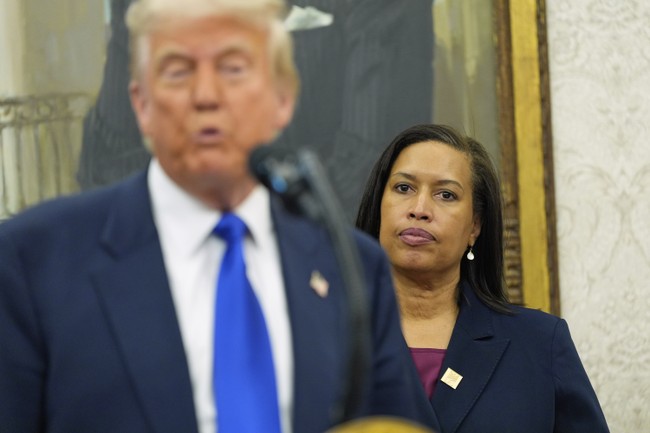
Muriel Bowser announced she will not seek another term after ten years as Washington, D.C.’s mayor, reflecting on achievements in housing, education and public safety while acknowledging federal help in recent crime reductions.
Muriel Bowser has served three terms as mayor of the District of Columbia and announced she will not run for re-election after a decade in office. Her departure opens up the city’s political field and sets the stage for a competitive mayoral race in 2026. For residents and local leaders, the decision redirects attention to who will carry forward—or change—the policies Bowser leaves behind.
Bowser used her announcement to list policy wins and outline priorities she says were advanced under her watch. She emphasized investments in housing and schools and pointed to measurable results that, in her view, restored confidence in city government. Her language was proud and deliberate, aimed at framing her tenure as one of rebuilding and forward momentum.
“My fellow Washingtonians, for 10 years, you and I have worked together on an ambitious agenda to restore faith in our government and ensure that every D.C. resident gets the fair shot they deserve,” Bowser said. “To keep that promise, we took big swings, keeping D.C. teams in D.C., raising enrollment and graduation rates in our schools, and investing more money in housing than any other city or state, creating 36,000 homes.”
“We also brought our city back from the ravages of a global pandemic and summoned our collective strength to stand tall against bullies who threaten our very autonomy, while preserving home rule. That is our North Star,” Bowser said. “… Looking to the future, I know we’ve laid the groundwork for others to build upon, to reshape and grow D.C.’s economy, establish D.C. as the 51st state, and protect our investments in affordable housing, transportation, public safety, and public schools.
“… When you placed your trust in me 10 years ago, you gave me an extraordinary opportunity to have a positive impact on my hometown. Every day since, I’ve cherished the opportunity and have happily given all my passion and energy to the job that I love. Together, you and I have built a legacy of success, of which I’m intensely proud, and for the next 12 months, let’s run through the tape and keep winning for D.C.”
It has been the honor of my life to be your Mayor. Together, we have built a legacy of success of which I am intensely proud.
With a grateful heart, I am announcing that I will not seek a fourth term.
For the next 12 months, let's run through the tape and keep winning for DC. pic.twitter.com/q0wQWe0h2c
— Muriel Bowser (@MurielBowser) November 25, 2025
The announcement came after a contentious period over federal assistance and crime-fighting in the city. Bowser initially pushed back on President Trump’s decision to deploy National Guard and other federal forces to D.C., but later acknowledged the action had a beneficial effect. She said the surge of federal law enforcement officers “enhance[d] what [the Metropolitan Police Department] has been able to do in this city.”
At a news conference, Bowser described specific outcomes she credits to having more federal officers present. “Having more federal law enforcement officers on the street — [has led to] having more stops that got to illegal guns,” Bowser said during a news conference. “We think that there is more accountability in the system, or at least perceived accountability in the system, that is driving down illegal behavior. We know that we have had fewer gun crimes, fewer homicides, and we have experienced an extreme reduction in carjackings.”
Her admission about federal personnel and improved street-level results is likely to be seized on by candidates and commentators across the political spectrum. Conservatives who prioritize law and order will highlight the admission as proof federal involvement can help plug safety gaps. Progressives and local advocates will still focus on long-term investments and community-based solutions as the city prepares to choose new leadership.
The policy balance Bowser struck—large housing investments and increased school enrollment alongside accepting federal help for crime—creates a mixed legacy. Supporters point to the 36,000 homes figure and improved graduation rates as wins for taxpayers and families, while critics argue questions remain about long-term affordability and public safety strategy. That debate will be central in the months ahead as candidates lay out competing visions.
With the next D.C. mayoral election scheduled for November 3, 2026, political players are already recalibrating. Local party leaders, activists and potential candidates will weigh Bowser’s record against public concerns about cost of living, safety and governance. Expect a crowded field and an intense focus on the issues voters have been naming as priorities.
Bowser framed her decision as a personal and professional choice after a decade of public service, underscoring pride in what she and her team accomplished. The mayor’s closing months in office will be watched closely as she seeks to lock in policy and personnel moves that shape the city’s next chapter. For now, the announcement formally begins the transition from an era defined by her leadership to open competition for D.C.’s next mayor.