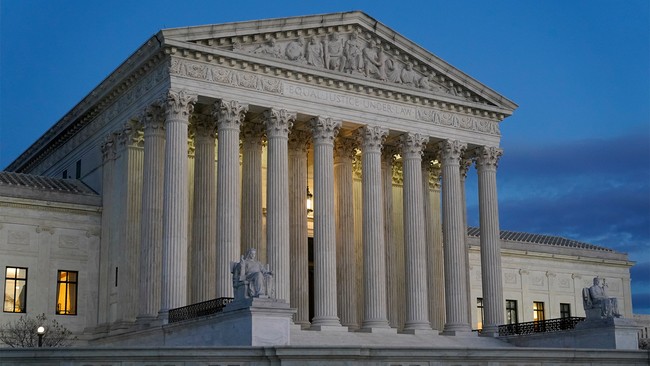
The Supreme Court has agreed to take up Watson v. Republican National Committee, a case that could change how states handle mail-in ballots and Election Day deadlines. At stake is whether federal law bars states from counting ballots that are postmarked by Election Day but arrive later. The decision could force states to abandon their postmark grace periods ahead of the 2026 midterms and reshape how campaigns approach vote-by-mail strategies.
The Court’s decision to hear Watson v. Republican National Committee focuses squarely on the tension between federal election-day rules and state-level grace periods for mailed ballots. The lawsuit asks whether federal law requires all ballots for federal offices to be received by the statutory Election Day, or whether states can accept ballots that were mailed and postmarked by that date but arrive afterward. Lower courts split, and that division is what brought the case up to the high court.
From SCOTUSBlog: The following passage summarizes the litigation and lower-court rulings that led the Supreme Court to step in. It lays out how the case began, what judges found in Gulfport, and why the 5th Circuit reversed that ruling, producing the current dispute over federal election timing and state discretion.
The dispute began in 2024, when the RNC – along with the Mississippi Republican Party and two individuals – went to federal court to challenge the Mississippi law. Their case was later joined with a similar case brought by the Libertarian Party of Mississippi.
A federal judge in Gulfport, Mississippi, upheld the law, rejecting the challengers’ contention that it conflicted with federal law. Senior U.S. District Judge Louis Guirola explained that, according to Supreme Court precedent, “Congress set a national election day to avoid the ‘evils’ of burdening citizens with multiple election days and of risking undue influence upon voters in one state from the announced tallies in states voting earlier. Neither of those concerns,” he concluded, “is raised by allowing a reasonable interval for ballots cast and postmarked by election day to arrive by mail.”
The challengers appealed to the U.S. Court of Appeals for the 5th Circuit, which reversed Guirola’s decision. It ruled that federal election law, which sets the Tuesday after the first Monday in November as the “election” day for federal offices, requires all ballots to be received by that day. The full 5th Circuit declined to rehear the case, over a dissent by five judges.
The background matters because federal precedent and statutory language collide with practical election administration. States with existing grace periods say they accommodate postal delays and protect voters who mailed ballots on time. Opponents argue that letting ballots arrive after Election Day undermines the uniformity Congress intended and creates the potential for staggered, election-influencing results.
BREAKING: The Supreme Court will take up the case of Watson v. Republican National Committee– which will decide if mail-in ballots received after Election Day can be counted.
At least 18 states allow this– including Nevada, Pennsylvania, and North Carolina. pic.twitter.com/bpZXO4cTkU
— Greg Price (@greg_price11) November 10, 2025
The Trump administration issued an executive order on March 25, 2025, directing that ballots be submitted by Election Day, reinforcing the argument that federal law should set a firm receipt deadline. Currently, roughly 18 to 30 states plus the District of Columbia allow ballots postmarked by Election Day to be counted if they arrive within a prescribed grace period. That patchwork of rules is exactly the inconsistency that supporters of a stricter federal rule point to.
If the Supreme Court rules for the Republican Party, states would likely have to eliminate those postmark grace periods and reject any ballots that arrive after Election Day. That change would need to be implemented before the 2026 midterms, creating a tight timeline for state legislatures and election officials to adjust procedures and voter communications. The practical ripple effects would touch ballot delivery deadlines, early voting strategies, and how campaigns advise their voters to return ballots.
Expect Democrats to frame such a ruling as disenfranchising and to raise racial-impact arguments. They will likely claim this prevents people, including Black voters, from casting lawful ballots and muddy the legitimacy of tightened deadlines. From a Republican perspective, those claims often mask the political reality: grace periods tend to favor one party, which explains the resistance to a uniform, stricter receipt deadline.
Voting behavior statistics underline the partisan angle critics point to. Approximately 58 percent of Democratic voters cast their ballots by mail in the 2020 presidential election, compared with 29 percent of Republican voters. In recent cycles, though, more Republicans have turned to mail voting, likely recognizing the strategic advantage that broader mail-in rules have provided their opponents. That shift makes the stakes in Watson even higher for both parties.
Editor’s Note: After more than 40 days of screwing Americans, a few Dems have finally caved. The Schumer Shutdown was never about principle—just inflicting pain for political points.