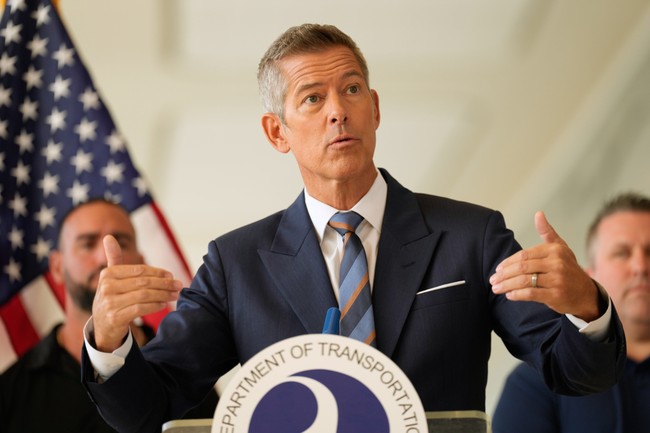
Transportation Secretary Sean Duffy has ordered trucking schools to meet federal standards within 30 days, aiming to shut down programs that put American drivers at risk and to restore accountability in the industry.
Secretary of Transportation Sean Duffy announced today that the days of a “Wild West” trucking industry are over, and that trucking schools have 30 days to comply with federal rules or face being shut down. His move is framed as an urgent federal intervention to restore basic standards for training and certification across programs that feed into our highway system. The decision targets programs the department says may be failing to meet minimum requirements for safe, standardized CDL instruction. It signals a tougher, enforcement-first approach from a Republican administration focused on public safety.
That news comes after months of stories about illegal immigrants obtaining CDLs, many of whom can’t speak English or read English road signs, and some of whom have caused catastrophic, fatal crashes on American roads. Reports and investigations painted a picture of inconsistent oversight and lax standards at some schools, which critics say allowed unqualified drivers to enter commercial fleets. Republicans have seized on those failures to argue that policy, enforcement, and border security are tightly linked to roadway safety. This directive from Duffy answers that concern with concrete deadlines and the threat of decertification.
Nearly 44% of the 16,000 truck driving programs listed nationwide by the government may be forced to close if they lose their students after a review by the federal Transportation Department found they may not be complying with minimum requirements.
🚨HUGE ALERT🚨 @USDOT is giving THOUSANDS of trucking schools 30 days to comply with federal rules for drivers or they may be forced to close down.
The days of a “Wild Wild West” trucking industry are over under the Trump administration 🚛 https://t.co/ZRWebpTXij
— Secretary Sean Duffy (@SecDuffy) December 1, 2025
The Transportation Department said Monday that it plans to revoke the certification of nearly 3,000 schools unless they can comply with training requirements in the next 30 days. The targeted schools must notify students that their certification is in jeopardy. Another 4,500 schools are being warned they may face similar action.
Schools that lose certification will no longer be able to issue the certificates showing a driver completed training that’s required to get a license, so students are likely to abandon those schools. It’s not clear how many of those schools have been actively teaching students.
The problem is ongoing, widespread, and serious, and the examples are grim enough to demand action now. On November 20, reporting showed nearly one-third of truck drivers stopped in Texas were undocumented, and those same reporting cycles documented fatal crashes tied to drivers who held questionable or improperly issued CDLs. One crash in Indiana killed National Guardsman Terry Frye, 23, and the driver in that case, Georgian national Goderdzi Gujabidze, had been issued a CDL in New York. In California on October 24, Jashanpreet Singh drove under the influence and killed three people after being licensed by state authorities, and in August Harjinder Singh’s illegal U-turn in Florida caused an accident that also killed three people.
This has to stop. Physically removing dangerous training programs and holding schools to greater transparency will take pressure off law enforcement and the trucking industry while protecting ordinary motorists who share highways with large commercial rigs. Swift enforcement is not just a regulatory move, it’s a public safety imperative that conservative lawmakers and state officials can rally behind to restore order to a sector long criticized for uneven oversight.
Democrats always call for gun bans after shootings, to “save one life,” but they will oppose this when it would actually save lives. That contradiction is politically convenient and morally hollow, because practical steps like revoking certifications or strengthening background checks for commercial licensing actually prevent catastrophic collisions. Conservatives argue that enforcing existing rules, improving border security, and tightening oversight of training programs are commonsense measures that save lives without trampling lawful industry activity. This is the kind of practical policy Republicans can sell to voters who want safer roads, fewer tragedies, and restored accountability.
Donalds is right to call on Congress to codify the Trump administration’s actions into law. Translating executive enforcement into durable statute would make it harder for future administrations to roll back sensible safety standards and would give states clearer authority and federal resources to pursue bad actors. Congress can write protections that preserve careers in trucking while stamping out fly-by-night programs and improper certification schemes, and doing so would close loopholes that have been exploited for too long.
Imagine what a disaster this would be under a Kamala Harris-Tim Walz administration. A weak or distracted federal leadership would likely reverse these moves, leaving states and taxpayers to pick up the pieces after preventable tragedies. It’s a refreshing change of pace to have a Transportation Secretary who wants to make our roads safe, instead of one who called roads “racist.” Responsible enforcement and clear standards are what keep families safe during long holiday drives and every workday commute.