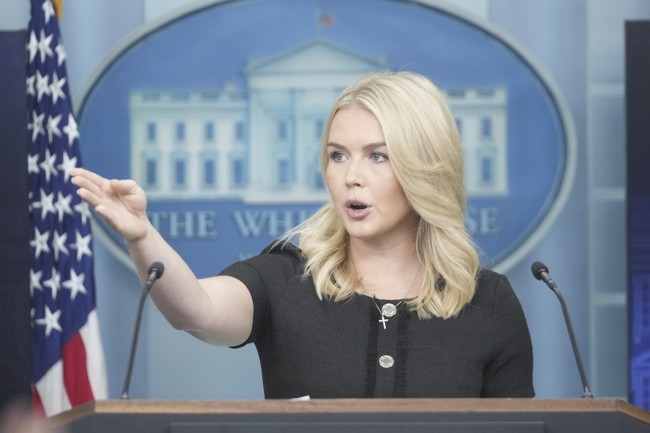
At a White House briefing, Karoline Leavitt sharply challenged the mainstream press over its economic coverage, trading barbs with CNN’s Kaitlin Collins and laying out data the administration says shows inflation easing. The exchange exposed stark differences in how the White House and much of the media frame the economy, and it highlighted a tougher, more confrontational press strategy. Leavitt pushed back on narratives she called false and stressed factual data the administration believes supports its case.
Yesterday’s briefing turned into a showdown when questions about the economy moved from mild to pointed. Press secretary Karoline Leavitt did not waste time rebutting reporters she viewed as promoting misleading stories. Her tone reflected a broader Republican argument that the press often amplifies negative takes while ignoring positive indicators.
Leavitt responded directly to CNN’s line of questioning with concrete numbers and a sharp delivery intended to shift the frame. She listed several data points to argue that inflation has eased and the economy is stabilizing under the current administration. The goal was to force the press corps to contend with those figures instead of relying on one-sided narratives.
“So we’ve covered the economy, but there are mixed signals of what that looks like,” Collins began before Leavitt pounced from the top rope. The exchange that followed was fast and pointed, with Leavitt pressing her case and the reporter pressing back. It was a clear example of the new White House approach to media pushback.
But inflation is down from where it was, as measured by the overall CPI; it has slowed to an average 2.5 percent base, this is down from what the president inherited. The president inherited 2.9 percent in January; today it’s at about 2.5 percent, so we are trending in the right direction with more to come. And I would remind you when President Trump left office in his first term, inflation was 1.7 percent, and the previous administration jacked it up to a record high nine percent. So again, in 10 months, the president has clawed us out of this hole, kept it low at 2.5 percent, and we believe that number is going to continue to decline, especially as energy and oil prices continue to decline as well.
The block of data Leavitt recited was meant to contrast past and present administration outcomes and to remind listeners of the trajectory she claims the economy is on. Her argument centers on a return to lower inflation and falling energy prices as signs of recovery. For supporters, that narrative underscores fiscal competence and policy success.
“We are not saying it wasn’t high under Biden…” a reporter began. The interjection framed the debate around whether the current improvements erase earlier pain. That tension — acknowledging past hardship while claiming current progress — is a consistent messaging challenge for conservatives and Republicans pushing back on media framing.
“Well, nobody reported on it being high under Biden,” Leavitt shot back. She emphasized that media scrutiny has shifted and suggested there was selective attention in prior years. Her point was blunt: critics ignored real problems then while now magnifying imperfections for political effect.
A subsequent question pointed to presidential statements about inflation this year, forcing Leavitt to address claims directly. She did not shy away from calling out previous messaging she considered misleading, and she named the consequence of trusting such claims. The White House strategy now includes naming past errors in coverage to weaken ongoing critiques.
“The previous administration said that too,” Leavit replied. “My predecessor stood up at this podium, and she said, ‘inflation doesn’t exist,’ she said that the border was secure. And people like you just took her at her word, and those were two utter lies. Everything I’m telling you is the truth backed by real factual data, and you don’t want to report on it because you want to push untrue narratives about the president.”
🔥POW POW — @PressSec ROCKS Kaitlan Collins for FAILING to grill Biden's Press Secretaries about his failed economy.
"NOBODY reported [inflation] being high under Biden…My predecessor stood up at this podium and said inflation doesn’t exist! She said the border was secure!… pic.twitter.com/MQAAcAalJE
— Townhall.com (@townhallcom) December 11, 2025
The media thinks it can control the narrative, but Leavitt is making sure it doesn’t. Inflation has dropped from its peak, yet many Americans are still hurting and Republican messaging must acknowledge that reality while pointing to improvement. The administration’s playbook is to show numbers, call out past double standards, and demand fair treatment from reporters.
There is a political calculation here: you can argue that improving metrics matter, even if pocketbook pain persists for some households. Republicans are framing declining inflation as validation of policy and competence, and they see media resistance as partisan stubbornness. Expect continued aggressive pushback in future briefings when the press presses on negative angles.
Leavitt’s performance also speaks to a larger conservative critique of elite institutions and their coverage choices. Rather than politely taking questions, the current team is prepared to call out omissions and selective reporting. That posture resonates with voters who feel traditional media outlets have consistently favored certain narratives.
For the press corps, the challenge is balancing skepticism with accuracy, and for Republicans the task is to keep the focus on measurable improvement. This briefing showed how messaging battles now unfold in real time, with both sides jockeying to own the economic story. The exchange will likely be replayed by allies as evidence of a tougher, more assertive communications approach.
Editor’s Note: The mainstream media continues to deflect, gaslight, spin, and lie about President Trump, his administration, and conservatives.