A short, direct look at a public debate between two conservatives over what actually makes someone American: Michael Knowles stressed lineage and shared historical experience at AmericaFest, while Vivek Ramaswamy argued in an op-ed that the creed and ideals define Americanness.
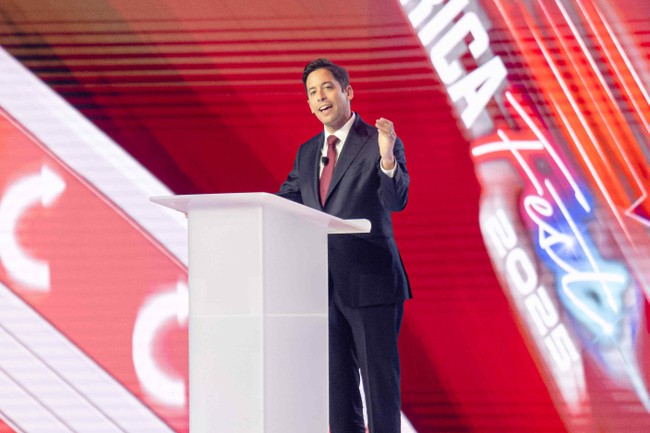
Michael Knowles, Daily Wire host and conservative commentator, laid out a version of American identity at Turning Point USA’s AmericaFest that leaned heavily on ancestry and shared history. He framed national belonging as a matter of a continuous people, made by specific migrations, battles and a distinct character. Knowles warned against treating nationhood as merely abstract philosophy, arguing instead that it comes from lived experience across generations. His remarks drew a clear line between cultural assimilation that works and cultural separation that does not.
Knowles said, “To be on the team, you have to acknowledge that there is such a thing as the American people. We’re not just an idea floating in outer space. We are a real people with a real historical lineage and a real historical destiny,” and he continued in the same vein to anchor his point in America’s founding moments. He pointed to arrivals on the Mayflower and other ships, the Revolution, and the spread across the continent as evidence of that lineage. He added a wry aside during his description, saying, “We came here on the Mayflower, which is a great cigar brand by the way, we came here on other ships as well. We landed at Plymouth and Jamestown, we fought a war of independence, and plenty of wars after that. We spread across the continent. We have a real historical experience and character that is not magically imbued through a few lines of philosophy or a naturalization pop quiz.”
Knowles argued further that when immigration and assimilation have gone well, newcomers adopt the language, habits and symbols of their adopted nation. He contrasted that with cases where newcomers keep the customs and flags of their origin, which he said places them outside the “team.” The team metaphor drove his point: public allegiance and cultural assimilation are what bind people into a single political community. For Knowles, that bond is reinforced by a shared past and a common story about who Americans are.
That exacting view of membership on the right collided with a different conservative strain this week when Vivek Ramaswamy, a 2024 presidential candidate who is now running for Ohio governor, published an op-ed arguing that American identity is primarily an idea. Ramaswamy’s piece rejected ancestry as the main criterion and instead elevated the founding creed, arguing anyone who embraces those ideals and swears allegiance can be fully American. He also used the moment to distinguish his vision from groups he considers exclusionary and extremist.
.@michaeljknowles: "To be on the team, you have to acknowledge that there is such a thing as the American people…If you prefer the flag of some other nation, the customs and habits of some other people, you are not on my team." pic.twitter.com/tIDAERK786
— Daily Wire (@realDailyWire) December 19, 2025
There are two competing visions now emerging on the American right, and they are incompatible. One vision of American identity is based on lineage, blood and soil: Inherited attributes matter most. The purest form of an American is a so-called heritage American — one whose ancestry traces back to the founding of the United States or earlier.
Ramaswamy went on to insist that being American is a binary status tied to belief in a set of civic principles, not a sliding scale determined by genetics or genealogy. He emphasized the rule of law, freedom of conscience and expression, colorblind meritocracy, the Constitution and exclusive allegiance to the nation as the essentials. In his framing, a legal citizen who embraces those things is every bit as American as any Mayflower descendant.
Americanness isn’t a scalar quality that varies based on your ancestry. It’s binary: Either you’re an American or you’re not. You are an American if you believe in the rule of law, in freedom of conscience and freedom of expression, in colorblind meritocracy, in the U.S. Constitution, in the American dream, and if you are a citizen who swears exclusive allegiance to our nation.
As Ronald Reagan quipped, you can go to live in France, but you can’t become a Frenchman; but anyone from any corner of the world can come to live in the United States and become an American. No matter your ancestry, if you wait your turn and obtain citizenship, you are every bit as American as a Mayflower descendant, as long as you subscribe to the creed of the American founding and the culture that was born of it. This is what makes American exceptionalism possible.
The debate between Knowles and Ramaswamy is more than academic; it gets at how the right defines its base and what policies and rhetoric follow. One side stresses continuity, cultural cohesion and historical memory as the glue of nationhood. The other leans heavily on a civic creed, saying shared beliefs and commitments should predominate over heritage.
Both visions aim to protect a version of American identity from what they see as corrosive trends—and both offer concrete political consequences. If lineage is central, policy and rhetoric will prioritize cultural preservation and cautious immigration. If creed wins, emphasis shifts to assimilation, legal pathways and civic education as the path to full membership. The clash is now squarely in the open among conservative thinkers and leaders.
Editor’s Note: President Trump is leading America into the “Golden Age” as Democrats try desperately to stop it.