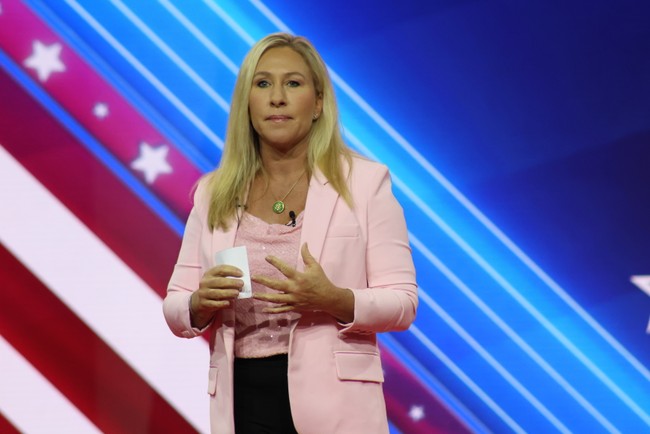
Marjorie Taylor Greene has publicly shifted away from Donald Trump and the MAGA core, sparking questions about motives, timing, and the sudden change in tone from a once-relentless partisan fighter.
I used to be a Marjorie Taylor Greene fan; she carved out a role as a fierce partisan who hammered Democrats and energized the base. Over time she amassed a reputation as an unapologetic attack dog whose rhetoric never softened—until this year, when her stance toward Trump and the movement changed dramatically. That flip has left many conservatives scratching their heads and wondering what, exactly, prompted it.
Her recent behavior moves beyond old quirks and boldness into something that looks like a public break. She’s taken positions that put her at odds with Trump on Gaza, criticized certain tech and donor-friendly policy stances, and pressed for release of the Jeffrey Epstein files. Rumors have swirled that internal politics and a blocked Senate bid in Georgia played a role in the split, and while Greene disputes some reports, the political theater has been unmistakable.
The coverage included a long magazine piece that explored her shift and suggested several catalysts, including the fallout after Charlie Kirk’s death and Greene’s reported spiritual reckoning. The piece paints a picture of someone reassessing a partisan posture that had been modeled after Trump’s relentless refusal to apologize. That reassessment, whatever its origins, has real consequences for how she’s viewed by the conservative movement and the media.
It also, Greene said, clarified something about herself. Over the past five years, as Trump’s most notorious acolyte in Congress, she had adopted his unrepentant pugilism as her own. “Our side has been trained by Donald Trump to never apologize and to never admit when you’re wrong,” she told me in her Capitol Hill office one afternoon in early December. “You just keep pummeling your enemies, no matter what. And as a Christian, I don’t believe in doing that. I agree with Erika Kirk, who did the hardest thing possible and said it out loud.”
Greene’s reaction put her in a distinct minority among influential conservative figures. Almost immediately after Kirk was declared dead, many of her comrades on the right — the billionaire Elon Musk, the Fox News host Jesse Watters, the podcaster Steve Bannon — labeled the killing an act of war by the left and exhorted their audience to think in similar terms.
But Greene — who for years took a back seat to no one when it came to reactionary rhetoric, going so far, before she was in office, as to accuse Democrats, including Speaker Nancy Pelosi, of treasonous conduct and adding that treason was punishable by imprisonment or death — realized that she had suddenly lost all appetite for vengeance. She later told a friend, who confirmed the exchange: “After Charlie died, I realized that I’m part of this toxic culture. I really started looking at my faith. I wanted to be more like Christ.”
That was when the stress fracture that had been steadily widening between Greene and her political godfather became an irrevocable break. She had increasingly taken stands apart from the president and the Republican Party: declaring the war in Gaza a “genocide”; objecting to cryptocurrency and artificial-intelligence policies that, from her perspective, prioritized billionaire donors over working-class Americans; criticizing the Trump administration for approving foreign student visas, for enacting tariffs that hurt businesses in her district and for allowing Obamacare subsidies to expire.
Most significant, she defied the president and compliant House Republican leaders as she argued that all investigative material pertaining to Jeffrey Epstein should be released. “The Epstein files represent everything wrong with Washington,” Greene told me in December. “Rich, powerful elites doing horrible things and getting away with it. And the women are the victims.”
Whatever the internal causes, the public result is what matters now: Greene has announced she will quit Congress shortly after her pension vests, and her break with Trump appears complete. To many on the right this looks like a political reset that coincides with personal and spiritual language rather than a simple policy dispute. That shift has also produced a predictable media reaction that praises her newfound independence while ignoring her past rhetoric and record.
The epitome of media bias. She was a racist, antisemetic lunatic until she broke from Trump. Now a NYT magazine cover girl. @jarvis_best playing the role of Nostradamus https://t.co/88YFXBqJ6W
— Josh Holmes (@HolmesJosh) December 30, 2025
Her leftward-seeming appearances, oddbedfellows moments and high-profile detours into cable talkland read like an effort to remake a brand. Conservatives who once applauded her willingness to attack the other side are now left debating whether her pivot is sincere, strategic, or revenge-driven after personal political ambition was blocked. The turnabout raises questions about loyalty, messaging, and what it takes to stay relevant in a movement that prizes firmness over retreat.
The press has a short memory when it suits them: the same outlet that lionized her for toughness a few years back is now applauding her for walking away from the leader who helped define that posture. That inconsistency is striking to anyone watching the choreography of modern political tribalism, and it helps explain both the confusion and the amusement among conservatives.