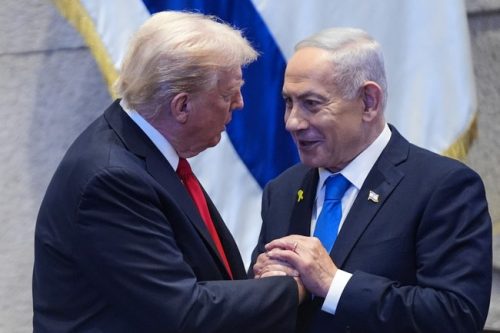
Benjamin Netanyahu said he would travel to New York without hesitation despite Mayor-elect Zohran Mamdani’s vow to enforce an International Criminal Court arrest warrant, and he set a clear condition for any meeting: recognition of Israel’s right to exist.
Benjamin Netanyahu spoke at the Dealbook Summit at Lincoln Center and joined the session virtually from Israel, telling the audience, “I’ll come to New York,” followed by, “Yes, of course I will.” His answer was short, confident, and meant to put the rhetoric about an ICC warrant in perspective. Netanyahu also spelled out a political line in the sand regarding who he will engage with in the United States.
He said he would not meet with New York’s newly elected mayor unless the mayor supported Israel’s existence, quoting, “If [Mamdani] changes his mind and says that we have the right to exist, that’ll be a good opening for a conversation.” That phrasing focuses the dispute on basic recognition rather than procedural legal arguments, making the issue about legitimacy as much as law. In doing so, Netanyahu framed the encounter as political, not purely legal.
Zohran Mamdani has argued that New York City officials should comply with international law and that a local mayor could honor ICC arrest warrants against foreign leaders, including both Benjamin Netanyahu and Vladimir Putin. Mamdani, a self-described democratic socialist, framed his position as even-handed by saying he would treat warrants against Putin the same as those against Netanyahu. That stance has set off a storm in Washington and among conservative commentators who see a mayoral promise to enforce ICC warrants as legally dubious.
🚨BREAKING: Netanyahu declares in an interview with the New York Times: "I will come to New York despite Mayor Mamadani's promise to arrest me, wait and see." pic.twitter.com/wTXyTKKt8B
— Eli Afriat 🇮🇱🎗 (@EliAfriatISR) December 3, 2025
The United States is not a member of the International Criminal Court, and successive administrations have rejected the idea that the ICC has jurisdiction over U.S. citizens or America’s allies. Critics argue that the court operates without direct accountability to American voters and can be used as a political tool by international actors. From a Republican perspective, surrendering American discretion to an outside tribunal or asking local officials to act on international warrants is risky and unnecessary.
For many Americans, the notion of a U.S. mayor attempting to enforce an ICC warrant reads as performative politics rather than grounded legal practice. It plays well on social media where bold pronouncements score immediate attention, but social media applause does not change the limits of municipal power. Legal experts note that local law enforcement has no mandate to execute international warrants issued to nations where the U.S. has not ceded jurisdiction.
The episode also touches on a broader concern among conservatives that international bodies single out Israel for scrutiny while other conflicts and actors receive different treatment. That perception fuels a narrative that global institutions are politicized and prone to bias, which in turn makes any effort to rely on such institutions politically fraught. For Republican readers, the instinct is to defend allied sovereignty and to reject symbolic gestures that lack legal standing.
Netanyahu’s readiness to travel underscores a second, practical point: diplomacy and direct engagement matter more than public threats. Showing up in person signals confidence and a preference for state-to-state dialogue rather than letting supra-national institutions set the stage. His condition about recognition makes political accountability clear — if a mayor wants to transform New York into a platform for international legal action, that stance will have consequences for access to leaders.
The clash between a national leader and a municipal official also highlights how local politics can collide with foreign policy in an era of hyperlocal media and activist-driven agendas. Mayors are powerful in city governance, but foreign policy remains the constitutional province of the federal government. That separation of roles is a guardrail conservatives argue should be kept intact to prevent confusion and mixed signals in international affairs.
At its core, this disagreement is a test of priorities: whether to pursue headline-grabbing gestures or to protect stable alliances and diplomatic norms. Netanyahu’s quick, public response was designed to put the issue back into an arena where state actors talk to state actors and where recognition and security questions get central billing. For those who favor clear, sober foreign policy, that is the right outcome.