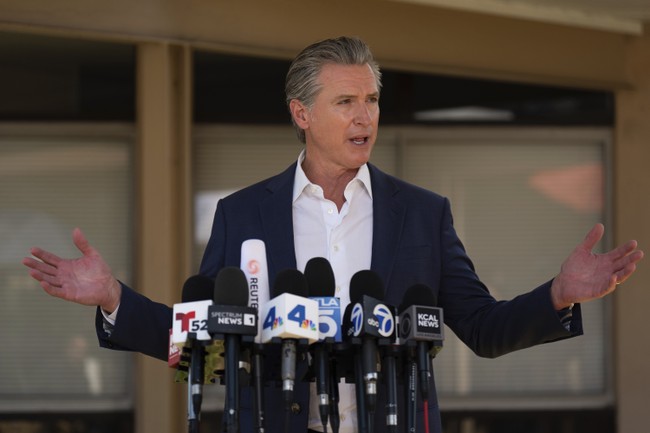
Gavin Newsom has publicly rejected a high-profile proposal to tax a small set of ultrawealthy Californians to pay for state services, and his opposition comes amid clear positioning for a possible 2028 presidential bid.
California is facing a recurring political and fiscal argument: raise huge one-time levies on the ultrawealthy or risk driving more people and capital out of the state. Gov. Gavin Newsom has opposed a campaign that would impose a one-time 5 percent tax on roughly 200 Californians worth more than $1 billion, framing his stance amid broader strategic calculations. That proposed levy would be applied to net worth and target names like Mark Zuckerberg and Nvidia’s Jensen Huang.
A political adviser aligned against the billionaire tax explained the governor’s position, noting that Newsom opposes the proposal to levy a one-time 5 percent tax on roughly 200 Californians worth more than $1 billion to “replace lost federal dollars and protect essential services.” Opponents warn that a sudden wealth grab measured in billions could prompt litigation, relocation, or clever tax avoidance that undermines any short-term windfall.
Advocates for the measure label it the “2026 Billionaire Tax Act” and claim it would produce over $100 billion in revenue in the first five years. That is an eye-popping projection, yet it comes with an equally big risk: accelerating the exodus of residents and headquarters already wrestling with high housing costs and regulatory burdens. The back-and-forth turns the tax debate into a referendum on whether California wants to stop the bleeding or double down on policies that chase wealth away.
Newsom’s decision to oppose the plan cannot be separated from his national profile. He has been laying a public trail for years that reads like slow-motion campaign preparation, sharpening messages that resonate with moderates and swing voters. Part of that playbook is to poke at Washington and at President Trump, while also softening certain progressive stances to court a broader electorate.
Publicly, Newsom has tightened rhetoric on homelessness while still defending his record, and he has launched a podcast and other platforms to shape his brand. On those platforms he has criticized ideas like defunding the police and has tried to show empathy with gun owners in an effort to neutralize wedge issues. On transgender policy he has distanced himself from more extreme positions when it suits the fairness argument, particularly about men competing in women’s sports.
For Republicans watching national politics, Newsom’s maneuvers read like careful triangulation designed to avoid the leftmost lane while keeping his anti-Trump credentials front and center. He leans into being the Democratic candidate who can loudly oppose former President Trump, even borrowing a confrontational tone at times that mimics his opponent’s social media swagger. That posture matters in Democratic circles consumed by opposition to Trump, and it also shapes how conservatives frame him.
Practical concerns about the billionaire tax are straightforward: a one-time levy of that scale would be unprecedented in modern state tax policy, and economists and legal experts would likely spend years untangling its consequences. Even supporters acknowledge the magnitude of the gamble, arguing the funds would patch budget holes and bolster services at a time when federal money alone cannot cover rising costs. Opponents answer that promising immediate relief while risking capital flight is poor stewardship for a state already losing taxpayers.
The political calculus also includes public perception. Voters who are fed up with high costs and crime may welcome bold-sounding proposals, but they are also responsive to promises of stability and jobs. Newsom’s refusal to back the tax gives him a talking point: he can say he is protecting the state’s economic base while claiming to pursue humane solutions to California’s crises. That message aims to win over centrists who worry about both fiscal chaos and cultural turbulence.
California lost 19,000 entry level fast food jobs because of Gavin Newsom's recent wage hike. Yet, he's leading to be the DNC nominee in 2028, according to Polymarket.
The opposition ads against Newsom will be delicious. pic.twitter.com/1lGt2Jqz4d
— George (@BehizyTweets) November 29, 2025
Markets and betting pools reflect the growing focus on Newsom as a national figure. According to Polymarket data, he leads as the Democratic favorite for 2028 by a wide margin of 25 points, with New York Congresswoman Alexandria Ocasio-Cortez at 12 percent and Newsom at 37 percent. Those numbers keep the speculation alive and underline why decisions in Sacramento carry consequences far beyond the state border.
At stake in this debate is more than a single tax proposal; it is whether California doubles down on policies that risk alienating its richest residents or pivots toward incentives that keep people and businesses in place. Newsom is choosing a path that looks like careful political calculation, balancing progressive credentials with a need to avoid sharper economic fallout. Voters will judge whether that balancing act is courage, calculation, or both.