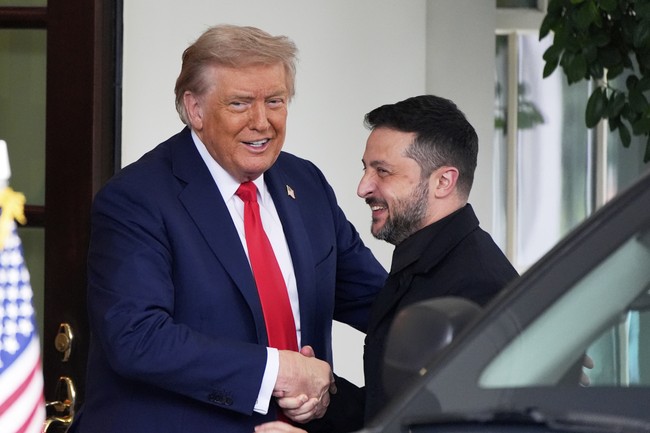
President Trump and Ukraine’s Volodymyr Zelensky held a joint press conference at Mar-a-Lago after talks on a proposed peace deal, signaling that a framework is close without releasing final details.
President Trump and Ukrainian President Volodymyr Zelensky appeared together at Mar-a-Lago after intensive negotiations over a proposed peace agreement, and both leaders said progress has been made. The tone of the press conference was pragmatic, with repeated nods to ongoing diplomacy and the need to finalize terms. Observers were left with the sense that a lot has been settled, but key points remain unresolved. The meeting underscored Washington’s central role in brokering steps toward ending the fighting.
An official video of the joint presser captured the exchanges and was shown publicly for context.
.@POTUS welcomes Ukrainian President Volodymyr Zelensky to Mar-a-Lago 🇺🇸🇺🇦 pic.twitter.com/aRbMAiKGSF
— Rapid Response 47 (@RapidResponse47) December 28, 2025
Both men signaled that an agreement to end the war in Ukraine was nearing finalization, but did not announce specifics. “Our meeting was excellent,” Trump said. “We covered, somebody would say 95 percent…I don’t know what percent, but we have made a lot of progress on ending that war, which is really…certainly the most deadly war since World War Two.” Those words were meant to convey significant momentum while leaving room for more negotiation.
Trump returned repeatedly to the theme of steady progress and credited several advisers for their work on the talks. He thanked his son-in-law Jared Kushner, a key figure in the Abraham Accords, U.S. diplomat Steve Witkoff, Sec. Marco Rubio, and Sec. Pete Hegseth for their “unbelievable job” in the negotiations. Zelensky echoed that gratitude and emphasized the practical results of recent diplomacy between teams.
President Zelensky outlined a general structure for the proposed deal without giving detailed text. He said the framework includes a 20-point peace plan, U.S.-Ukraine security guarantees, further U.S.-Europe-Ukraine security guarantees, a prosperity plan, and the timeline for each of the items. He also indicated that negotiators will meet again soon to iron out outstanding matters.
Zelensky told reporters that diplomatic teams will reconvene quickly. He announced that U.S. and Ukrainian diplomats will be gathering “in the coming weeks” to finalize the deal, a timeline meant to push work toward a concrete conclusion. “Ukraine is ready for peace,” Zelensky’s statement ended, a line aimed at reassuring both domestic and international audiences.
Trump stressed shared incentives to stop the fighting and framed the work as a humanitarian and strategic imperative. “Russian wants [the war] ended, everybody wants it ended, and we want it ended because I don’t want to see so many people dying,” Trump said. ”We’re losing massive numbers of people, the biggest by far since World War Two.” That blunt assessment tied the push for a deal to the cost of continued conflict.
While optimistic, Trump acknowledged thorny disagreements remain that require careful bargaining. “We could be very close,” Trump said. “There are one or two very thorny issues, very tough issues, but I think that we’re doing very well. We’ve made a lot of progress today, but we’ve really made it over the last month. This is not a one day process.” He framed the remaining points as solvable with continued talks rather than deal-breakers.
Territorial issues were singled out as the main obstacle to final language and timing. “Some of that land has been taken, and some of that land is maybe up for grabs, but it may be taken over…number of months,” Trump said. “You’re better off making a deal now.” That line reflects the bargaining trade-offs at the heart of peace talks, where lines on maps and security guarantees collide.
Trump also left open the option of more direct outreach if it helps seal a deal, including rare diplomacy aimed at legislative bodies. “[I] don’t anticipate it,” Trump said. “[I] would like to get the deal done and not necessarily have to go. I’ve offered to speak to [Ukraine’s] parliament if that would help. If it would help save 25,000 lives a month, or whatever it may be, I would certainly be willing to do that.” The willingness to personally engage underscores the administration’s interest in closing a deal.
In the hours before the joint session, Trump said he had extended talks beyond just the two leaders. Trump spoke to Russian President Vladimir Putin for over two hours before the meeting with Zelensky. “We’ve done very well,” Trump said. “We’ve had discussions on just about every subject, and that includes with President Putin.” The two leaders then joined a one-hour conversation with a group of European leaders to coordinate next steps and gather endorsements for further negotiation.
Negotiations are slated to continue into the new year, with teams expected to meet in January to refine the remaining language. The public takeaway from the presser was clear: leaders are pushing hard for a deal, major items are outlined, and diplomats will return to close the gaps. For supporters, the event read as pragmatic statesmanship aimed at ending a costly war.