Acting Venezuelan leader Delcy Rodríguez says she and other officials were given 15 minutes to agree to US demands after a surprise American operation captured Nicolás Maduro, an episode that exposes the raw power politics at play and the choices facing regime officials under pressure.
On January 3, the United States reportedly executed a precision operation that resulted in the capture of Nicolás Maduro and his wife, an action described by some as swift and decisive. The mission—referred to in some accounts as Operation Absolute Resolve—allegedly included airstrikes and helicopter engagements that overwhelmed Venezuela’s defenses. From a Republican viewpoint, that display of American capability and resolve is exactly what deterrence looks like when it matters.
Acting President Delcy Rodríguez, who had been vice president at the time, recently detailed the moment she and others faced a stark choice. She says they were given only 15 minutes to decide whether to “play ball” with Washington or face lethal consequences. That timeframe and the pressure it implies are the kind of real-world tests that expose who is willing to cling to power and who will protect their own lives and ambitions instead.
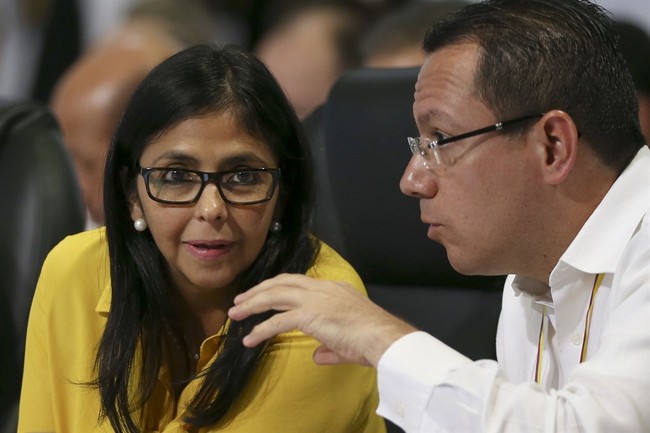
The communications minister holds a phone up to a microphone before a gathering of regime-friendly influencers.
On speakerphone is Venezuela’s acting president, Delcy Rodríguez, who claims that when US forces captured the dictator Nicolás Maduro, she and other members of his cabinet were given 15 minutes to decide whether to comply with Washington’s demands – “or they would kill us”.
Rodríguez, the former vice-president who assumed power after the US attack – and has since been praised by Donald Trump for playing along with his demands – says she was doing so only because the “threats and blackmail are constant”. She also concedes that her priority was “to preserve political power”.
Her remarks appear in a leaked recording of the nearly two-hour meeting that was held in Venezuela seven days after the US attack.
The leaked recording, reported by The Guardian, shows Rodríguez addressing loyalists and admitting the calculus she made under pressure. Her language is plain and transactional: survive, preserve power, comply when necessary. To many on the right, those are predictable choices for regime insiders who have long profited from corruption and patronage networks.
This episode should be read as a lesson in consequences. When the United States acts with clarity and force, allied autocrats and corrupt officials get a simple message: your choices matter and the free world can change facts on the ground. That reality unsettles left-leaning critics who prefer to cast American military strength as reckless rather than effective.
Critics will claim the operation crossed lines or violated norms, but realpolitik has always required hard calls when tyrants threaten regional stability and democratic allies. Republicans tend to favor clear-eyed pressure that forces concessions and breaks kleptocratic grips. If a short, decisive operation accelerates a transition away from dictatorship, many on the right will judge the result worth the risk.
Rodríguez’s admission that she acted to “preserve political power” is telling and unsurprising. Authoritarian regimes are built on survival instincts, loyalty tests, and the constant threat of violence. When those at the top see their security evaporate, self-preservation often trumps ideology or loyalty to a fallen leader.
The aftermath raises practical questions about governance and stability in Venezuela. Who fills the vacuum when a long-entrenched strongman is removed, and what mechanisms will ensure a peaceful, credible transition? Conservatives emphasize that power vacuums must be managed with firm policies that protect U.S. interests, support allies, and prevent chaos that could be exploited by rival powers.
Finally, the episode underscores the value of American leverage, when used wisely, to shape outcomes in volatile regions. Strong, resolute policy backed by capabilities creates options that diplomatic talk alone cannot. For Republicans, the broader point is straightforward: power matters, deterrence matters, and when liberty and security are on the line, the United States must be ready to act.