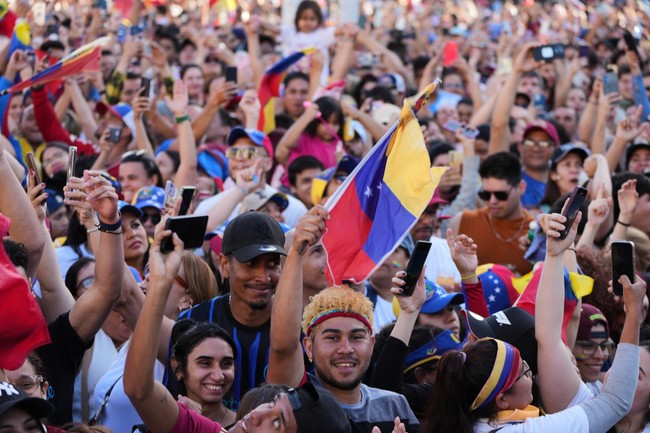
Outside a Manhattan courthouse, jubilant Venezuelan and Cuban demonstrators celebrating Nicolás Maduro’s capture clashed with left-wing protesters demanding his release, forcing the NYPD to step in and separate the crowds.
Police lines held as two tense groups faced off near the courthouse where Maduro and his wife were scheduled for their initial court appearance, turning a routine security detail into a heated public showdown. The scene mixed relief, anger, and pointed accusations about who in the crowd actually represented Venezuelan voices. Emotions ran high and physical confrontation nearly followed words, revealing deep fractures among people who share geography but not perspective.
Several immigrants who fled Venezuela spoke plainly about what Maduro’s capture meant to them, insisting this moment represented a long-awaited turn toward accountability. “They are not Venezuelans. They are paid protesters. They don’t speak Spanish!” one woman said, calling out those she saw as outsiders. That sentiment reflected a frustration with performative activism that ignores the lived suffering of people under authoritarian rule.
Protest against #US’s actions against #Maduro and #Venezuela in #LowerManhattan#Trump pic.twitter.com/savZFUFkx3
— Joseph F Gargiulo (@JosephFGargiulo) January 5, 2026
In the crowd someone defended Maduro with a familiar talking point: “I don’t understand how the US gets to call him a dictator when he’s been rightfully elected twice by the people of Venezuela in a very transparent election,” a protester said. That line drew sharp rebuttals from those who remember rigged contests and crushed dissent in Venezuela, and it underscored how some Americans repeat talking points divorced from on-the-ground reality. When foreign repression shows up in our cities, it exposes both genuine expats and well-meaning sympathizers who lack context.
Words quickly escalated into insults when a Cuban-born man shouted at a counterprotester, “You’re an a**hole! You don’t even know where Venezuela is!” The exchange captured how identity and authenticity were weaponized on the sidewalk, turning complex history into a shouting match. Those present warned that simplifying this conflict into left-versus-right talking points misses how many in the Venezuelan diaspora view Maduro as a disaster for their homeland.
Another immigrant punched through the noise with a direct charge: “You’re not for my country! Go to Cuba. Eighty percent of you guys don’t even understand what I’m saying. You don’t speak Spanish!” The outburst wasn’t just rhetorical flare—it was a demand that advocacy match experience and sacrifice. For many, the protest felt like a claim on truth by those who lived the consequences of Maduro’s rule.
Before police intervened, a scuffle ignited when a man carrying a Venezuelan flag—who later admitted he was from Staten Island and was “standing with Venezuelans”—was confronted by people celebrating Maduro’s arrest. The flag was torn and tensions spilled into pushing before officers stepped between the groups. That moment crystallized the larger problem: symbols can be seized as easily as arguments, and authenticity is the battleground.
What played out in Manhattan was not a classic debate over foreign policy nuance; it was a moral clash between those who cheered a leader’s removal and those who reflexively defend regimes they perceive as opposing U.S. influence. Many on the left reflexively frame any action they dislike as imperialist, even when the outcome directly relieves oppression for millions. That binary ignores the fact that foreign interventions can, in some cases, remove tyrants and give breathing room to oppressed citizens.
Critics in the crowd suggested some pro-Maduro demonstrators may have been outside actors or ideologues rather than Venezuelans with firsthand experience. That charge, whether true in every instance or not, fueled anger and distrust among refugees who said their families fled hunger and repression. When people who suffered speak up, their claims demand a different weight than abstract solidarity from afar.
The scene also revealed how politicized public reactions have become, with domestic partisan lenses coloring responses to foreign affairs. Supporters of bold foreign policy moves framed the courthouse moment as a win for accountability and for American leadership, while opponents painted it as meddling. The result is less dialogue and more accusation, which only heightens the risk of street-level confrontations.
For Venezuelans in New York, this episode was personal, not theoretical; years of shortages, arrests, and exile are not easily summarized by slogans. Those who celebrated saw a rare moment of justice, and they voiced frustration when others denied that reality or suggested the arrest was illegitimate. That clash of lived experience versus ideology played out in full view of the city and the nation.
The NYPD’s intervention kept the fight from becoming something worse, but the underlying tensions remain unresolved. People on both sides left convinced of their correctness and suspicious of motives across the line. If anything, the courthouse confrontation was a reminder that foreign policy can land on local sidewalks and force communities to confront uncomfortable truths about who speaks for whom.
What happened that day in Manhattan will stick in people’s memories: a torn flag, a shouted epithet, and a courthouse backdrop for a dispute about legitimacy and suffering. Those images will be used by advocates and critics alike to make their case about U.S. actions abroad and who deserves to claim the moral high ground. For many Venezuelans in exile, however, the moment was simply a long-delayed flicker of justice and a public airing of grief turned to relief.