Iran’s new president warned that any foreign strike against Supreme Leader Ayatollah Ali Khamenei would be treated as an all‑out war, comments made as broad protests and brutal crackdowns continue across the country.
President Masoud Pezeshkian’s warning landed during a volatile moment, with nationwide demonstrations that began in late December still unfolding. The remark raises the stakes for any nation weighing intervention or targeted action, given Tehran’s explicit phrasing about national response.
The unrest has drawn sharp international attention, and President Donald Trump has publicly threatened steps against the Iranian regime if it continues to kill protesters. From a Republican perspective, backing people who demand freedom is warranted, but any military option must be weighed against clear strategic goals and exit plans.
Iranian President Masoud Pezeshkian urged foreign counterparts on Sunday not to direct aggression at Iran Supreme Leader Ali Khamenei, as protests across Tehran and other provinces drew international concern.
“If the people of #Iran face hardship and difficulties in their lives, one of the main reasons for it is the longstanding enmity and inhumane sanctions imposed by the United States government and its allies,” Pezeshkian wrote in a post on the social platform X.
“Any aggression against the Supreme Leader of our country is tantamount to all-out war against the Iranian nation,” he added.
His comments follow days of criticism from President Trump, German Chancellor Friedrich Merz and European Union President Ursula von der Leyen. The three leaders have condemned the Islamic Republic’s approach to demonstrations by threatening protestors with violence.
Trump told Politico on Saturday, “It’s time to look for new leadership in Iran.”
Officials in Tehran have accused the president of undermining its leaders after vowing to back demonstrators and protect them from violence.
“The US President sent a message to the seditionists saying he would support them and provide military support,” Khamenei wrote in a Saturday statement.
“In other words, the US President himself was involved in the sedition. These are criminal acts,” he added.
Pezeshkian’s warning could be read in the context of recent bold moves and rhetoric about regime change, including reports of pressure on foreign leaders. He cast blame broadly for inside suffering, pointing to long years of sanctions and external hostility as part of the explanation.
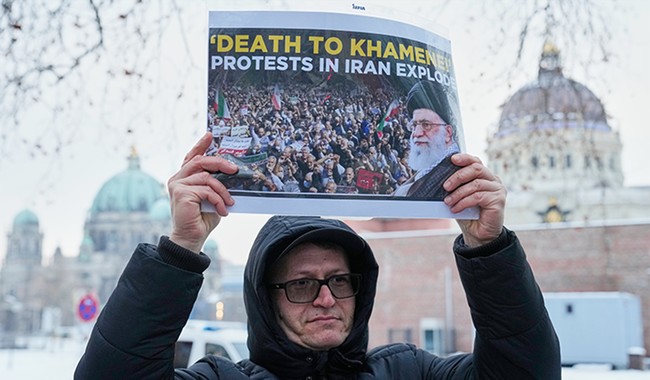
Tens of thousands of Iranians remain on the streets, driven by anger over economic collapse, political repression, and government violence. Security forces have answered with severe crackdowns, sending a chill through cities and rural provinces alike.
Iran’s President Masoud Pezeshkian is a surgeon turned politician who wears a modest quartz Citizen BF2011-01EC. Seen by some as reform minded, he has struggled to balance calls for moderation with unrest at home and an increasingly hardline system. pic.twitter.com/wAPlhRNa7E
— Watches of Espionage (@watchesofespion) January 19, 2026
Internet blackouts and information suppression have made it hard to confirm casualty figures, and independent verification remains limited in many areas. Estimates circulating outside Iran vary widely, with some counting several thousand dead and others reporting figures that climb much higher.
European and U.S. officials have discussed a range of responses, and some have suggested the White House could consider limited airstrikes if Iranian repression escalates or if Americans are directly threatened. Conservatives who back decisive measures argue that deterrence and protecting civilians must be part of a credible foreign policy framework.
Still, any kinetic step risks widening the conflict and drawing in regional actors that could turn a narrow operation into a broader confrontation. That reality is why Republican voices typically push for clear objectives and allied cooperation rather than open-ended military commitments.
Inside Iran, the protests began amid economic collapse but quickly took on political dimensions, with ordinary people calling out systemic failures and theocratic control. The movement has persisted despite harsh reprisals because it taps into long‑standing grievances over governance and opportunity.
Washington faces a difficult choice: stand resolutely with protesters and impose greater pressure on Tehran, or risk escalation through direct military moves that could provoke the exact national response Pezeshkian warned about. Republicans often favor strong measures that are paired with a clear, enforceable plan to limit unintended consequences.
For now, the situation remains fluid and dangerous, with lives at stake and regional stability hanging in the balance. Policymakers will need to balance moral clarity about Iran’s regime with sober calculations about how far to push in the name of protecting innocent people and U.S. interests.