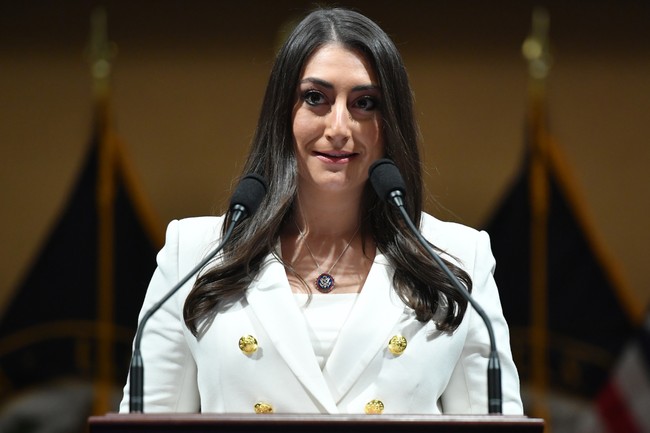
Congresswoman Sara Jacobs is pushing a federal minimum wage increase, arguing workers deserve a living wage, while critics warn the move will raise costs, reduce jobs, and accelerate automation across the economy.
Sara Jacobs, the Democratic congresswoman from California’s 51st district, is backing a federal minimum wage hike and framing it as a fairness issue for workers nationwide. Opponents contend that a one-size-fits-all federal approach ignores regional differences and risks damaging entry-level employment. The debate centers on whether mandated wage floors help workers or simply shift costs onto small businesses and consumers. That clash is shaping state-level policy choices and national political messaging.
“19 states are raising their minimum wage in 2026 – but the federal minimum wage is still stuck at $7.25, far below what’s needed to survive. All workers, no matter what state they live in, deserve a living wage,” Jacobs wrote on X. Here’s more from CNBC:
19 states are raising their minimum wage in 2026 – but the federal minimum wage is still stuck at $7.25, far below what’s needed to survive. All workers, no matter what state they live in, deserve a living wage.https://t.co/Cl3nUO6LSj
— Congresswoman Sara Jacobs (@RepSaraJacobs) January 5, 2026
Many U.S. workers are ringing in the new year with a raise as new minimum wage increases take effect in states and localities across the country on Thursday.
More than 8.3 million workers are expected to benefit from minimum wage hikes in 19 states, which will collectively add an estimated $5 billion in earnings nationwide, according to a December report by the Economic Policy Institute.
On top of changes to state minimum wages, many cities and municipalities with local wage standards increased their minimum wages Thursday as well. For example, Seattle’s minimum wage rose to $21.30 an hour, and the minimum wage in Minneapolis is now $16.37 an hour.
Hawaii is scheduled for the largest jump, moving from $14 to $16 an hour, while states such as Arizona, California, Michigan, New Jersey, and New York are also increasing their floors. Supporters say these changes reflect local living costs and will boost earnings for millions. Critics note the disparity between state-level adjustments and a federal minimum that has not changed significantly in years.
The federal minimum wage has remained $7.25 an hour since 2009, a fact often cited by advocates who want a nationwide update. But opponents argue that tying the entire country to a single federal number risks unintended consequences in lower-cost areas. Economists and business owners warn that raising mandated wages can push employers to cut staff, reduce hours, or speed up automation to offset higher payroll costs. Those trade-offs are central to the partisan split on the issue.
California’s experience is frequently cited in this debate: the state increased fast-food minimums to $20 on April 1, 2024, and the period afterward saw measurable shifts in employment. Between that date and March 2025, California reportedly lost about 16,000 fast-food jobs, and Pizza Hut announced roughly 1,200 delivery driver layoffs by December 2024 tied to higher operating costs. Consumers also felt the impact, with fast-food prices rising by nearly 15 percent on average in some markets.
Critics reject the notion of a universally applicable “living wage” by pointing out the arbitrary nature of chosen targets. If $15 is sold as the magic number, opponents ask why the figure stops there and not at $50 or $100 an hour. They argue Democrats push headline-friendly wage targets even when those policies increase costs for businesses and customers. According to this view, the political benefit of sounding pro-worker outweighs attention to the economic fallout.
Each time minimum wages climb, businesses often respond by trimming hours, laying off staff, or automating roles that used to offer entry-level work. Prices for goods and services tend to rise as companies pass labor costs to customers, which can erode the intended gains for low-wage workers. That dynamic informs conservative calls to prioritize job creation and flexible employment over higher mandated floors.
Critics say the pattern repeats: raise the wage, watch costs go up, then see employers adapt in ways that hurt the very people the policy aimed to help. They accuse Democrats of favoring virtue signaling over practical solutions that preserve entry-level opportunities. From this perspective, rhetoric about protecting workers doesn’t change the market forces that determine employment.
Meanwhile, many conservatives point out that the real-world starting wage for many Americans is zero—meaning the option to find work at no wage is a baseline that policy should not undermine. That observation is used to argue for policies that expand access to work, training, and opportunity rather than imposing one-size-fits-all federal mandates. The focus, advocates say, should be on sustainable job growth and preserving paths into the workforce.
Editor’s Note: Every single day, here at Townhall, we will stand up and FIGHT, FIGHT, FIGHT against the radical left and deliver the conservative reporting our readers deserve.