Valentino Garavani, the Italian couturier whose name became shorthand for red-carpet glamour and timeless eveningwear, has died in Rome at 93. He built a decades-long career dressing celebrities and royalty, sold his brand for a major sum, and retired after a celebrated final show.
Legendary Italian fashion designer Valentino Garavani has died at his home in Rome. He was 93 years old.
Italian fashion legend Valentino Garavani, whose elegant evening gowns were favored for decades by some of the world’s most glamorous women, has died at 93, according to his foundation. He “peacefully passed away today at his residence in Rome, surrounded by the love of his family,” a statement posted to Instagram said.
Italian fashion legend Valentino Garavani, whose elegant evening gowns were favored for decades by some of the world's most glamorous women, has died at 93, according to his foundation.https://t.co/6BkoUmtrfK pic.twitter.com/hTIzr8G05s
— CNN Breaking News (@cnnbrk) January 19, 2026
In a post on Instagram, his foundation said that Valentino will lie in state from January 21 to 22 from 11 am to 6 pm local time.
Valentino was born in 1932 in Voghera in the Italian province of Pavia to parents Teresa de Biaggi and Mauro Garavani. He was named after actor Rudolph Valentino and showed an early hunger for fashion that sent him to Paris for training. There he apprenticed with Jacques Fath and Balenciaga, absorbing technique and an eye for proportion before returning to Italy.
In 1960 he left Paris and opened a fashion house in Rome, and later that year he met Giancarlo Giammetti, who became his longtime partner in business and life. The pair built the Valentino label into a byword for refined glamour, blending Italian craft with an international clientele. Their partnership anchored the brand as it grew beyond couture into a global luxury name.
Valentino made his international debut in Florence in 1962, and a key turning point came in 1964 when Jacqueline Kennedy took notice. She privately ordered six haute couture dresses in black and white, which she wore during her year of mourning after President Kennedy’s assassination, and he later designed the gown she wore when she married Aristotle Onassis. That presidential-era cachet helped cement Valentino’s reputation among the fashion elite.
Through the 60s, 70s and 80s, Valentino continued designing clothing for celebrities including Elizabeth Taylor, Joan Collins, Audrey Hepburn, and Queen Paola of Belgium. His gowns became regulars on the red carpet and at state occasions, prized for their craftsmanship and dramatic yet elegant lines. He managed to keep haute couture relevance even as ready-to-wear and celebrity culture shifted the industry.
In the 1970s he spent a lot of time in New York City, where he crossed paths with influential cultural figures and forged friendships that broadened his reach. He became close to Andy Warhol and Vogue editor Diana Vreeland, ties that blended fashion with broader pop and editorial culture. Those relationships helped Valentino navigate change while remaining a touchstone for style.
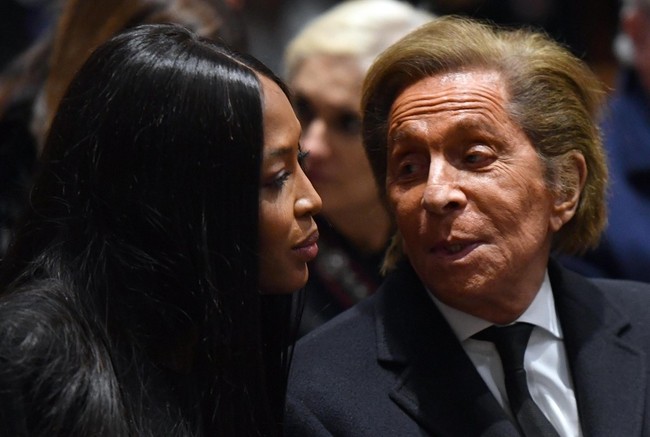
His influence stretched into the 1990s and beyond, dressing supermodels like Claudia Schiffer and Naomi Campbell and maintaining a steady presence on award stages. Jane Fonda, Julia Roberts, Jennifer Lopez and Cate Blanchett all wore Valentino gowns, and Roberts and Blanchett won Oscars in years when they stepped out in his work. In 2002 Anne Hathaway wore a Valentino gown and was escorted by the designer himself, a rare personal touch that fans remembered.
Valentino was as famous for his personal quirks as for his clothes, and one charming detail stuck with the press: his deep fondness for pugs. At one point he owned six with names that all began with M — Maggie, Margot, Maude, Milton, Molly and Monty — a small, humanizing detail amid the glamour. It made him feel approachable to fans who only knew him from glossy photographs.
In 1998 Valentino sold his company for $300 million but stayed creatively involved, guiding the house through transitions while new teams handled operations. He continued working until 2008, when he staged a star-studded farewell show in Paris and formally retired from the runway. The exit was fitting: a final act that celebrated a lifetime spent shaping eveningwear and red-carpet moments.
Valentino was survived by partner Bruce Hoeksema, the former vice president of his fashion house, with whom he had lived since 1982. Their long relationship was part of the designer’s private world, which he kept carefully shielded even as his public persona defined an era of style.