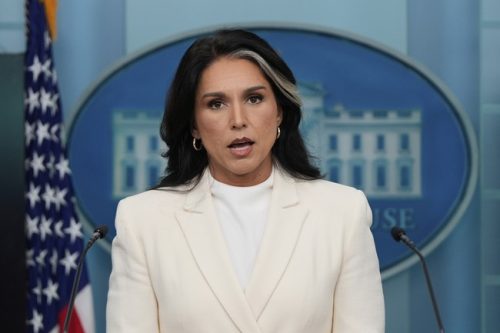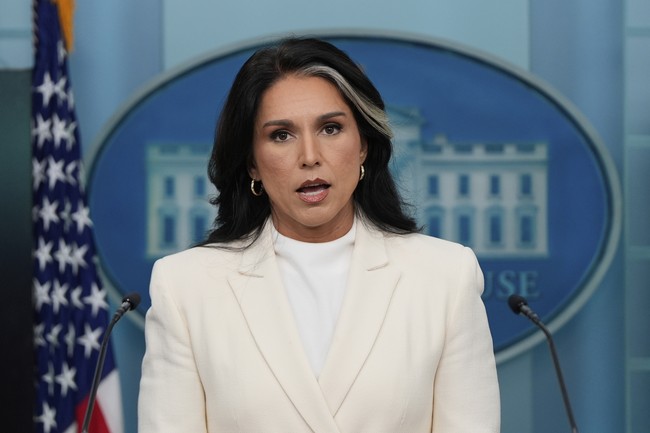
Tulsi Gabbard pushed back hard after a classified whistleblower claim surfaced in a Wall Street Journal piece, insisted the inspector general found the allegations not credible, explained her presence at the Fulton County FBI search as part of her DNI duties, and argued that election security is a national security issue.
The Wall Street Journal ran a story this week that revived an old, highly classified whistleblower complaint about Director of National Intelligence Tulsi Gabbard. The complaint reportedly required lengthy debate before parts of it could be shared with Congress, and the narrative immediately fueled a media smear campaign. That background matters because timing and selective leaks shape public perception more than the underlying facts.
A representative for the inspector general said the office had determined specific allegations against Gabbard weren’t credible. That finding undercuts the WSJ’s framing and raises real questions about why the story ran when it did. Conservative readers will see this as another example of media outlets amplifying weak claims to influence headlines.
The article ran right after Gabbard was publicly present during the FBI’s execution of a search warrant in Fulton County, Georgia, where boxes of 2020 election records were seized. Observers on both sides noticed the coincidence and questioned whether the timing was accidental. Gabbard promptly answered to Congress, explaining why she was there and what she did while on the scene.
Now, Gabbard has sent a formal letter to Congress clarifying her role and actions related to the Fulton County search. She made a point of describing the authority she holds as DNI and why she was in Atlanta on that day. The letter is detailed and insists her presence was limited, procedural, and consistent with her responsibilities.
I have received your letter regarding my presence at the Federal Bureau of Investigation’s (FBI) execution of a search warrant on the Office of the Clerk of the Court of Fulton County, Georgia on 28 January 2026. For a brief period of time, I accompanied FBI Deputy Director Bailey and Atlanta Acting Special Agent in Charge Pete Ellis in observing FBI personnel executing that search warrant, issued by the United States District Court for the Northern District of Georgia pursuant to a probable cause finding. My presence was requested by the President and executed by my broad statutory authority to coordinate, integrate, and analyze intelligence related to election security, including counterintelligence (CI), foreign and other malign influence and cybersecurity. The FBI’s Intelligence/Counterintelligence divisions are one of 18 elements that I oversee.
Contrary to the blatantly false and slanderous accusations being made against me by Members of Congress and their friends in the propaganda media, the Office of the Director of National Intelligence has and will continue to take action under my statutory authorities to secure our… pic.twitter.com/eX4Kdnp8oU
— DNI Tulsi Gabbard (@DNIGabbard) February 3, 2026
In twelve FBI Field Offices across the country, including the Atlanta Field Office, the senior FBI official (Assistant Director in Charge or Special Agent in Charge) is dual-hatted as my Domestic DNI-Representative. The Domestic DNI-Rep program was established in 2011 through a Memorandum of Understanding between the ODNI and FBI. Domestic DNI-Reps are distributed by region and focus on specific domestic issues of concern or interest, including threats to critical infrastructure. I have visited several of my Domestic DNI-Reps at FBI Field Offices across the country. While visiting the FBI Field Office in Atlanta, I thanked the FBI agents for their professionalism and great work, and facilitated a brief phone call for the President to thank the agents personally for their work. He did not ask any questions, nor did he issue any directives.
Gabbard also directly framed the issue as one of national security, responding to questions from Congress by stressing the stakes. “Interference in U.S. elections is a threat to our republic and a national security threat. The President and his Administration are committed to safeguarding the integrity of U.S. elections to ensure that neither foreign nor domestic powers undermine the American people’s right to determine who our elected leaders are,” she wrote. That line puts election integrity at the center of the debate and pushes back on those who want to treat the matter as merely political theater.
She pointed to statutory limits on congressional notification, citing language about the National Security Act of 1947: “congressional accountability requirements of that Act do not require that the President obtain approval from the congressional intelligence committees before initiating a significant intelligence activity.” Gabbard noted the Fulton County warrant was issued under seal and said she had not seen the warrant or the probable cause evidence submitted to the court. On that basis, she argued ODNI had no ability, authority, or responsibility to inform the congressional committees prior to execution.
Those who follow Gabbard’s recent clashes with the establishment will remember her public claims about surveillance and intimidation. Early last year she told Laura Ingraham she believed she had been included in the “Quiet Skies” program after criticizing then-Vice President Kamala Harris and the Biden administration. “I think they were trying to intimidate me, but also, they were trying to really create this chilling effect…send a message out to people that if you go and criticize then-Vice President Kamala Harris…you too, would face consequences,” she said.
Republicans concerned about government overreach and election integrity will see Gabbard’s letter as a necessary rebuttal to rushed headlines and anonymous allegations. Her explanation underscores two clear points: she claims the inspector general found the specific allegations lacking, and she insists her official actions were within the scope of her DNI authority. The back-and-forth that follows will matter in how the country treats classified complaints and political reporting.
What happens next depends on whether Congress demands documents and testimony or lets the story fade into the noise of the day. For now, Gabbard has put her version on record, argued the legal boundaries that constrained her, and tied the episode back to a broader concern about protecting elections from interference. That framing guarantees the issue will remain part of the political conversation going forward.