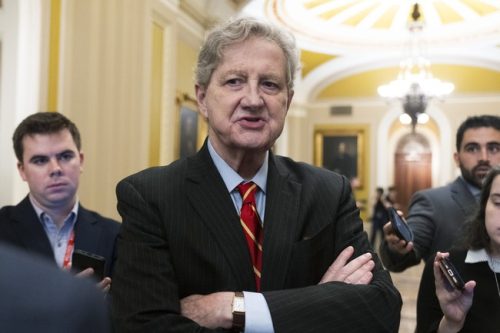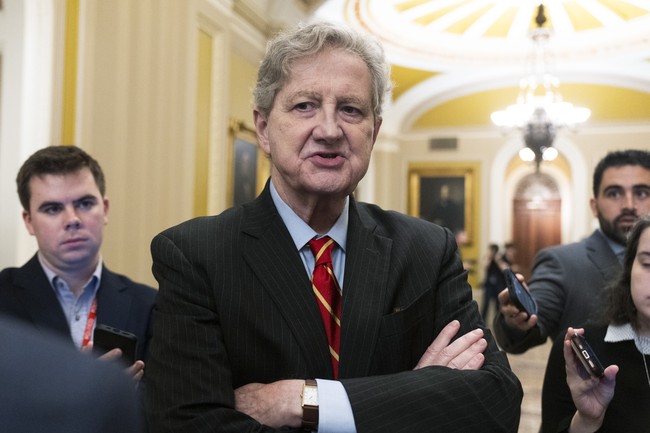
Sen. John Kennedy spoke with Katie Pavlich on NewsNation about a newly signed law aimed at stopping federal payments to deceased people, outlining how the measure works, what it changes for agencies, and why he thinks it was necessary.
Sen. John Kennedy, R-LA, sat down with Katie Pavlich to explain the practical changes behind the legislation and to call out the waste it addresses. He framed the problem bluntly and walked through how the new law plugs gaps in federal data sharing. The tone was direct and colored by a clear frustration with bureaucratic failures.
On Feb. 10, President Trump signed S. 269, the “Ending Improper Payments to Deceased People Act,” establishing a permanent pathway to share death records to prevent and recover improper payments. The statute gives agencies clearer authority to exchange death information so payments stop going to accounts tied to people who have died. Kennedy emphasized that making routine data sharing routine again was the whole point.
The reform specifically permits the Social Security Administration to provide the Death Master File—a comprehensive record of deceased individuals—to the Treasury Department’s Do Not Pay system. That connection is meant to flag potential improper disbursements before money leaves federal coffers. Kennedy argued that simple data matches will stop obvious waste without reinventing how agencies operate.
A 2015 Inspector General report found anomalies so extreme they read like errors: 6.5 million people listed as living were recorded as being older than 112 years. Those kinds of red flags show how stale or mismatched datasets can allow fraud and mistakes to persist. This law forces agencies to confront and correct those mismatches in a way that produces immediate results.
The statute also authorizes the Treasury to cross-check SSA death data against records held by other federal entities and to share relevant matches with any paying or administering agency authorized to use the Do Not Pay system. That crawl-match-share approach is exactly what the law enables so agencies can find and stop improper payments faster. Kennedy made clear this is about practical fixes, not headline-grabbing bureaucracy.
The Treasury Department projects the change will save roughly $330 million from 2024 to 2026, savings that Kennedy and supporters frame as taxpayer relief. That estimate gives the effort a tangible payoff beyond the moral argument against sending checks to the dead. Kennedy pointed to those numbers as proof the law will pay for itself through reduced fraud and recovered funds.
“Using dead Americans to rip off taxpayers is as low as it gets. Many Americans have seen these scams play out across the country and are tired of watching these fraudsters game the system—so am I. That’s why I wrote this common-sense bill to end this outrageous abuse permanently, and I’m grateful President Trump signed it into law so we can ensure taxpayer dollars go to living Americans who actually need our help,” said Kennedy.
He didn’t spare the political class from criticism when describing life inside the Capitol. He said bluntly: “This place is…uhhh…some days it’s like the game room of a mental hospital up here.” The remark landed as part of his broader argument that Congress too often tolerates sloppy systems and absurd outcomes.
Senator John Kennedy just delivered over two straight minutes of pitch-perfect “Kennedyisms” on NewsNation.
As @KatiePavlich sat across from Kennedy, she couldn’t help but crack up at times.
KENNEDY: “The idea that we send billions of dollars to dead people and they get cashed.… pic.twitter.com/S47Ka6LEKB
— Overton (@overton_news) February 13, 2026
Kennedy also offered a characteristically cutting line about Washington’s talent mix: “There are a lot of of intelligent people in Washington, but I call them high IQ stupid people.”“They’ve got lot of education, but no sense.” Those exact words underline his impatience with smart people who lack practical judgment.
Beyond the rhetoric, the law forces agencies to build matches and to act on them, which should improve internal controls and help reclaim wrongly issued funds. The Do Not Pay system will get more reliable inputs, and paying agencies will have better information before approvals go out. The mechanics are straightforward: better data sharing, quicker matches, fewer improper payments.
Implementation now becomes the test: agencies will have to coordinate, update processes, and use the new authorities to shut down obvious abuses. If the systems actually connect and operate as intended, the country should see immediate reductions in waste. Kennedy made the case that this kind of fix is the sort of commonsense government reform Americans expect.