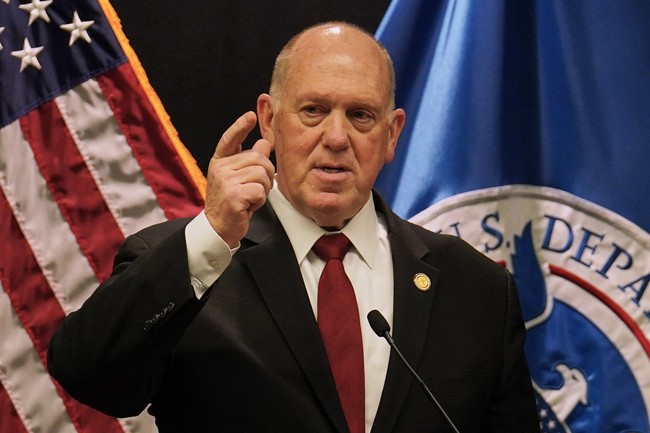
Tom Homan’s push to send more immigration agents into sanctuary jurisdictions is gaining steam after recent actions in Minnesota, with federal officials arguing stepped-up enforcement is needed to protect public safety.
White House Border Czar Tom Hohman said he wants to “flood the zone” of sanctuary cities with immigration enforcement after making progress in Minnesota. He made the remark in an interview with Face the Nation as part of a broader effort to push back against jurisdictions that limit cooperation with federal authorities. The language is blunt and intentional, signaling a more assertive posture from the administration on immigration enforcement.
“The number of agents depends on the situation on the ground,” he said in an interview with Face the Nation. “How many known criminal targets are out there, because we know we have a problem with sanctuary cities, because we know they’re releasing public safety threats to the public.” That focus on criminal targets frames enforcement as a public-safety priority rather than a purely immigration issue. For many Republicans, the point is simple: if local rules protect criminal aliens, federal agents must be able to act.
Hohman made a practical argument about detainers and resource use, saying it’s safer when local agencies honor federal holds so ICE doesn’t have to assemble large teams to track down suspects. The current workaround costs time and lives, he argued, and it wastes manpower when agents must “hunt” offenders instead of processing them locally. The administration appears ready to shift more officers into places where cooperation is lacking to close that gap.
The Department of Justice has already compiled a list of sanctuary jurisdictions, and federal officials point to big cities and numerous counties where local policies limit federal action. Those policies, critics say, obstruct federal law enforcement from arresting illegal aliens and create openings for criminals to remain at large. Examples cited repeatedly in the debate include large urban centers and more than 1,000 other municipalities that federal authorities monitor for noncooperation.
Homan: I'm hoping other sanctuary cities look at what happened in Minnesota, and how we got to the place we're at, which I think is a good place. I hope more people pay attention to that, and we work with these states to let our officers in the jails.
— Breaking911 (@Breaking911) February 15, 2026
Hohman said he’s already removed over 1,000 immigration officers from Minnesota, moving them to where they can be more effective, while keeping a presence to handle sensitive investigations. He emphasized that agents working on fraud and incidents such as Leftists storming a church will remain in place to protect officers and maintain coordination. “There will be a small security force called RQs that will respond when our soldiers are out and get surrounded by agitators and things get out of control. They will remain for a short period of time just to make sure that the coordination, the agreements we have with state and local law enforcement stays in place and they respond to a public safety threat when needed.”
When asked on CNN whether a partial federal freeze would hinder immigration enforcement, Hohman was direct and dismissive of the concern, replying “Not one bit.” That reply underscores a message the administration wants to send: political constraints will not stop operations aimed at deterring illegal entries and removing criminals. For supporters of stricter enforcement, those words signal resolve rather than retreat.
Even some voices typically associated with the other side have acknowledged problems with current policies, underscoring the political breathing room for tougher action. “There’s a legitimate reason to have a debate about things like migration,” Clinton said at the conference. “It went too far. It’s been disruptive and destabilizing, and it needs to be fixed in a humane way, secure borders that don’t torture and kill people.” That kind of admission from high-profile figures shifts the conversation and gives enforcement advocates an opening.
From a Republican perspective the choice is clear: federal authorities must be able to enforce the law where local leaders refuse to cooperate. Flooding the zone is not about intimidation; it’s about restoring basic public-safety norms and ensuring agencies can do their jobs. If detainers and routine transfers would prevent gangs and violent offenders from roaming free, the federal government has a duty to use its resources accordingly.
Practical politics will matter: deploying agents takes planning, logistics, and legal cover, and that’s exactly the work being signaled publicly now. Conservatives pushing for stronger enforcement can point to recent actions and statements as proof the administration understands the stakes. The debate over sanctuary policies will continue to be a frontline issue in cities and states where local politics clash with federal law enforcement priorities.