Democrats are keeping DHS funding frozen while pushing a hard line to bar ICE from polling places, even as Operation Epic Fury has coincided with a wave of Islamic-inspired attacks and threats.
Operation Epic Fury has coincided with a string of Islamic-inspired terror incidents that have unsettled communities across the country. The Department of Homeland Security has been in a partial shutdown since Feb. 14 because House Democrats have refused to approve funding tied to immigration enforcement priorities. That stand has real consequences for personnel, intelligence sharing, and the day-to-day ability of agencies to respond when threats emerge.
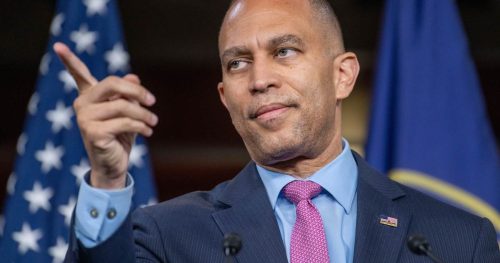
House Minority Leader Hakeem Jeffries and other Democrats have made clear one of their nonnegotiable demands is to define certain locations as off-limits to immigration enforcement. Jeffries has framed the fight in terms of protecting so-called sensitive places and insisted the party will not yield on that point. The standoff has hardened both sides and left DHS operating with limited resources while threats keep appearing across the country.
“We’ve defined that as schools, houses of worship, hospitals, and polling sites,” Jeffries said. “We want an explicit prohibition that ICE can go nowhere near any polling sites in the United States of America. It’s one of our demands, we’re not gonna bend on it.” Those words say a lot about the priorities guiding this funding fight and the level of political calculation at play.
🚨 HOLY CRAP! Hakeem Jeffries says Democrats are REFUSING to reopen DHS because Republicans will not commit to keeping ICE agents away from polling places
Jeffries just admitted Democrats ANTICIPATE illegals voting.
They’re EXPOSING themselves pic.twitter.com/yPnmFc2GC2
— Nick Sortor (@nicksortor) March 9, 2026
If Democrats truly believed noncitizens were not voting in American elections, as they often claim, why insist on an absolute barrier to ICE operations near polling places? That argument rings hollow when you consider the obvious motive: secure voter rolls and tougher enforcement could reduce the margin for error that favors one party. The choice to keep DHS constrained while pressing for a ban around polling places suggests politics is a primary driver here.
Republicans have pointed to legislative efforts like the SAVE Act and to recent enforcement actions to argue that election integrity matters and that some illegal voting has been documented. Federal charges have already been handed down this year against aliens who illegally voted in federal elections, but Democrats will still tell you that this is a right-wing conspiracy theory. Critics say dismissing those prosecutions out of hand ignores the problem and leaves the system more vulnerable.
At the same time Democrats hold funding for DHS, the country has seen a series of violent incidents tied to Islamist ideology. Reports have described terror attacks against Christians in New York City, an Islamic-inspired shooting that targeted bar-goers in Texas college towns, and bombing threats at airports and on planes. To many voters it looks like a practical contradiction: curtail resources for the agency that responds to these threats while insisting ICE stay away from polling stations.
Scaling back enforcement capacity in the name of politics risks real-world consequences for security and public confidence. Local law enforcement often relies on federal partners for investigations, detention, and information sharing; when DHS is hamstrung those cooperative operations can slow or stall. The debate is not just about a few policy lines on paper, it affects response times, staffing, and the ability to follow leads that could stop attackers before they strike.
Whatever the long-term legal arguments over “sensitive places” might look like, the immediate result is a partisan gridlock that keeps DHS in limbo. Republicans argue that public safety should not be used as a bargaining chip, and that protecting polling integrity is compatible with sensible enforcement rather than mutually exclusive. Voters watching this fight should weigh whether the choices being made match the real risks on the ground or simply reflect who benefits at the ballot box.