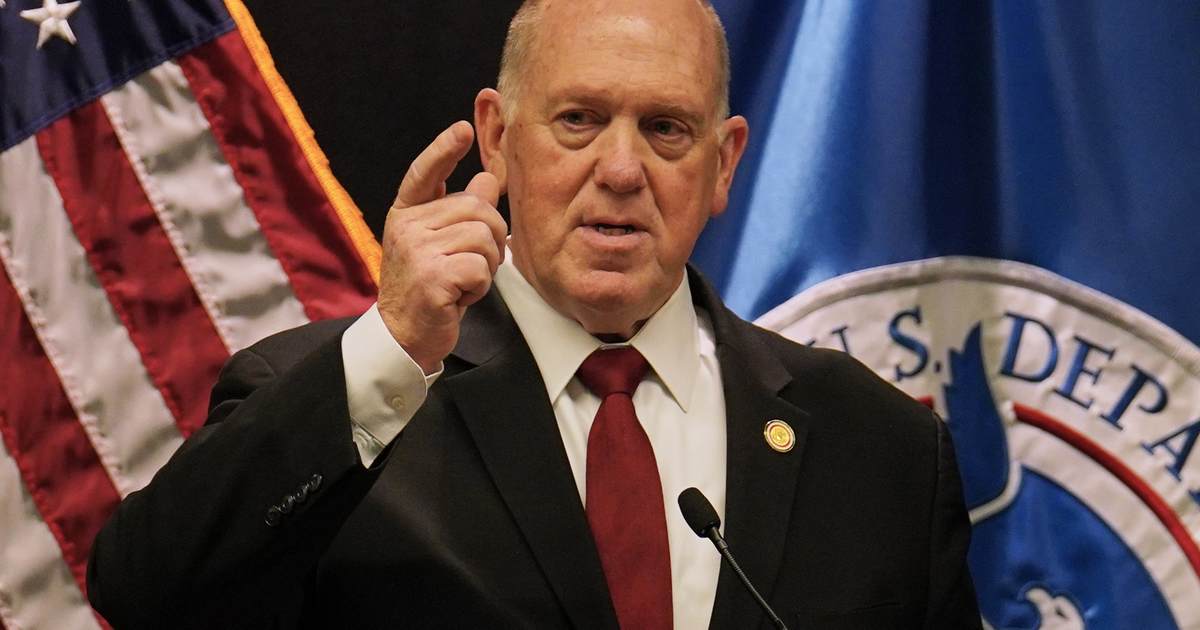
Tom Homan squared off with Sunday show hosts, defended ICE and DHS staffers stepping into airport roles, and pushed back on media attempts to blame the White House for a partial DHS shutdown.
Tom Homan didn’t mince words when hosts tried to pin the Department of Homeland Security shutdown on the White House. He made it clear he views the shutdown as the result of Democrats refusing to fund DHS, not a failure by the administration. Homan framed ICE officers’ airport work as practical, immediate help for travelers and for airport security operations.
Homan described ICE agents helping travelers in very ordinary but useful ways, from giving out water to assisting with medical issues and covering short staff gaps. Those actions are practical measures to keep lines moving and people safe while Congress argues. The scene he painted is of agents doing commonsense tasks so trained TSA officers can return to full screening duties.
On CBS, Margaret Brennan tried to turn this into a White House problem, but Homan pushed back hard. He stressed that he has been meeting with lawmakers and saw firsthand who was responsible for the shutdown. He insisted the issue is Democrats shutting down DHS and holding its staff hostage over immigration policy fights.
CBS viewers are not going to like this one.
A smug Margaret Brennan tried to pin the DHS shutdown on President Trump — Tom Homan instantly SHATTERED that narrative right to her face.
BRENNAN: “Why wasn’t the White House able to get both heads of the party the president… pic.twitter.com/2Y1DxBqogK
— Overton (@overton_news) March 29, 2026
BRENNAN: “Why wasn’t the White House able to get both heads of the party the president controls on the same page?!”
HOMAN: “Look, I’ve been up on the Hill. I’ve been in these meetings. I’ve met with lawmakers on both sides. This isn’t a White House issue. This is the Democrats shutting down the Department of Homeland Security. I’ve been in these meetings—”
BRENNAN: “So did you support the Republican bill in the Senate that passed?”
HOMAN: “I support Congress opening up the ENTIRE government, the entire DHS, and not holding people in DHS hostage because they don’t like immigration enforcement.”
BRENNAN: “So, no. You weren’t on board with the Senate bill?”
HOMAN: “I’m with the president.”
BRENNAN: “Okay…”
When Jake Tapper asked what ICE agents were actually doing at airports, Homan answered with concrete examples and results. He pointed to places where wait times fell dramatically after ICE officers stepped in. His message was simple: these are practical fixes that reduce congestion and restore order while lawmakers bicker.
TAPPER: “What have ICE agents at airports been doing? What have they actually accomplished?”
HOMAN: “Well, look, the wait lines have decreased.”
“I was in Houston — wait lines decreased by about half.”
“We got additional agents going to Baltimore yesterday to bring those lines down.”
“And I can understand the TSA union’s position. You know, they want to be paid and they’re frustrated.”
“However, the facts are every place we send ICE officers, the lines have decreased — and they need to decrease more.”
“Look, they’re checking identification before you go to screening. We’re not going to have an ICE officer looking at x-ray images, deciding what bags need to be secondary.”
“That’s a high level of training. But we can check IDs before they get to that machine.”
“We can cover exits to make sure that people don’t enter through the exits.”
“That takes that TSA agent off that security line and puts him on an x-ray machine.”
“We’re plugging other security holes. We want to keep the airport safe.”
“So we’re doing the job TSA is asking us to do so their officers can get back to main screening.”
Homan emphasized that ICE personnel are not replacing TSA screeners at critical technical tasks like x-ray analysis. Instead, they handle identity checks and perimeter coverage—tasks that free TSA to focus on trained screening duties. From Homan’s perspective, this is commonsense resource allocation to protect travelers and maintain security standards.
He also rebutted the notion that ICE presence is a political stunt or an overreach, arguing the on-the-ground results speak for themselves. Lines shortened in multiple cities, and additional agents were sent where needed to relieve pressure. That practical outcome undercut the narrative that the deployment was unnecessary or purely symbolic.
Asked when ICE agents would leave airports, Homan made no promises of an immediate withdrawal. He framed any timeline as dependent on Congress reopening DHS and funding full operations. For Homan, the choice is clear: reopen DHS so regular operations resume, or expect ICE to remain where they are needed to keep airports functioning.
There was also skepticism from some quarters about why ICE officers mask up while working in airports. Homan acknowledged the question but kept the focus on operational safety and mission needs. Masks, he suggested, are part of standard precautions in crowded, high-contact environments where agents interact with many members of the public.
The larger political point Homan made on these shows cut to the chase: the operational chaos at airports is a political decision by those who control the Democratic agenda in Congress. He argued that punishing frontline DHS employees and passengers for a policy disagreement is neither fair nor sensible. His tone across interviews was blunt and unapologetic, reflecting a priority on practical fixes and accountability for those who caused the stoppage.
Whatever one’s view of immigration policy, the short-term problem at hand was simple and solvable, Homan said: reopen the department and let professionals get back to their jobs. In Homan’s telling, the public is paying the price while political theater plays out in Washington, and that reality is what he went on the record to confront.