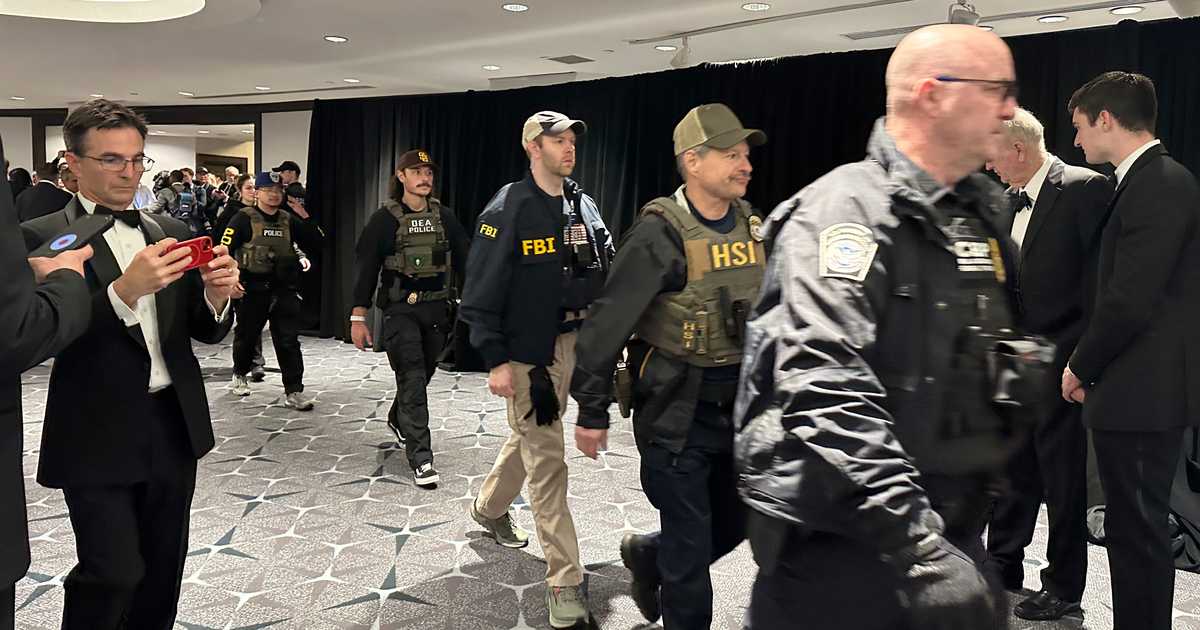
A Daily Beast editor who stayed next door at the Washington Hilton describes being held in the hallway while law enforcement waited for a judge to search the room beside his, and his account raises tough questions about hotel and event security ahead of a planned attack on attendees.
The editor, Hugh Dougherty, says he was kept out of his room for an extended period as officers secured the corridor and informed him they were waiting on a judge because the adjacent room was an FBI crime scene. He realized the guest next door was the man who tried to turn the White House Correspondents’ Association dinner into a mass shooting. The scene left him as a potential witness and highlighted gaps that allowed the suspect to pass through hotel checkpoints with weapons disassembled.
He reported being asked for basic information and handed his business card, but was surprised by what investigators requested only hours later: cleaning logs and minimal room-level checks. Those omissions exposed a chain of small failures adding up to a big risk when high-profile officials were in the same building. The unfiltered account shows how routine procedures can fail when they matter most and why strict enforcement is not optional.
Security at the hotel meant magnetometers at one point in the route, but Dougherty says those measures were not enforced consistently and that tickets could be photocopied to get past checkpoints. He notes that neither luggage checks nor ID verifications were performed when guests arrived, creating a pathway for someone to bring parts of a long gun into the building. The idea that a disassembled long gun could be checked in and assembled later raises obvious policy and enforcement questions for any venue hosting top government officials.
A Daily Beast editor had the hotel room next door to the alleged WHCD attacker.
“How on earth could someone with a disassembled long gun check into a room at a hotel where the president was going to speak? I can answer that: Nobody even looked at my luggage on Friday afternoon.…
— Bill Melugin (@BillMelugin_) April 26, 2026
When I went back upstairs to get into 10235, the 20 minutes I’d been asked to wait were long gone.
The Hilton worker was much nearer the elevator this time. There were many more uniformed men behind him. “I’m sorry, Sir, I can’t let you go further,” he said. “I know you were here earlier.”
“When do you think I can get back in?” I asked. “I don’t know, Sir,” a man in a Metropolitan Police uniform next to the Hilton worker said. “We’re waiting on a judge.”
In that moment, I had a flash of realization: The police needed a judge because they needed to search the room. Already, security sources had said that they were working on the theory that the gunman had been a hotel guest.
I knew then that I had been next door to the man who wanted to turn the White House Correspondents’ Association dinner into a mass shooting. Maybe I had slept the night with an assassin in the next room.
“He was next door to me?” I asked the Hilton worker. “I can’t tell you anything, Sir,” he said. An officer in a Metropolitan Police Department “detective” windbreaker turned to me and said, “I’m sorry, Sir,”
Another officer said, “Sir, just to let you know, this will be an FBI crime scene when they get here. We’re waiting for a judge. When exactly did you check in?”
That was apparent confirmation that, yes, the gunman had been the guest next door—and that I might actually be a witness to this whole case.
[…]
I asked the detective another question. “Do you want to talk to me? I mean, I was next door.”
I gave him my business card, then told him the only things I could think of that might be relevant. I knew when I had checked in. I knew when the cleaner had been in my room in the morning. I had seen no guests in the rooms beside mine at the end of the corridor.
Then I was left incredulous by what he did. The detective said to the Hilton worker, “I need the cleaning logs for the room.”
They hadn’t thought of this? It was almost three hours since I had been lying on a floor, the echo of gunshots in my head.
“We’ll be in touch, sir.”
[…]
It does not take a security expert to unravel the layers of failure that happened at a Washington, D.C. hotel on Saturday night.
How on earth could someone with a disassembled long gun check into a room at a hotel where the president was going to speak? I can answer that: Nobody even looked at my luggage on Friday afternoon.
Worse, my colleague arrived on Saturday at 5 p.m. Nobody looked at his luggage either: No magnometers, no hand checks, no I.D. checks. Nothing.
How on earth could that person get downstairs and assemble a long gun? I can answer that too. I moved up and down from Floor 10 all day. Nobody ever stopped me and asked me anything. I have never shown my I.D., except to the clerk who checked me in; I have never been searched or frisked when I checked in, or moved in and out of the hotel. To get down from my room to the dinner, I simply flashed my ticket. It could have been a photocopy.
The only time I went past a checkpoint was at the same magnetometers that Cole Allen, 31, sprinted past with his gun.
Another colleague was outside; I texted them a copy of their ticket. That allowed them to get into the hotel as far as those same magnetometers, entirely unchecked.
How on earth could that be considered safe?
The suspect, Cole Allen, 31, admitted he planned to target Trump officials at the event and his manifesto was directed at the president. Law enforcement recovered a shotgun, a handgun, and two knives, and officials say he traveled by train from Torrance, California, to carry out the attack. Those facts make the security failures more than hypothetical; they show a real vulnerability exploited by a determined actor.
President Trump has said the dinner will be held again, and administration officials are already focusing on Secret Service and hotel protocols. That attention is warranted, and the response should include enforced luggage checks, consistent magnetometer screening, and thorough ID verification for anyone moving between guest rooms and event spaces. Republican officials will press for hardened procedures that protect the chain of command and reduce opportunities for similar plots.
This episode is a reminder that security is only as strong as the weakest checkpoint and the least enforced rule. When the people at the table of national leadership are exposed by avoidable oversights, the risk is not theoretical. Policymakers and venue operators need to treat these failures as lessons that demand immediate fixes.