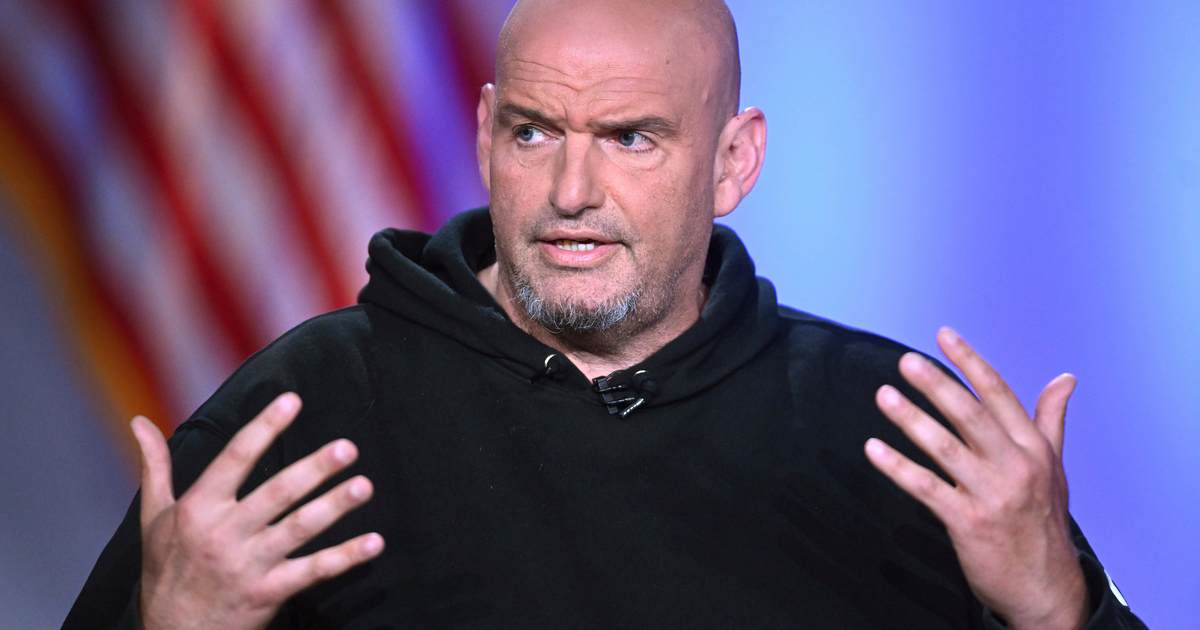
Senator John Fetterman publicly rebuked the Democratic Socialists of America and warned that their influence is not a harmless extension of the party, but a calculated effort to reshape the Democratic Party from the inside.
The Democratic Socialists of America (DSA) have been explicit about their long-term goals, and that clarity has unnerved members across the political spectrum. Many Democrats claim the DSA fits under a “big tent,” yet voices inside the party say otherwise. That internal tension is what Fetterman put on display, rejecting the notion that the DSA are simply another faction to be absorbed.
Fetterman drew a hard line earlier this month when he described his party as an “orgy of socialism,” and he has not backed away from that language. He argues the DSA’s strategy looks less like coalition-building and more like takeover. Those are not mere stylistic complaints; they reflect a fight over control and direction within the party.
“This isn’t a big tent—it’s anarchy,” he wrote on X.
That blunt assessment grabbed attention because it came from a sitting senator who still identifies as a Democrat. His critique has resonance for voters who worry the party’s message gets drowned out by radical policies. Conservatives see this as proof that the left is not moderating but doubling down on extreme positions.
https://x.com/SenFettermanPA/status/2081440670833660012
Fetterman’s comments also underline a broader argument: when a faction is explicit about using a major party as a vehicle, it stops being a harmless ally and starts being a hostile takeover force. Plenty of Democrats privately fret that the DSA intends to reshape platform priorities, staffing, and candidate selection. From a Republican perspective, that confirms the risk of letting one side of the spectrum dominate a nominally broad coalition.
The DSA’s stated plans are taken seriously because they are stated openly, not because they are secret. Saying you will use another party as a vehicle removes ambiguity and raises the stakes for anyone who values institutional stability. It’s a reminder that political coalitions are fragile when one faction treats the tent as something to be occupied rather than shared.
People who watch these fights closely warn that when ideology overtakes pragmatic governance, voter alienation follows. Democrats who want to win general elections need to recover a message that appeals to working families and swing voters. Republicans believe the path forward is to highlight the contrast between free-market, law-and-order policies and the disruptions proposed by the far left.
Fetterman has positioned himself as one of the few high-profile Democrats willing to call out the DSA publicly, and that matters. His stance provides political cover for others inside the party to air similar concerns without being instantly branded as disloyal. From a conservative point of view, internal dissent is a healthy sign that not everyone on the left embraces radical policy prescriptions.
Observers from across the map note that rhetoric alone cannot replace policy clarity or effective governance. Plenty of voters respond to results, not slogans, and the DSA’s more revolutionary language rings alarm bells for those worried about economic and social stability. Republicans argue the DSA’s agenda would produce vast government expansion without corresponding accountability.
Some critics point to the moral consequences of implementing policies that relax law enforcement or dilute personal responsibility. “It’s deranged. Poverty doesn’t make people rape and murder. Being violent does.” That line, stark as it is, captures a view held by many who reject deterministic explanations for criminal behavior and push for stronger accountability.
Not every progressive or Democrat supports the DSA’s aims; centrists and moderates remain a significant bloc. “They’re few and far between,” some allies say of the more extreme elements, but even a small, organized faction can exert outsized influence if it controls key committees and nomination processes. That’s why internal party debates matter to the broader electorate.
Legal safeguards and existing statutes—what some call anti-communist laws still on the books—remain part of the background to this debate. Whether those laws are enforced or remain dormant is a separate policy discussion, but their presence shows the country has historical mechanisms to guard against revolutionary shifts. Republicans tend to favor using legal and institutional checks to preserve democratic norms.
At bottom, Fetterman’s warnings expose a crossroads: will the Democratic Party reaffirm broad-based appeals and practical governance, or will it drift toward a factionalized identity that repels the center? From a Republican vantage, that drift is an opportunity to make the case for fiscal restraint, public safety, and individual liberty as better routes to prosperity and social order.