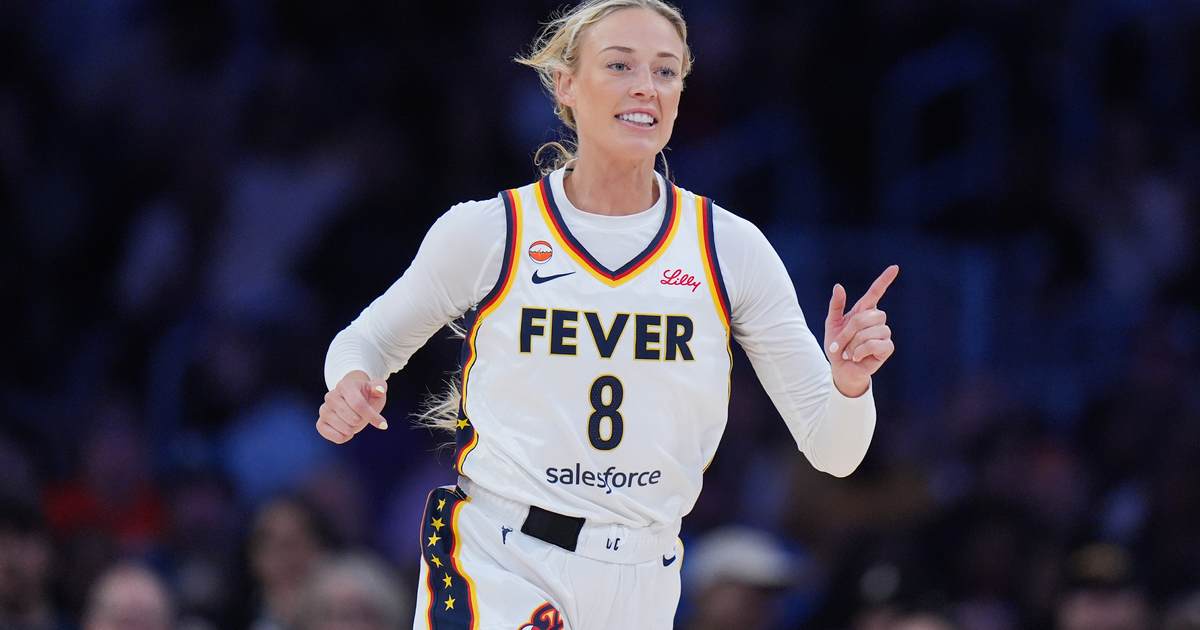
Sophie Cunningham, an Indiana Fever guard, pushed back on a reporter after restating her view that transgender athletes should not compete in women’s sports, sparking a larger debate about fairness, public reaction, and the mood inside the WNBA following a viral on-court moment.
Sophie Cunningham has been the subject of more than one viral moment since a June 24 matchup with the Phoenix Mercury produced a now-famous pointing image and a heated exchange with DeWanna Bonner. The meme hit social feeds fast, and fans have turned that grin-and-point into part of her persona. But beyond the laughs, Cunningham has been asked direct questions about a serious issue: whether transgender athletes should compete in women’s sports.
At a pregame press conference she answered plainly and refused to be baited by a reporter trying to escalate the story. Cunningham framed her position as simple and protective of women’s competitive space, while also saying she tries not to be political in her public role. That mix of firmness and civility is what made the exchange notable; she didn’t retreat or apologize for standing on what she described as common-sense principles.
She also made clear she thinks the conversation matters for children. The statistic that roughly 70 percent of Americans share concern about preserving women’s sports has circulated in public debate and helps explain why this stance resonates beyond the sidelines. For many voters and fans, this is not an abstract policy fight but a straightforward judgment about fairness and safety, and Cunningham spoke to that crowd in a direct way.
The reaction from progressive circles was swift and loud, with some responders treating her comments as beyond the pale. That kind of public outrage has become familiar: a single quote can be inflated into character assassination in certain corners of media and social platforms. From a Republican-leaning perspective, the overreaction underscores a cultural gap where common-sense positions on sex-based athletic competition are labeled intolerant instead of debated on merits.
https://x.com/RedWavePress/status/2080100954314006537?ref_src=twsrc%5Etfw
Cunningham made several declarative lines that the press could record and repeat without spin. “I think it’s kind of common sense, and I think I’ll always believe in that,” she said when asked to explain her view. She then turned the focus to protecting young people: “I think it’s really important to protect children and that’s little girls…I do have beliefs. I do have morals, and I’ll always stand on those.” Those words landed plainly and without flourish, which is part of why some critics found them unacceptable.
She did not back down when a reporter tried to escalate the exchange, and when asked about the fallout she answered with a memorable line that cut through the noise: “I said what I said.” That short, unapologetic response is exactly the kind of clarity a lot of voters ask for from public figures. It also points to a broader truth in modern discourse — people want direct answers instead of hedged statements that try to please everyone.
Inside the WNBA, this is more than a headline. Teams and players have to navigate locker room dynamics, fan reactions, and league messaging at the same time they try to win games. Cunningham’s role as a gritty guard who mixes toughness with personality makes her comments weigh heavier; fans see her as someone who speaks plainly and plays hard, not as a politician reading from talking points.
To critics who want athletes to stay silent on social issues, this episode shows why that expectation is unrealistic and unfair. Athletes are public figures with platforms and opinions, and when a player offers a viewpoint shared by a sizable portion of the public, it becomes part of the conversation rather than an isolated outburst. From a conservative viewpoint, defending women’s sports is a commonsense position, and those who shout the loudest at dissent often reveal how fragile their arguments are when tested in public.
Public debate will continue, and it will get messy. But Cunningham’s exchange — the viral meme, the press conference, and the terse follow-up — is a snapshot of how cultural disputes play out in real time: a blend of performative outrage, genuine concern, and a few people who simply speak their mind. That mix guarantees the issue will stay in the headlines as teams, leagues, and fans sort through what fairness in sport actually looks like.