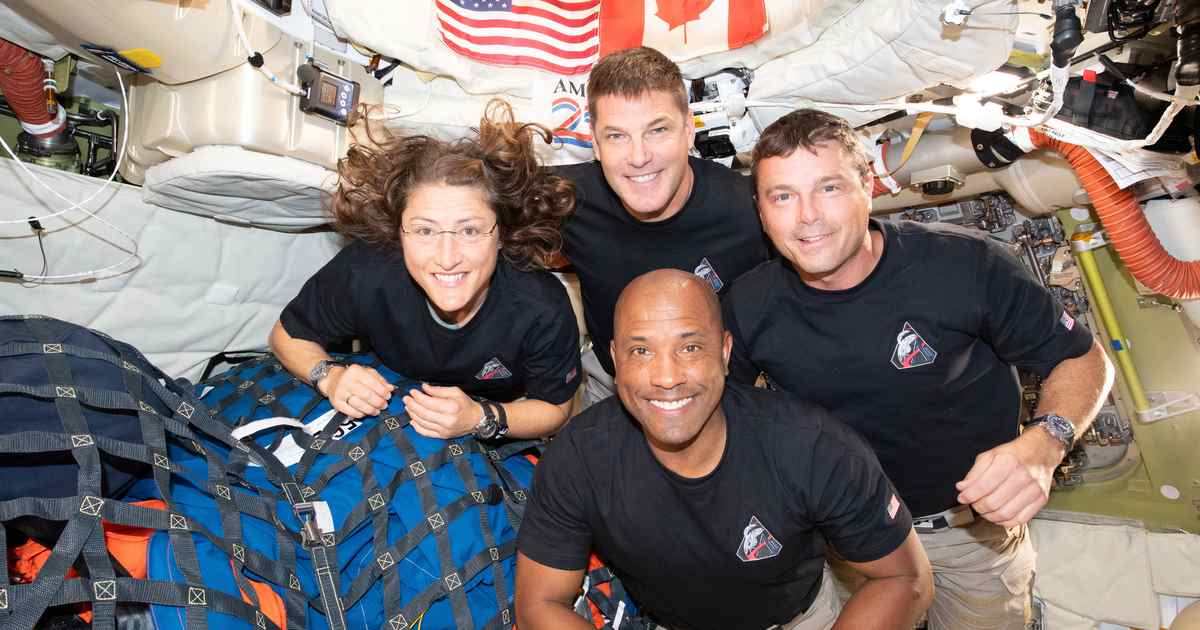
Artemis II astronauts received the Congressional Space Medal of Honor while President Donald Trump unveiled plans for a U.S. Space Academy, signing an Executive Order to set a new commission in motion. Commander Reid Wiseman, pilot Victor Glover, and mission specialists Christina Koch and Jeremy Hansen were the honorees. The event at NASA’s Johnson Space Center paired recognition of individual courage with a broader push to reassert American leadership in space.
The four members of Artemis II were formally presented with the Congressional Space Medal of Honor, a recognition reserved for a tiny group of explorers whose work reshaped the nation’s capabilities beyond Earth. Commander Reid Wiseman, pilot Victor Glover, mission specialist Christina Koch and mission specialist Jeremy Hansen stood together as the award was announced. Veterans inside the space community noted that this medal underscores both mission achievement and symbolic leadership during a renewed national focus on space.
President Trump framed the ceremony as a milestone in restoring momentum for the U.S. space program, and he did not hide his view of that revival. “This is a very rare thing,” Trump said at NASA’s Johnson Space Center. “Only 30 extraordinary men and women – long period of time, too – in history of our country have received this extremely rare and distinguished honor,” he added.
Trump went on to highlight the addition of the Artemis II crew to that list and tied the awards to a larger policy push designed to strengthen the country’s presence in space. “And today, we add four new names to this elite roster of fearless explorers,” he later added. The language used at the podium emphasized pride, continuity and a national mission to lead technologically and strategically beyond low Earth orbit.
Alongside the medal presentations, the president signed an Executive Order launching steps toward a new U.S. Space Academy, and he said a presidential commission will work out the details and structure. The order aims to create a formal school and training pipeline for military, civil and commercial space professionals, marking a more institutional approach to defending and advancing U.S. interests off planet.
Trump painted the policy moves as ending what he described as a “Dark Age” for American space efforts and beginning a “Golden Age,” language meant to signal both a break with past approaches and a bold new trajectory. “As the world can see today under the Trump administration, we have brought America’s space program – it came out of its Dark Age and it’s into its Golden Age. This is the Golden Age of America and this is a big part of it,” he said. Those lines were intended to connect the awards to a larger narrative of revitalization and national ambition.
The president addressed the gathering directly with a vow to keep pushing boundaries and to treat space as a strategic priority. “So to every astronaut here today, I want to make this promise to you: Our nation will conquer and we will conquer indeed,” the president continued. “We explore it, we will tame it, and we will win it. We will always win,” Trump added.
During the visit the president also checked in with crew aboard the International Space Station and accepted a commemorative NASA flight jacket in recognition of the ceremony and the ongoing partnership between civilian and defense programs. The call to the orbiting crew and the jacket presentation underlined the ceremonial and practical ties between leadership in Washington and operations in space.
https://x.com/RapidResponse47/status/2093393962966954203