Hunter Biden says his father’s collapse in the June 2024 debate was the result of an undiagnosed, advanced cancer, and the claim has reopened questions about judgment, accountability, and the Democrats’ last-minute scramble to rescue their ticket.
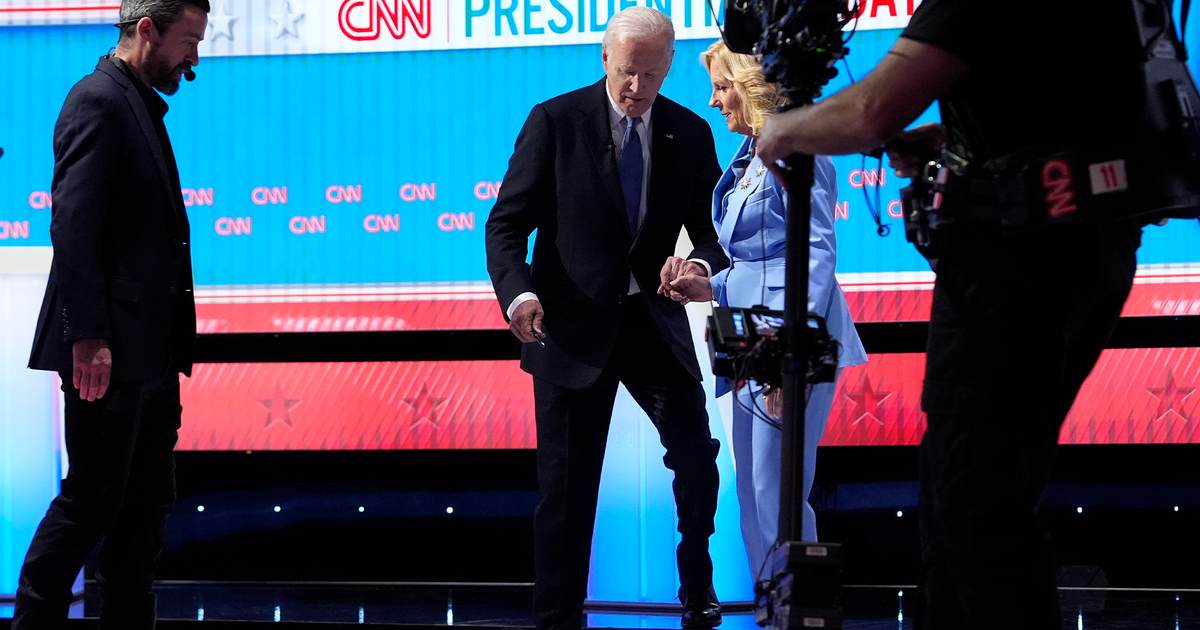
The June 2024 debate was a political disaster that fast-tracked the end of Joe Biden’s re-election bid, and Hunter Biden has now weighed in with a striking explanation. He told listeners on the Macrodosing podcast that his father seemed “blank” that night and that only later did the family learn he had advanced cancer. Republicans and voters who saw the debate as confirmation of long-standing concerns about Biden’s fitness say the new detail only underscores what they already believed.
From a conservative perspective, the story isn’t sympathy for an elderly man who’s been ill; it’s about accountability and competence. The debate exposed more than a bad night—it exposed a pattern of performance and decisions that many believe were unsuited to the responsibilities of the presidency. When a candidate’s impairments are hidden or minimized until after the fact, voters lose the ability to make an informed choice about leadership and national security.
Family members and campaign insiders scrambled in the weeks after the debate, and Democrats ultimately removed Biden from the ticket to avoid a repeat disaster. That decision was less a brave act of transparency than a panic move to contain electoral damage. The party’s internal calculations, the DNC autopsy, and the frantic messaging that followed all point to a campaign that had underestimated the political consequences of running an 81-year-old nominee.
Hunter Biden said on a podcast episode published this week that he believed his father, former President Joseph R. Biden Jr., was unknowingly suffering from cancer during the disastrous debate performance that led to the end of his 2024 presidential campaign.
“He looked blank,” Hunter Biden said on the “Macrodosing” podcast. “And what do I attribute that to? Well, I now know what to attribute it to.” He added: “My dad had cancer. My dad, he was, and he didn’t know. I mean, we didn’t find out until nine months later that he not only had Stage 4 prostate cancer, but he had Stage 4 metastatic bone cancer, which means that it had been metastasizing for over a three-year period of time.”
Mr. Biden, 83, was diagnosed in May 2025 with an aggressive form of prostate cancer, which had spread to his bones, his office revealed at the time. Last year he also had surgery to remove skin cancer lesions and completed a course of radiation therapy, his office has said.
The June 2024 debate effectively ended Mr. Biden’s re-election bid. During the debate, he lost his train of thought and made confusing comments. He spent the next few weeks trying to reassure allies he could continue his run. But polls, which had already shown voters believed he was too old to be president, turned sharply against him while a cascade of Democrats called for him to drop out of the race. He bowed out in late July 2024.
Hunter’s revelation does not erase the visual evidence from that debate: a candidate who struggled with basic conversational flow and appeared disconnected from the topics at hand. For conservatives, the debate was proof that age and decline matter in the highest office, and the cancer explanation is seen as an inconvenient after-the-fact justification. Voters deserve straight answers before votes are cast, not explanations after the campaign collapses.
The timing of the diagnosis—announced in May 2025—and the description of metastatic spread over several years raises tough questions about transparency within the president’s inner circle. If the disease had been progressing for years, how was that not known or communicated sooner? The public deserves clarity on what decision-makers knew and when they knew it.
Politics is unforgiving, and campaigns that ignore hard realities put the country at risk. Republicans point out that the broader lesson here is about honesty and preparedness in leadership, not about private medical sympathy. When the stakes are national security and global credibility, concealment or ambiguity about a leader’s condition is a policy problem.
Democrats who moved to remove Biden from the ticket argued they did so to save the party from a rout, but the episode still reads like political damage control. The hurried replacements and frantic spin only reinforced the sense that the party prioritized short-term optics over clear communication with voters. That failure costs them trust, and trust is hard to rebuild.
Hunter Biden’s comments have reignited scrutiny of the Biden years and the decisions around his candidacy. For conservatives, the moment is a validation of long-held concerns: that age, fitness, and transparency are non-negotiable when choosing who leads the nation. The debate night will be remembered not just for one bad performance, but for the chain reaction it set off within a party unwilling to confront a difficult truth until it was politically unavoidable.