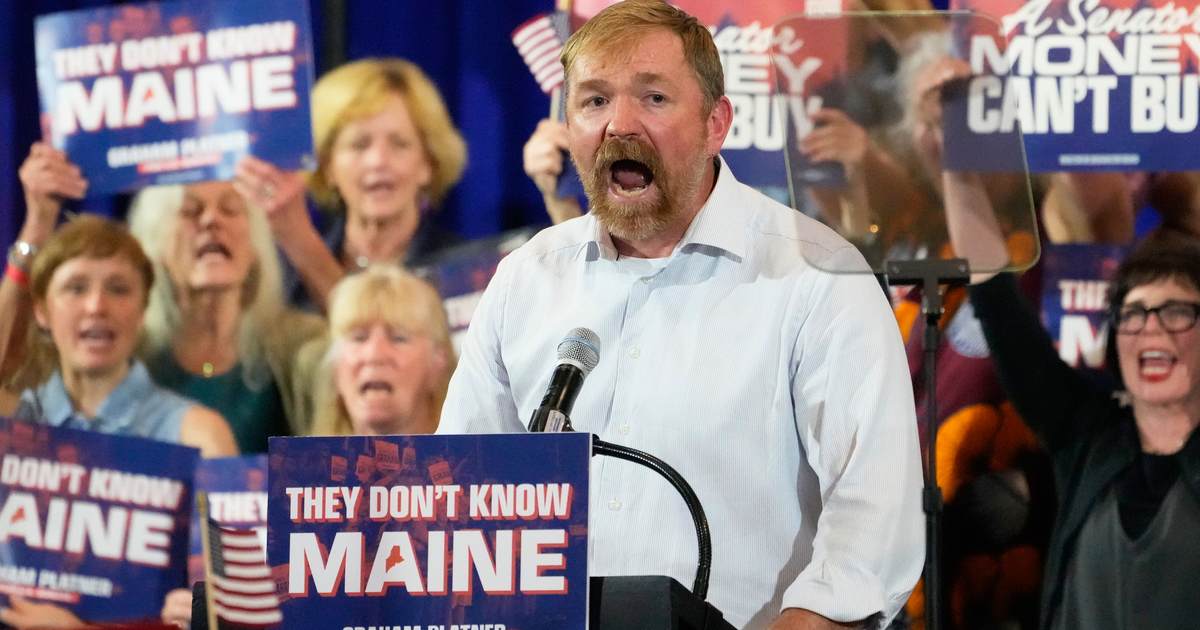
Reporters and readers are buzzing over rumors that Graham Platner may be backing a write-in push in Maine, creating chaos for Democrats and bolstering Sen. Susan Collins’ reelection prospects while raising fresh questions about party judgment and candidate vetting.
If the rumors circulating around Maine are true, the idea of a coordinated write-in campaign for Graham Platner would be explosive and messy. Democrats already have a nominee on the ballot, so the prospect of his supporters turning to a write-in insurgency spotlights internal fractures and poor vetting. That split could hand a major advantage to Sen. Susan Collins (R-ME) in a tight race.
Platner’s campaign collapsed after a credible rape allegation by Jenny Racicot, a liberal Democrat, and that allegation remains the central reason many voters and activists turned away. Beyond that charge, his past raised alarms — graphic social media posts, a Nazi tattoo, reports of domestic abuse allegations, and associations with an app that critics call a haven for predators. Those elements combined to make his candidacy toxic for many and a political liability for local Democrats.
Into that vacuum stepped Troy Jackson, who ran for governor and lost in the primary, and now finds himself positioned by parts of the party as the fallback option. Some in Maine have floated writing Platner in anyway, and rumors surfaced that Platner may have endorsed the idea of a write-in push. That possibility has local activists and reporters asking who is coordinating and how widespread the movement might be.
Jackson’s tone has been cautious, and he has not embraced the chaos wholeheartedly. He has said he never wanted the Senate bid and wished the situation with Platner had never happened, but he also suggested he felt a responsibility to keep progressive energy alive. That mixed message leaves room for speculation and frustration among voters who want a clear alternative to Collins.
Jackson said he never expected or even really wanted to run for the U.S. Senate — he instead ran for governor this year and finished third in the Democratic primary — but told supporters in Belfast that he felt it was important to carry forward the progressive movement Platner helped galvanize, even as Republicans run ads attacking Jackson for his association with Platner.
https://x.com/PollTracker2024/status/2092071657527562452
“I wish nothing would have happened with Graham,” Jackson said in Belfast on Aug. 22. “I wish, you know, things would have continued like all that. It would have been much better. But when it did, I just didn’t want to see all these people that are looking for somebody to fight for them go away once again broken and hopeless.”
Jackson compared the moment to the aftermath of Bernie Sanders’ unsuccessful 2016 presidential campaign, which Jackson worked on, saying many Sanders supporters believed the process had been unfair and subsequently left the movement.
The lingering oddities around the situation are fueling chatter about the party’s bench in Maine and the quality of candidates being promoted. Platner’s personal controversies remain part of the story and prompt an obvious question: why would a party tolerate or revive someone with that baggage? Voters on all sides are watching whether Democrats will clean house or double down on unlikely alliances.
For now, the state faces an unusual mix: a formal Democratic nominee, a rumored write-in insurgency for a discredited former candidate, and a reluctant surrogate trying to hold together progressive momentum. That combination injects uncertainty into what could otherwise be a straightforward fall campaign. Republicans, and especially Sen. Collins, are likely to benefit from opposition disarray if Democrats cannot resolve it quickly.
Rumors and raw political emotion can spread fast, and Maine’s situation is a reminder of how badly vetting failures and internal divisions can change the map. We’ll see whether the write-in chatter translates into ballots, but either way the episode raises deeper questions about candidate standards and the consequences of moving past serious allegations. What happens next in Maine will matter for both parties and for the tone of this year’s races.