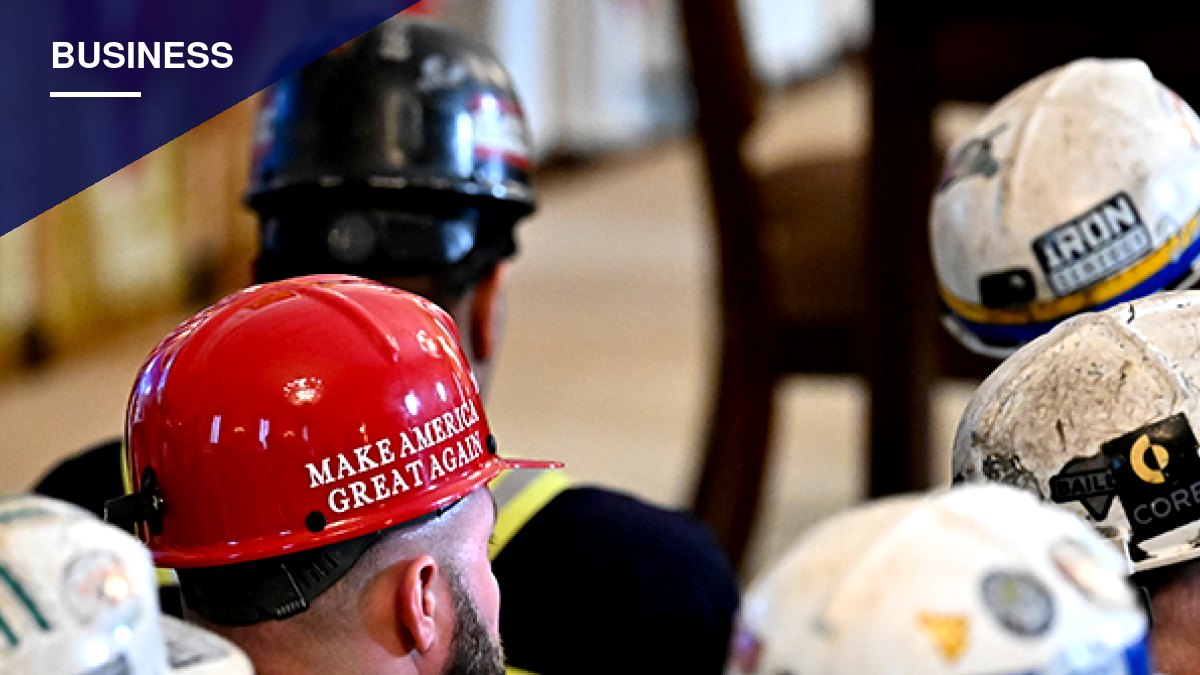
The latest Federal Reserve Beige Book, a regular snapshot of business conditions across the country, shows an American economy splitting in two. Manufacturing, energy, defense, data centers and large construction projects are growing fast. Meanwhile, everyday consumers, small businesses and the housing market are showing strain.
An analysis from BlackRock this week gave that split a name: the “Gator Jaw” economy, because the gap between the two sides looks like an open jaw. BlackRock’s read was that the divergence is worrisome. But some economists argue the opposite may be true — that this exact kind of split is what a successful economic “soft landing” is supposed to look like.
The Federal Reserve has been trying to bring down consumer inflation, measured through the personal consumption expenditures price index, without derailing production, hiring or investment. The Beige Book suggests that may be exactly what’s happening.
What the Beige Book Found
The report describes modest growth across ten of the twelve Federal Reserve districts. Consumer spending rose only slightly, and car sales were subdued. Home construction declined. Shoppers grew more price-conscious, which limited how much businesses could raise prices.
At the same time, manufacturing strengthened in most districts:
- The Philadelphia Fed reported a surge in factory activity, with orders and shipments running well above normal levels.
- The Cleveland Fed reported robust demand.
- The New York Fed found solid order and shipment growth, rising backlogs and falling inventories.
- The Chicago Fed reported gains in metals, machinery, automobiles and trucks.
- The Dallas Fed found continued strength in machinery, transportation equipment, computers and metals.
Those districts cover manufacturing-heavy states including Pennsylvania, Ohio, New York, Illinois and Texas — meaning workers in those states are more likely to be feeling the factory-side boom directly, even as consumer spending nationally cools.
Labor demand followed the same pattern. Factories and construction firms added workers, increased overtime and raised wages for scarce skilled employees, even as retailers and hospitality businesses pulled back on hiring.
Why the Split May Be a Good Sign
The Fed does not target the cost of industrial materials, equipment or labor directly — it targets consumer prices. That means an industrial boom can push up prices for metals, electricity, freight and construction without necessarily driving up the prices consumers pay at the store.
Businesses facing higher costs don’t automatically pass them on to customers. Competition for market share often prevents that, and without more money flowing into consumers’ hands, retailers can’t easily raise prices across the board. The Beige Book repeatedly describes companies struggling to pass costs along, with households trading down, delaying purchases and resisting price hikes.
This pattern echoes what happened with tariffs under the Trump administration’s trade policies: businesses largely absorbed the added costs into their profit margins, found efficiencies elsewhere, or pushed costs back onto foreign suppliers, rather than passing them fully to American shoppers.
Building Now, Producing More Later
The sectors showing the most strength — manufacturing, energy, data centers, nonresidential construction — share one trait: they’re building future production capacity, not just current consumption. A family can put off buying a house if rates are high, hoping for better terms later. A tech company racing to build out artificial intelligence capacity generally can’t afford to wait.
That kind of investment creates demand today and adds supply for tomorrow, unlike straightforward consumer spending, which simply uses up existing capacity.
Lessons From the Past
Economists point to two historical warnings about investment booms during tight monetary policy. In 1966, business investment hit a record 10.7 percent of gross national product while tight credit choked off mortgage lending and home construction. But that period did not lead to disinflation — instead, consumer prices, which had risen just over 1 percent in 1964, began the sustained climb that became the Great Inflation of the 1970s. A major factor was that the Vietnam War buildup and President Lyndon Johnson’s Great Society programs added huge government demand on top of an already tight labor market, with unemployment already below 4 percent.
Today’s investment boom looks different because it’s driven mainly by private companies rather than a Vietnam-scale surge in government and defense spending. Analysts note that even the current U.S. involvement related to Iran hasn’t produced anything close to that kind of Pentagon spending surge.
The second warning comes from 1956 and 1957, during the Eisenhower administration, when strong private investment eventually collapsed after companies realized their expansion plans had been too optimistic — helping tip the economy into recession. Some analysts see a similar risk today if the artificial intelligence data-center buildout outpaces actual demand, creating bottlenecks in power and equipment that could reverse investment and slow growth. Anyone who remembers the dot-com and telecom bust of the late 1990s may find this scenario familiar.
For now, though, factory growth is spreading beyond data centers into machinery, metals, electrical equipment, computers and transportation equipment — evidence, analysts say, of a broader expansion in American production capacity rather than a narrow bubble. Durable goods manufacturing productivity is showing its strongest improvement since the late 1990s.
Whether the gap between booming factories and cautious consumers is a warning sign or the shape of a successful soft landing may become clearer in the months ahead. For now, workers in manufacturing-heavy states are seeing job gains and rising wages even as shoppers everywhere are tightening their belts.