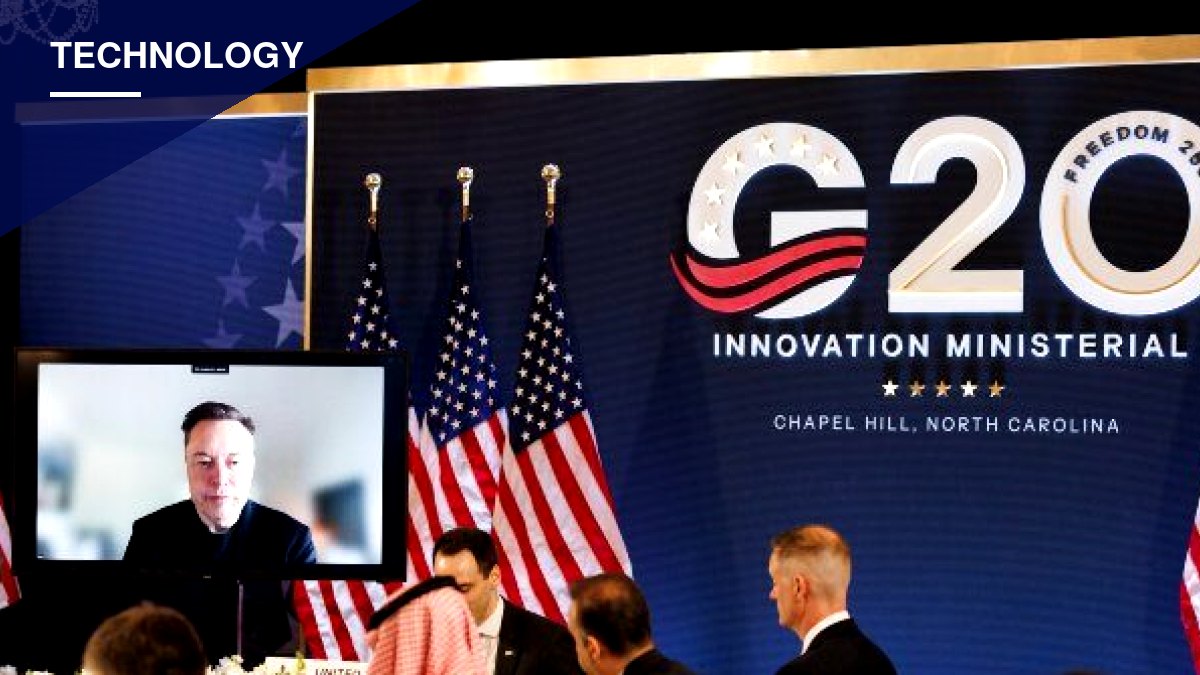
Elon Musk told a virtual session of the G20 that within ten years, roughly one billion humanoid robots will be operating around the world, and that this fleet will outproduce all of humanity combined.
According to CNBC’s reporting on the session, Musk addressed four topics: power constraints on artificial intelligence, the technology’s economic potential, humanoid robotics, and how governments should approach regulating emerging tech.
Musk said a humanoid robot’s usefulness comes down to three factors: the AI software running it, the onboard AI chip, and its electromechanical dexterity, especially in the hands. He said all three are improving at an exponential rate. Once robots begin manufacturing other robots, he argued, growth becomes recursive — slow to start, then explosive. He called his own ten-year estimate conservative, projecting well over a billion humanoid robots, each about five times as productive as a person. He said this physical layer of the economy, rather than the digital economy, is where he expects overall output to grow tenfold or more.
Power, not chips, is the bottleneck
Musk cited estimates pointing to a shortfall of at least 15 gigawatts of power for AI chips by 2027. He said AI chip production is rising about 40 to 50 percent a year, while power generation outside China is growing only 10 to 20 percent annually. In his view, that gap in electricity supply — not chip manufacturing — is the real limit on the industry’s growth.
He noted that Google, Anthropic and other companies are now leasing computing capacity from SpaceX, which built its own power plants to bring capacity online quickly. China has abundant electricity, he said, but is blocked from importing the newest chips under GPU export bans. His advice to other countries was to build out power generation, host AI data centers, and then tax or charge fees for the privilege.
Economic projections and a chess benchmark
Musk said digital AI alone could add 20 to 30 percent to the global economy, or roughly $20 trillion to $30 trillion a year. He said that by the end of next year, AI should be able to handle any digital task that doesn’t require physically shaping objects by hand. On software specifically, he predicted AI would reach