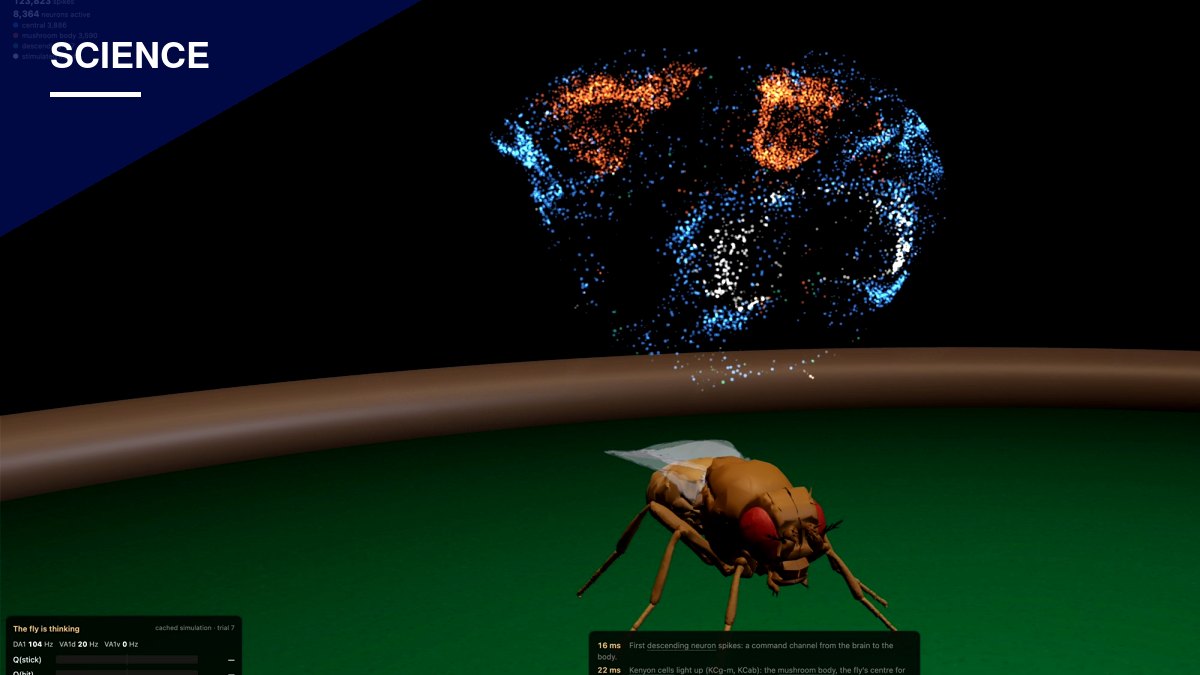
A complete map of a fruit fly’s brain, produced through work at HHMI Janelia Research in Virginia, has become an unlikely viral sensation online after developers used the data to beat one of the world’s most advanced AI models at chess — in just 11 moves.
Janelia Research, working with Google Research, spent years cataloguing every neuron and connection inside the brain of an adult male fruit fly: 166,000 individual neurons and 25.6 million connections, all packed into a brain small enough to fit on the head of a pin. The full dataset was released for public download on September 3.
Since then, programmers and hobbyists have been plugging the digitized fly brain into all sorts of software and machines to see what it can do.
A Surprising Chess Upset
Developer Maxime Labonne connected the mapped neural pathways to a chess engine and set it against Claude Opus 5, a leading AI model. The fly-powered engine won with a checkmate in 11 moves.
“The fly figured out ways to solve and compress chess that are far beyond what we could possibly comprehend. I had to stop training it because it was destroying Opus 5,” Labonne wrote, adding that a demo and model are available on Hugging Face.
From Trading Floors to Fighting Games
The novelty hasn’t stopped at chess. One engineer built a project called Stonkfly, giving the fly’s digital brain a $100 portfolio and letting it trade cryptocurrency, with a simulated dopamine reward built in whenever a trade turned a profit.
A Stanford student created a fighting game pitting a human-controlled digital fly against the fly neural network in a king-of-the-hill contest. As one developer described a similar setup: “166,700 neurons wired exactly like the male fly connectome that Google & HHMI Janelia just released. No training. It chases its opponent using the same circuit male flies use to chase females.”
The brain map has also made its way to the casino, in a blackjack program called FlyJack, where results against the dealer vary each time the experiment runs. Other users have wired the neural network into homemade robots, including animatronic cats, crab-like walkers and small drones.
The research behind it all traces back to the painstaking mapping work done in Virginia, a project now rippling far beyond the lab and into chess boards, trading apps and video games around the world.