Rabbi Arnold Resnicoff was not supposed to be in Beirut on Oct. 23, 1983, when suicide bombers drove explosive-laden trucks into U.S. Marine Corps barracks, killing 241 American service members. He told Fox News Digital that his presence that day, and the work he did afterward, grew from what he calls a simple truth: “a coincidence is just God acting anonymously.”
Resnicoff was serving with the U.S. Navy’s Sixth Fleet, part of a three-chaplain team supporting service members aboard 40 ships in the Mediterranean. He had arrived in Beirut on Friday, Oct. 21, to lead a memorial service for a Jewish Marine killed in the line of duty. Navy leadership wanted him back on his ship the next day, but as an observant Jew, he declined to travel on the Sabbath.
Early on the morning of Oct. 23, at 6:22 a.m., Resnicoff was brushing his teeth when his building shook violently. Doors came off their hinges and windows blew out. He and others dropped to the floor, thinking they had been hit by a rocket or mortar fire.
When the shaking stopped, they began to hear screaming from a building 50 yards away, where Protestant minister Danny Wheeler lived among a host of Marines. Resnicoff normally alternated staying with Wheeler and with Catholic chaplain George Pucciarelli. That Friday he should have stayed with Wheeler, but Pucciarelli had wanted to talk to him, so he stayed there instead. “Who knows what it was we talked about,” Resnicoff said. “But that probably saved my life.”
As the two men realized what had happened, Pucciarelli put on his purple stole, anticipating he would have to give last rites, and told Resnicoff, “Follow me.”
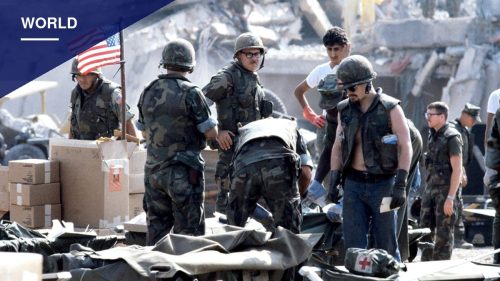
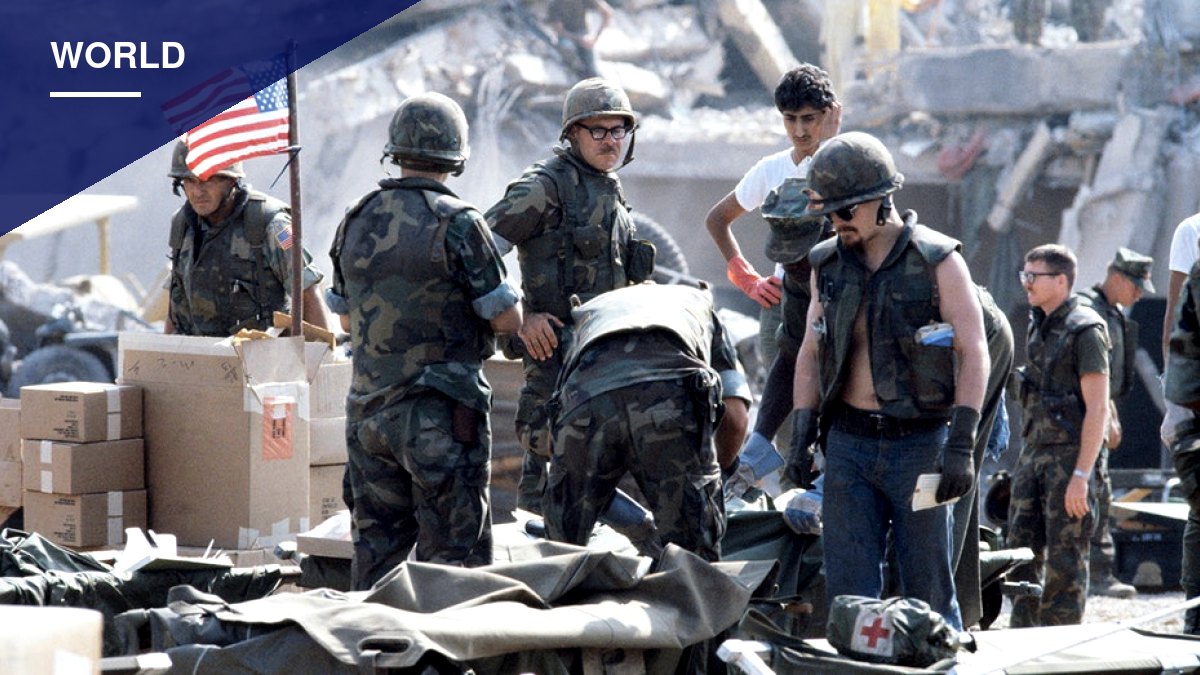
Outside, Resnicoff said, “the big, four-story building was gone with the smoke.” Buried in the rubble were 241 American service members — 220 Marines, 18 Navy personnel and three Army soldiers. The Navy dead included an entire medical detachment, leaving no one trained to treat the wounded.
Resnicoff and Pucciarelli moved through the debris with other first responders searching for survivors. “He went to one body on the ground, I went to another,” Resnicoff said. “We just cradled these wounded men and said, ‘Help is coming.'” They tore their own clothing to wipe blood and dust from the men’s faces. Resnicoff used his kippah until it, too, was “bloody and dirty and lost.”
When ambulances and helicopters finally arrived, Pucciarelli noticed Resnicoff’s bare head — he said he had never seen the rabbi without a head covering. He tore a piece of his own camouflage uniform and placed it on Resnicoff’s head, telling him: “In this country where every religion is killing every other religion, I want everyone here to remember not only that you and I, the chaplains, were helping everyone regardless of whether they had a religion or what religion they had, but that you and I had different religions and were standing together.”
Wheeler was the last living service member pulled from the wreckage, five hours after the blast. It took four days to recover the hundreds of bodies buried in the rubble. “These tough Marines were crying, helping their fellow military personnel,” Resnicoff said.
A quiet kind of ministry
As he moved among grieving and exhausted Marines, Resnicoff drew on a Jewish mourning tradition in which visitors do not initiate conversation but simply offer their presence, speaking only if the mourner speaks first. “So, when I would go from Marine to Marine, they were digging up the bodies of their comrades, I used that Jewish approach,” he said. “I didn’t start the conversation, I just stood next to them to show them I was there, and then if they wanted to talk, I talked.” He compared the approach to the teaching attributed to St. Francis of Assisi: “preach the gospel everywhere. Use words only if absolutely necessary.”
Before the bombing, Resnicoff said, Jewish service members had long struggled to get permission to wear a kippah. Congress had debated a Religious Apparel Amendment allowing it, but the measure had failed for two years. After the story of Pucciarelli fashioning a head covering from his uniform appeared in the Congressional Record, the amendment passed. “They understood that it was a matter of pride that we could work side by side from different religions,” Resnicoff said. Then-Vice President George H.W. Bush asked him to write a report on his experience, which President Ronald Reagan later shared with a gathering of 20,000 Baptists.
Resnicoff said his training as a chaplain had prepared him to field religious questions from the wounded, but none came. “It turned out none of the people I comforted in Beirut asked me a religious question. It was just ‘if I die, tell my mother I love her.’ Most of those Marines were too young to have their own children.” The experience, he said, taught him that “the role of the chaplain is so much broader and bigger than just being a religious representative.”
Looking back 43 years later, Resnicoff said the military had long modeled a kind of unity he wished the rest of the world would adopt. “When you’re in a foxhole or a bunker, you don’t really care if the guy next to you is a Democrat or Republican or independent, you don’t really care what their religion is. You just care that they’re going to protect you like you’re going to protect them and we’re all in this together.”
“If the world had more interfaith foxholes,” he said, “we would have less need for foxholes and more room for faith.”