President Trump signed a new executive order that centralizes AI regulation while also veering into topics from Venezuela operations to foreign policy and the economy, touching on military actions, tariffs, and the competition with China.
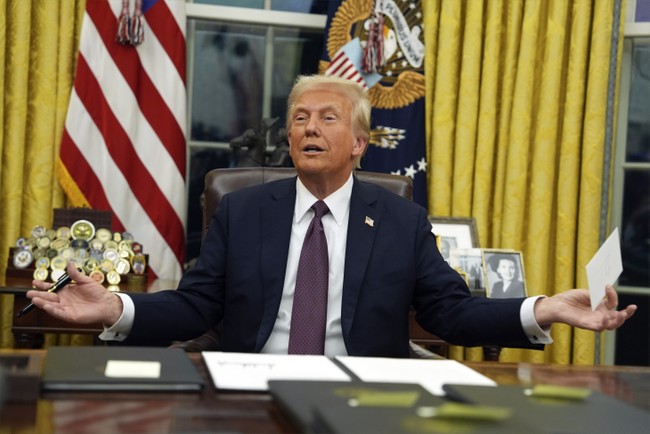
Nothing about a Trump signing follows a tight script, and that unpredictability was on display as the president signed an executive order intended to bring national cohesion to artificial intelligence rules. The event quickly wandered into security matters tied to Venezuela and an operation called Southern Spear, illustrating how domestic tech policy and foreign operations collided in one moment. Reporters were given the kind of freewheeling access that produces off-the-cuff declarations and policy crossovers.
At these signings the president takes questions from the floor, and this time the Q&A blended AI policy with military action and oversight. With the NDAA looming and a provision that would force the Pentagon to release footage of strikes on narco boats, the conversation moved to operations at sea. That provision was framed in colorful terms, even referencing Secretary of War Pete Hegseth’s travel funds, as the administration signaled the operation will continue and that Tren de Aragua’s capabilities are expected to degrade, with the possibility of airstrikes on land.
The executive order itself was presented as a national priority and a practical fix to a chaotic regulatory landscape. AI, while unsettling to some, is seen as the engine of future growth much like the internet was in the 1990s, and the White House made clear it wants America to lead. David Sacks, Trump’s AI and Cryptocurrency Czar, painted the image of companies asking 50 different legislatures how to operate every time they make a change, and noted there are at least 1,000 bills in state legislatures across the country aimed at regulating artificial intelligence. Centralizing authority under a single national framework is the remedy the administration touted, along with presidential tools to push back against overly burdensome rules.
🚨 BREAKING: Massive FAFO is about to play out – President Trump confirms LAND STRIKES are starting soon against narco-terrorists
"Drug traffic by sea is down 92%…we'll start on land too! It's gonna be starting on land pretty soon!" 🔥 pic.twitter.com/59tRdxwSYZ
— Eric Daugherty (@EricLDaugh) December 11, 2025
The president also spoke bluntly about the war in Ukraine, saying he wants the killing to stop after another 25,000 people reportedly died last month. He warned that diplomatic theater can accelerate the march toward a larger conflict and framed his approach as preventing escalation that could lead to a third world war. He added that he’d like to strike a deal with Tehran even as he praised the effects of Operation Midnight Hammer, saying it “obliterated the Islamic Republic’s nuclear program.”
On the economic and national security front the administration tied trade policy to technological dominance, arguing tariffs helped bring manufacturing back and bolster national strength. Trump insisted his tariff moves hauled in hundreds of billions in revenue and encouraged industries, including auto plants, to return — noting that 56 percent had left over the years. He also pointed to market performance, touting the Dow hitting a new high for the 52nd time in 10 months as evidence the economy is responding to his policies.
Treasury Secretary Scott Bessent framed the AI competition with China in stark terms, saying the contest is pass/fail. The concern is that even the most advanced hardware and weapons systems are vulnerable if adversaries can exploit AI to outmaneuver them, making software and algorithmic dominance a core facet of national defense. That logic underpins why the White House is pushing for a unified regulatory approach rather than a patchwork of state laws that could hobble innovation and readiness.
Back at the signing, the president referenced his previous economic record and his confidence in a second term, pointing to pre-COVID momentum as proof his policies make a difference. He emphasized that industry and workers respond to clear rules and robust trade stances, and framed the executive order as part of a broader strategy to keep the United States ahead technologically and economically. The tone combined policy talk with campaign-ready claims about revival and strength.
As he wrapped up, the president offered a characteristic, brash assessment of the moment: “We’re blowing it away right now,” he said, adding that America is truly back, and that we had a “dead country” under the equally inanimate Joe Biden. Those lines landed loud and clear, summing up the administration’s confidence that a tougher posture on trade, a national AI framework, and a forceful approach to security will deliver results.