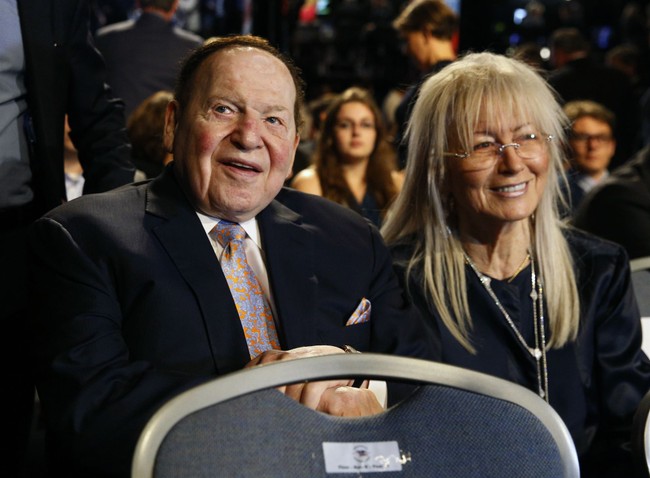
The Hanukkah gathering at the White House turned into a political moment when Miriam Adelson jokingly offered President Trump $250 million toward a third term, guests chanted “Four more years!” and the exchange underscored the backing Trump still commands from major conservative donors.
At a White House Hanukkah celebration Miriam Adelson leaned into the moment and floated the idea of extending President Trump’s time in office, turning a festive event into a headline-grabbing exchange. She brought up a conversation with Alan Dershowitz and framed the possibility with a wink, prompting an enthusiastic reaction from the crowd. The back-and-forth was informal, theatrical, and unmistakably political.
“I met [former Harvard Law School professor] Alan Dershowitz. And he said the legal thing about four more years. And I say, ‘Alan, I agree with you.’ So we can do it. Think about it,” Adelson told Trump, and as guests began to chant “Four more years!” she made an additional inaudible comment to President Trump. The moment had the cadence of a campaign rally, with supporters quick to turn a joke into a chant and a potential talking point. That kind of public enthusiasm is the currency of modern political movements.
“She said, ‘Think about it, I’ll give you another $250 million,’” the president told his guests. “I will give,” she confirmed into the microphone. That exchange put a price tag on political loyalty in plain sight and highlighted how big donors can reshape the conversation; Forbes places the Adelson family’s net worth near $42 billion. When a benefactor of that size speaks up, it matters to candidates and to the base that follows them.
Miriam Adelson, who was born in Israel, and her family have long been active supporters of politicians who prioritize a robust U.S.-Israel relationship, and their influence stretches across party lines when the focus is on defending America’s allies. Their giving has helped fund campaigns and policy efforts that align with their worldview, and their presence at high-profile events signals ongoing engagement in conservative politics. For Republicans, that kind of backing is both strategic and symbolic.
NOW – Miriam Adelson says she spoke to Alan Dershowitz in Israel about the legality of Trump serving a third 4-year term: "We can do it!.. Think about it. I will give you another $250 million." pic.twitter.com/Nw34IWpbDJ
— Disclose.tv (@disclosetv) December 17, 2025
The talk of a third term collided with the reality of the 22nd Amendment, which clearly bars more than two terms, yet that did not stop some allies from floating speculative legal workarounds. One idea that has surfaced in conservative circles is the vice-presidential gambit: run as a vice-presidential candidate and, if elected, have the president step down so the vice president — in this scenario Trump — could assume the presidency. Legal scholars and courts would almost certainly weigh in, and most of these proposals remain theoretical rather than realistic plans.
President Trump has historically enjoyed pushing the envelope and provoking his opponents, and the appearance of “Trump 2028” gear and campaign-style banter feeds the narrative his base likes to see: bold, unapologetic, and defiant of political norms. At the same time, he confirmed months ago that he does not intend to pursue a third term, which framed the episode as more spectacle than strategy for many conservative observers. Still, the episode served as a reminder that prominent backers like Adelson can steer public attention and keep the base energized.
The takeaway for Republicans is straightforward: major donors remain deeply invested in candidates who deliver on policy priorities, and public moments like this illustrate how money, messaging, and mythology intersect in contemporary politics. The exchange at the White House was less a legal blueprint than a show of force, a demonstration that influential supporters will put resources and heat behind leaders they believe defend core American and allied interests. That dynamic will shape conversations about future cycles, even if constitutional limits remain in place.