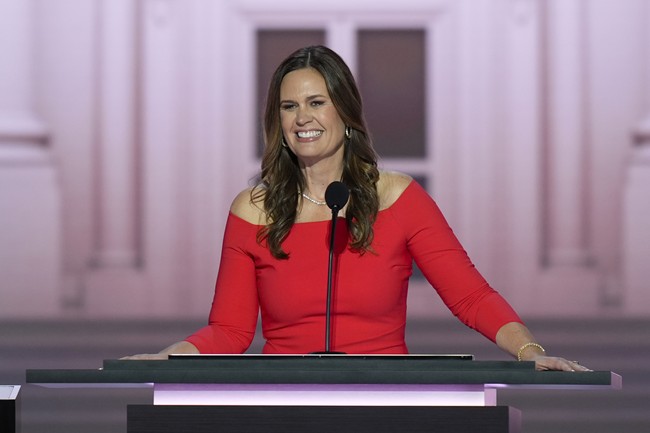
Sarah Huckabee Sanders defended keeping state offices closed on Dec. 26 for Christmas and pushed back hard against a secular group’s complaint about her proclamation.
Arkansas Governor Sarah Huckabee Sanders made a clear call to preserve Christmas as more than a cultural season, and she answered critics who said her proclamation crossed a line. The decision to keep government offices closed on Dec. 26 drew a rebuke from the Freedom From Religion Foundation, which objected to the religious language in her proclamation. Sanders responded publicly, framing the holiday around the birth of Jesus and the humility that story represents.
The Freedom From Religion Foundation sent a letter to Governor Sanders rebuking her for delivering “an explicitly theological account of the Christian story of Jesus’ birth, divinity, crucifixion, resurrection, and anticipated return.” That pushback set the tone for a very public exchange about religion in public life during the holiday season. For Sanders and many Arkansans, closing offices was a recognition of a religious observance, not a political stunt.
The @FFRF took issue with me closing state offices to celebrate Christmas and sent a letter demanding I rescind my proclamation.
Christmas isn’t a just a holiday, it’s the celebration of Jesus Christ’s birth. Meaning matters, we won’t pretend otherwise.
See my response here ⤵️ pic.twitter.com/UciehY3GtS
— Sarah Huckabee Sanders (@SarahHuckabee) December 22, 2025
Sanders fired back at the organization in a letter posted to X, “Christmas is not simply an ‘end-of-the-year holiday’ with ‘broadly observed secular cultural aspects,’ as your letter states. It’s not gifts, trees, and stockings that make this holiday special. Christmas is the celebration of the birth of Jesus Christ, and if we are to honor Him properly, we should tell His miraculous, world-changing story properly, too.” Her reply was pointed and unapologetic, insisting that the state can acknowledge the faith many citizens hold.
She continued by explaining the intent behind the proclamation and stressing humility as the core lesson. “I will end by saying that you missed the point of my proclamation. It was not to browbeat readers with Christian doctrine, but rather to point to the humility of Christ’s birth and to the amazing fact that the King of Kings was born not in a palace or temple, but in a humble manger attended only by poor shepherds,” the letter continued.” “It is in that spirit of humility that I am reminded that Christ did not dine with wise Pharisees or rich men but rather with fishermen and outcasts.” Those were her exact words and they underscore why she framed the holiday as she did.
Sanders kept her tone both confident and civil while defending a practice long familiar in many states and communities. She argued that recognizing Christmas is part of honoring history and faith, not coercing private belief. This is a familiar debate: where to draw the line between public acknowledgement and government overreach.
FFRF framed its complaint differently, saying Sanders’ proclamation presented Christian narrative as fact and that the state should not direct citizens’ religious actions. “Sanders further not only has misused the machinery of the state to promulgate her own personal fundamentalist Christian beliefs, but she has the chutzpah to direct citizen worship — that is, ordering them to ‘give thanks to Jesus,’ an act no public official in the United States has the authority to do,” FFRF official Annie Laurie Gaylor said in a statement. That statement fueled media coverage and energized secular critics nationwide.
The Freedom From Religion Foundation also made broader claims about religion’s role in history, arguing that freethinkers led many advances in social reform. FFRF claims that, “the history of Western civilization shows us that most social and moral progress has been brought about by persons free from religion,” and “the first to speak out for prison reform, for humane treatment of the mentally ill, the abolition of capital punishment, women’s right to vote, death with dignity for the terminally ill, and the right to choose contraception, sterilization and abortion have been freethinkers.” Those sweeping assertions read like a secular manifesto rather than an impartial record.
From the governor’s perspective, replying on social media and in a formal letter was a straightforward defense of religious freedom, not an attempt to push doctrine from the governor’s office. Her supporters argue the state should be able to acknowledge the faith that motivates many citizens without being accused of turning the state into a theocracy. That distinction matters in practical governance.
Critics on the left will keep pointing to separation-of-church-and-state concerns, while conservatives will keep saying public recognition of major religious holidays is normal and harmless. Amid the noise, Sanders’ message stuck to a basic, relatable point: Christmas marks the birth of Jesus and that story deserves to be told honestly and humbly by public leaders. The controversy is political theater to some, but to many families it’s about preserving a faith-centered holiday.
The Freedom From Religion Foundation’s position and Sanders’ rebuttal reflect a larger national argument: should public officials ever acknowledge faith in explicitly theological terms? In Arkansas, the governor chose to be explicit, and she met criticism with a direct, unapologetic defense. The debate will continue, but for now the governor stood by her proclamation and the reasons behind it.