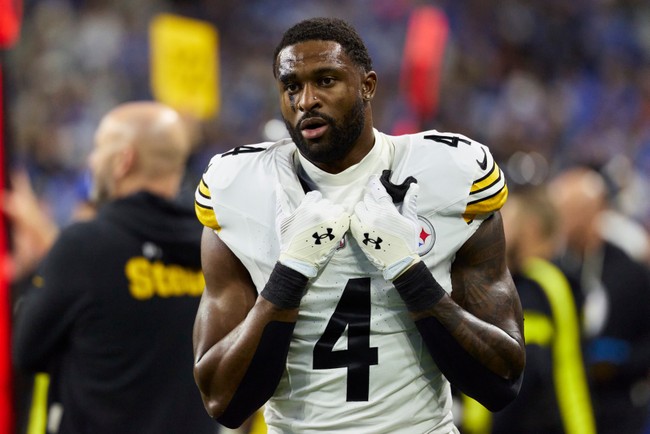
DK Metcalf’s punch at a Detroit fan cost him a suspension and big money, while questions about what was actually said keep the story tangled in denials and heated takes.
The Pittsburgh Steelers beat the Detroit Lions 29-24 on December 21, and Mike Tomlin’s streak of winning seasons reached another year in his 19th season as head coach. That result barely registers now because attention shifted to an off-field flashpoint involving Steelers receiver DK Metcalf. Metcalf was filmed striking a fan at Ford Field, an incident that led to his suspension for the remainder of the regular season.
The discipline hits Metcalf where it hurts financially: a suspension that wipes out more than $500,000 in pay and reportedly jeopardizes $45 million in guaranteed money. That kind of financial fallout is rare for a single in-game encounter and will be talked about longer than the play calls that decided the game. Beyond the dollars, the episode raises questions about player safety, fan conduct, and how leagues handle provocations.
NFL upheld DK Metcalf’s two-game suspension. He now will miss Pittsburgh’s final two regular-season games at Cleveland and against Baltimore. Metcalf now loses $555,556 in salary and has the guarantees on $45 million voided. pic.twitter.com/1zRmdLOrAr
— Adam Schefter (@AdamSchefter) December 24, 2025
The man identified as the fan is Ryan Kennedy, who has denied the most inflammatory claims through attorneys. Reports circulated that harsh slurs and insults were exchanged, but Kennedy’s legal team issued a firm statement calling those allegations false. The situation unfolded quickly on social media and in highlight clips, which only made it harder to separate fact from rumor.
The available video shows Kennedy leaning over and whispering to Metcalf before Metcalf reacted physically. Initial accounts suggested a racial slur and an insult to Metcalf’s mother, but Kennedy and his lawyers dispute that timeline and the language reported. The story also included a claim that the fan used Metcalf’s government name as a provocation, an odd detail that fueled skepticism about the reporting.
Social media and former players added fuel to the fire almost immediately, with some saying they heard the alleged slurs and others warning that nothing justifies a player hitting a spectator. Former NFL wide receiver Chad Johnson offered a theory on a podcast that the alleged words explained Metcalf’s reaction, while still acknowledging rules about players keeping their hands to themselves. Those kinds of reactions complicate any attempt to figure out what happened in a messy, crowded stadium moment.
The legal statement from Kennedy’s lawyers insists he “categorically denies using the ‘N-word,’ the ‘C-word’ or any racial, misogynistic, or hate-based language during the incident,” and calls the allegations “completely false.” The statement says Kennedy has since faced “harassment, threats and messages advocating violence” after the story spread online. That kind of backlash shows how quickly public opinion can turn when an explosive claim lands on social feeds.
Ryan Kennedy, the Detroit Lions fan involved in the altercation with Pittsburgh Steelers wide receiver DK Metcalf on Sunday, “categorically denies using the ‘N-word,’ the ‘C-word’ or any racial, misogynistic, or hate-based language during the incident,” according to a statement released by a Michigan law firm Monday afternoon.
“These allegations are completely false,” the statement released by Shawn Head and Sean Murphy of Head Murphy Law Firm reads.
The statement also said that Kennedy has experienced “harassment, threats and messages advocating violence” since reports began circulating on social media that Kennedy used a racial slur toward Metcalf and called Metcalf’s mother an inflammatory word.
[…]
On his “Nightcap” podcast Sunday, former NFL wide receiver Chad Johnson said the words caused Metcalf to react.
“I got word — obviously, I’m not condoning putting your hands on a fan or punching a fan — but he did call him a racial slur,” Johnson said. “He called him the N-word and he did call his mom a c–t. I think, with those words being exchanged and the fan saying that, I think that’s where the action occurred.
“That’s a bad combination [of words] … and it caused DK to react. I’m sure he will have to deal with some type of discipline. You know how the NFL is. No matter what’s said, they want you to be able to control yourself in that situation, but I understand.”
Kennedy, however, told the Detroit Free Press on Sunday that he called Metcalf by his full name — DeKaylin Zecharius Metcalf — and that prompted the interaction where Metcalf walked over to the fan, who was in the front row of the stands at Ford Field, and grabbed him by his shirt collar. Metcalf then forcefully released Kennedy, shoving him back.
“I called him that, and then he grabbed me and ripped my shirt,” Kennedy told the Free Press. “I’m a little shocked. Like everyone’s talking to me. I’m a little rattled, but I just want the Lions to win, baby.”
After the block of denials and counterclaims, the story settled into the familiar pattern of modern sports controversies: clips circulate, hot takes multiply, and official discipline lands before every detail is known. Some observers note Kennedy’s history of criticizing Metcalf online, suggesting motive for taunting, while others point out that even persistent trolling does not justify violence by players. The result is a mess where both the punch and the alleged provocation remain disputed.
Metcalf’s penalty and financial hit will be the clearest, immediate consequence: lost game checks and a major impact on guaranteed earnings. For the team and league, the episode creates pressure to refine response plans for fan-player incidents and to communicate standards clearly. Meanwhile fans, players, and commentators will keep arguing about who crossed the line first and what accountability should look like.
Whatever happens next, the case highlights how quickly an isolated interaction can escalate into a headline with real career and financial consequences. Stadiums are loud and chaotic, but professional athletes are held to a higher standard, and the NFL has shown little tolerance for players making physical contact with spectators. The ripple effects from a single moment at Ford Field will be felt long after the game film is filed away.