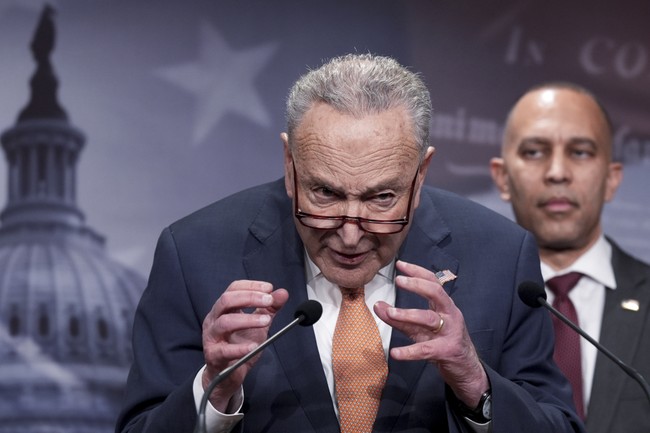
Senate Democrats blocked a key funding measure this week, leaving homeland security and other agencies unfunded as the clock ticks toward a possible shutdown, and several Republicans joined them in the procedural vote.
The Senate took a procedural test vote that failed with a 45-55 margin after Democrats objected to the package that would have funded the Department of Homeland Security and multiple agencies. Republicans tried to push a clean funding path, but negotiations over immigration enforcement and ICE reforms dragged the chamber into a standoff. With funding lapsing at the end of the month, the federal government now faces the real prospect of paused operations unless leaders strike a deal fast.
Democrats voted to block legislation to fund the Department of Homeland Security and several other agencies Thursday as they continued to negotiate with Republicans and the White House on new restrictions for President Donald Trump’s surge of immigration enforcement.
BREAKING: Democrats block a government funding package in the Senate as negotiations continue with the White House to avert a shutdown. https://t.co/R9cTUYWLkg
— The Associated Press (@AP) January 29, 2026
Thursday’s 45-55 test vote came as Democrats have threatened a partial government shutdown when money runs out on Friday. But Trump said just ahead of the vote that “we don’t want a shutdown” and the two sides were discussing a possible agreement to separate homeland security funding from the rest of the legislation and fund it for a short time.
The politics here are simple: Democrats are using a funding fight to demand changes to ICE and immigration enforcement that would tie the hands of law enforcement. That strategy risks a shutdown to win policy concessions, and it puts everyday services and federal workers in limbo. Conservatives argue that national security and border enforcement should not be bargaining chips in a maneuver that could cripple government operations.
Democrats have openly threatened to shut down the government if they don’t get their way on reforming ICE, and some in their caucus made that clear on the Senate floor. “The American people support law enforcement. They support border security. They do not support ICE terrorizing our streets and killing American citizens,” Schumer said, according to the Associated Press. Those words underline how raw the dispute has become and why compromise has been hard to find.
President Trump was on record before the vote saying “we don’t want a shutdown,” and White House negotiators have been involved in back-and-forth talks aimed at carving out homeland security funding separately. That approach—fund DHS short term while keeping broader appropriations in play—has surfaced as a potential bridge, but Democrats so far refused to advance the full package. The result is a tense calendar and an urgent need for leaders to choose seriousness over posturing.
The practical calendar matters: if a clean spending bill or an extension doesn’t pass, parts of the government could be forced to halt on January 30. Agencies tied to homeland security, veterans services, and other programs could face furloughs or interruptions, and that outcome is entirely avoidable if both parties prioritize funding over leverage. Republicans are pushing to fund the government and protect security programs without broad policy concessions that would weaken immigration enforcement.
Seven Republican senators joined Democrats in blocking the legislation: Ted Budd of North Carolina, Ron Johnson of Wisconsin, Tommy Tuberville of Alabama, Mike Lee of Utah, Rand Paul of Kentucky and Rick Scott and Ashley Moody of Florida. Thune also voted “no” for procedural reasons, giving himself the option to force reconsideration later. That cross-aisle vote complicates the GOP’s internal dynamics and shows how fractured the Senate remains on tactics and priorities.
For conservatives watching this unfold, the core complaint is that Democrats are willing to risk a shutdown to extract policy changes that, in the GOP view, would undermine enforcement and public safety. The better path, Republicans say, is to pass short-term funding to keep the government open and then address ICE policy through regular order, hearings, and targeted legislation. The current brinkmanship leaves no winners if it forces a shutdown and disrupts services Americans expect to work.
Negotiations will continue under intense pressure from both parties and the White House, but time is the enemy. Lawmakers who want to avoid the fallout will need to move quickly and put operational funding ahead of grandstanding. If the Senate can’t find a path forward, the political blame will be loud and immediate, and the consequences will be tangible for federal employees and citizens who rely on government services.