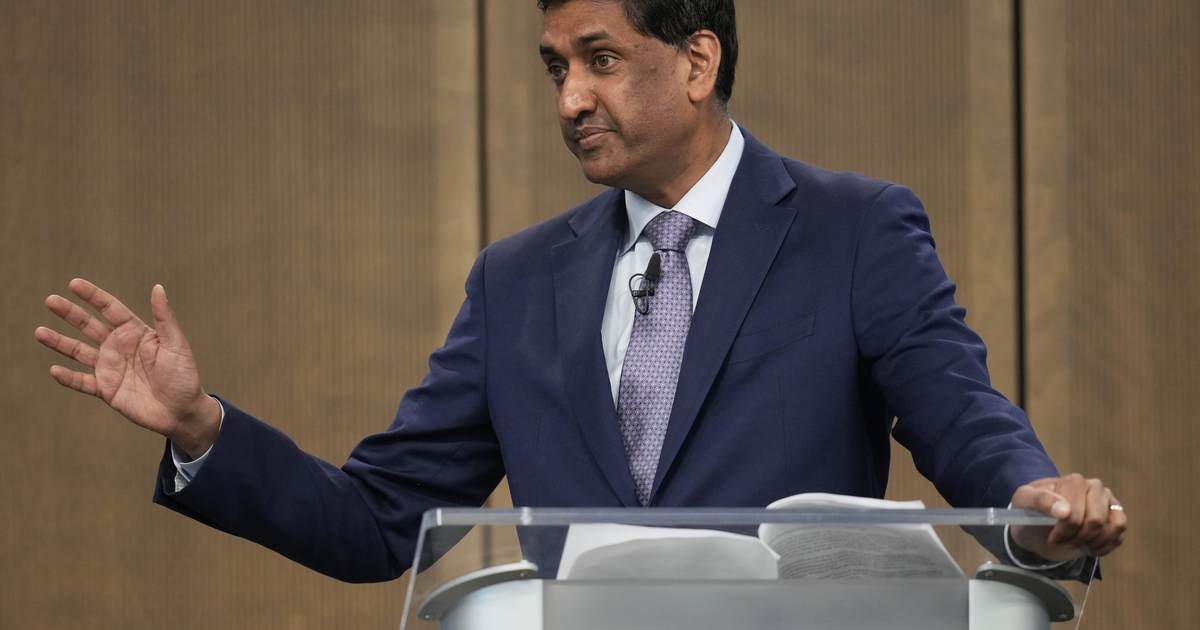
Representative Ro Khanna stood by his assessment that Barack Obama showed stronger leadership on Iran than Donald Trump, sparking a tense exchange that touched on payments to Tehran, backchannel diplomacy, and contrasting approaches to deterrence.
Representative Ro Khanna doubled down when pressed about his comparison of leadership on Iran between former President Barack Obama and President Donald Trump. He repeated his view even as critics cited specific actions and payments tied to the Obama years. The exchange highlights a deeper split over how to measure strength and deterrence.
Khanna insisted that Obama’s overall statesmanship left the country safer, a claim that met pushback about the details of Obama-era dealings with Tehran. Critics pointed to a $1.7 billion transfer and claimed a shadow backchannel as evidence those policies were flawed. Khanna maintained his stance despite the controversy and the contrast drawn with Trump’s policies.
“Are you suggesting that Obama’s leadership on Iran was better?” Fox Business’ Maria Bartiromo said. “Because under President Obama, there were 14 wire transfers to a Swiss account linked to Hezbollah. Between 2014 and 2016, that was a total of $1.7 billion. The same $1.7 billion, he told Congress, was frozen Iranian assets. Now, there was a backchannel to Tehran through Valerie Jarrett, active for 2012 to 2024. This was after he left office. So it was almost like a shadow government. He also sent pellets of cash in a plane to Iran. Now, why would you send money to Iran knowing that they are building a nuclear weapon and they are the leading sponsor of terrorism?”
FOX: "Are you suggesting that Obama's leadership on Iran was better?"
KHANNA: "Yes, I am"
FOX: "Under President Obama there were 14 wire transfers to a Swiss account linked to Hezbollah…he also sent pallets of cash in a plane…"
KHANNA: “Barack Obama was a great statesman" pic.twitter.com/K6umiuETtV
— RNC Research (@RNCResearch) April 20, 2026
“Barack Obama was a great statesman who left America much safer,” Khanna replied. “I wouldn’t put Donald Trump in the same paragraph.”
That blunt exchange shows how partisan lenses shape the debate more than facts sometimes do. For many conservatives, Obama’s diplomacy with Iran reads as naïve and costly, while Trump’s hard-line posture is the only approach that yields tangible results. Khanna’s remarks, from a Democrat, felt like a refusal to recognize those results.
For decades, U.S. policy toward Tehran alternated between engagement and paralysis, with officials repeatedly betting on negotiations that failed to halt Tehran’s malign behavior. The pattern produced setbacks and left regional allies uneasy about American resolve. Voters on the right argue that strength, not long negotiations, produced deterrence.
President Trump, his supporters say, made that calculation public and used pressure and clear consequences to change Tehran’s calculus. The case is simple in their view: offer a real path to diplomacy, but make sure failure carries real costs. That posture, they argue, restored credibility and reduced the chances Tehran could act with impunity.
Khanna’s defense of Obama overlooks the tactical wins Trump achieved against Iran’s network of terror sponsorship and its ability to intimidate neighbors. Those moves were messy and controversial, but they were decisive and visible. For Republicans, visibility matters because deterrence depends on clear consequences.
Critics of the Obama-era payments argue those transfers undercut leverage and sent the wrong message to Tehran and its proxies. The wire transfers and backchannel chatter suggest a foreign policy that relied too heavily on soft tools while ignoring hard security realities. That debate is central to why Khanna’s comments landed so poorly with conservative audiences.
Khanna’s posture also exposes a broader Democratic reluctance to acknowledge when tough, unilateral pressure works. Admitting partial credit to an opponent is rare in modern party politics, and this episode is no exception. The result is a conversation that emphasizes ideology over the practical question of what actually reduced threats.
Supporters of Trump’s Iran policy will point to measurable disruptions of terror financing and a return to a posture that prioritized American strength. They believe that deterrence requires consistent follow-through and an unwillingness to let adversaries exploit gray areas between diplomacy and force. That view guided the administration’s actions and still frames Republican foreign policy arguments.
Khanna’s comments and the pushback they generated are a snapshot of the larger fight over American strategy in the Middle East. One side favors extended diplomacy and cautious re-engagement, the other argues for pressure and consequences until Tehran changes behavior. The argument will continue to shape policy choices and political messaging.
Editor’s Note: For decades, former presidents have been all talk and no action. Now, Donald Trump is eliminating the threat from Iran once and for all.