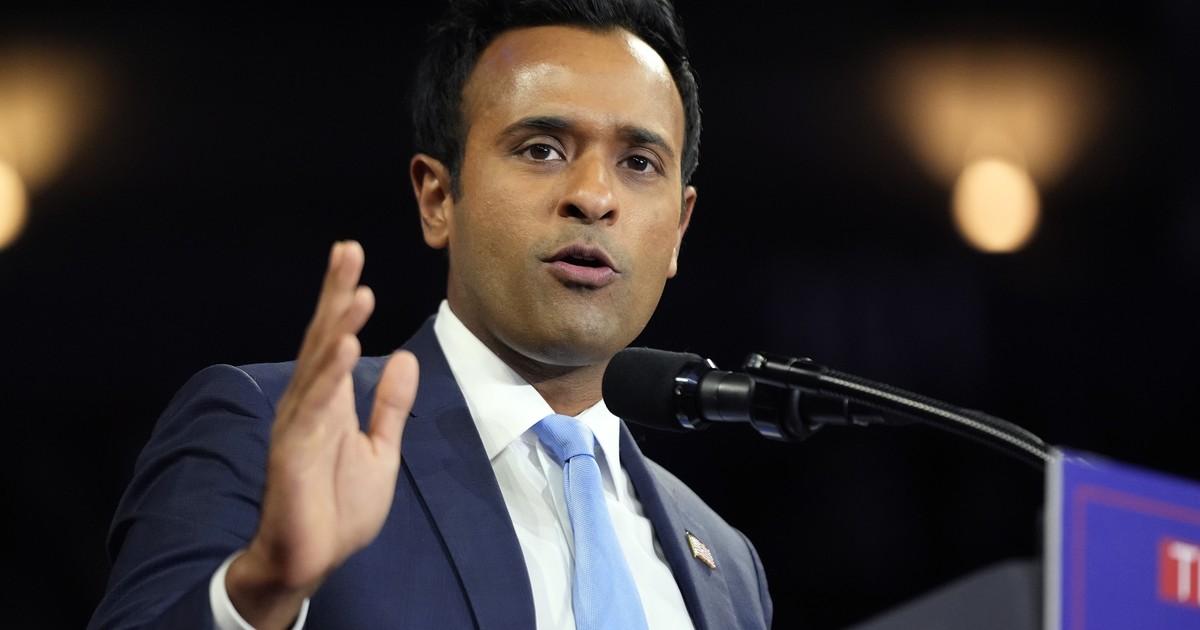
Vivek Ramaswamy pushed back hard at a Turning Point USA event against a line of questioning that wants to cut U.S. aid to Israel and reroute those dollars at home, arguing that the math and the politics are more complicated than critics suggest.
At the event, the Ohio gubernatorial hopeful faced a student who framed U.S. assistance to Israel as a trade-off with American needs. Ramaswamy acknowledged past calls to end a specific aid package, but he also refused to accept the idea that cutting aid would automatically solve domestic problems.
He argued that simply moving money from foreign partners back into Washington does not guarantee better outcomes for Americans. That point fed into a broader critique: taxpayers deserve accountability and results, not reflexive spending that produces little return.
“Hi, my name is Nora Long, I’m a student here. As you know, the United States has spent $12 billion on Israel. This could provide for 3.5 million children with free health care for a year, 2 million families with a year’s free groceries, or 600,000 families with a year’s free rent,” she said. “Since one of your main campaign promises is to provide for America first, will you commit to lobbying Congress to stop the funding of Israel?”
“So I’ll say a couple of things, Nora. So I want to separate two important and different themes here. Okay, this is really important to hear from me,” Ramaswamy replied. “It’s very personal to me for a reason. So when I ran for president, I was the only Republican on that stage who actually said that in the long run, I think it was in the best interest of the United States and for what it’s worth in the best interest of Israel, but I’m looking after the interest of the United States, to say that $3.8 billion a year, it should be sunset. That’s what I said.”
Excellent response on Israel aid by @VivekGRamaswamy.
Perfect.pic.twitter.com/jT75FmrGUP
— Daniel Di Martino (@DanielDiMartino) April 22, 2026
“And I took a lot of heat for that when I ran for president. So that’s one thing,” he continued. “But I would be incomplete if I did not also answer a second dimension to this question, which is that I do think it is strange.”
It is beyond bizarre to me, the fixation on that $3.8 billion of the federal budget, when you look at the extent of far more inexcusable waste, fraud, abuse in a lot of different directions, foreign aid to hundreds of other countries, that we also should not be supporting. Which raises a deeper question of what the heck is going on with this particular line item and that obsession. And I don’t think it’s just about saying how many more American lives we could have improved with that $3.8 billion, because you could be talking about $3 trillion that we could be recapturing and recovering from wind subsidies to third world country foreign aid that’s actually a lot of which is corrupt.
“So here’s, I’ll tell you what I do think underlies it. I think it’s this mentality that somehow it is a mindset that one country in the world, in the U.S. relationship with it, or particularly even, let’s just talk about it, Jewish Americans are somehow responsible for the struggles of Americans here,” Ramaswamy said. “And I think that view is also ridiculous. And I don’t think that we should be indulging this.”
“So, at once I can say that, do I think we should probably sunset long run $3.8 billion a year to Israel? I think it’s in our interest, and for what it’s worth. I think it’s in Israel’s interest too,” he added. “And views have changed since I was up there two years ago. I think a lot of people who might have disagreed with me then agree now.”
“But I will say that while also saying that the focus that smacks of, I would say some anti-Semitic instincts of laser focusing on this without focusing on other problems is also weird, bizarre, and should probably also stop,” Ramaswamy added.
From a practical standpoint, the argument that U.S. aid to Israel yields measurable returns is central to the conservative case Ramaswamy pressed. Israel is often cited as a partner that shares intelligence, supports operations against mutual threats, and yields tangible security benefits for the United States.
That comparison matters because critics who frame foreign aid as inherently wasteful ignore how selective partnerships can advance American goals. The bigger problem, he suggested, is inconsistent scrutiny: some foreign aid items and domestic programs lack oversight while this one line item draws disproportionate attention.
Ramaswamy’s stance blends a willingness to reconsider certain long-term appropriations with a demand for even-handed accountability. His message to voters was blunt: focus on results and root out corruption everywhere, not single out one ally while letting larger failures persist at home and abroad.
For voters who prioritize national security, his position will resonate: the choice is not simply between sending money overseas and investing at home, it is about where taxpayer dollars generate clear benefits and where they do not. That is the debate he tried to steer the audience toward at the TPUSA gathering.