Federal agents removed five illegal card skimmers in Sacramento and Napa counties during an outreach sweep April 27–29, halting about $5.2 million in potential fraud and inspecting thousands of payment devices.
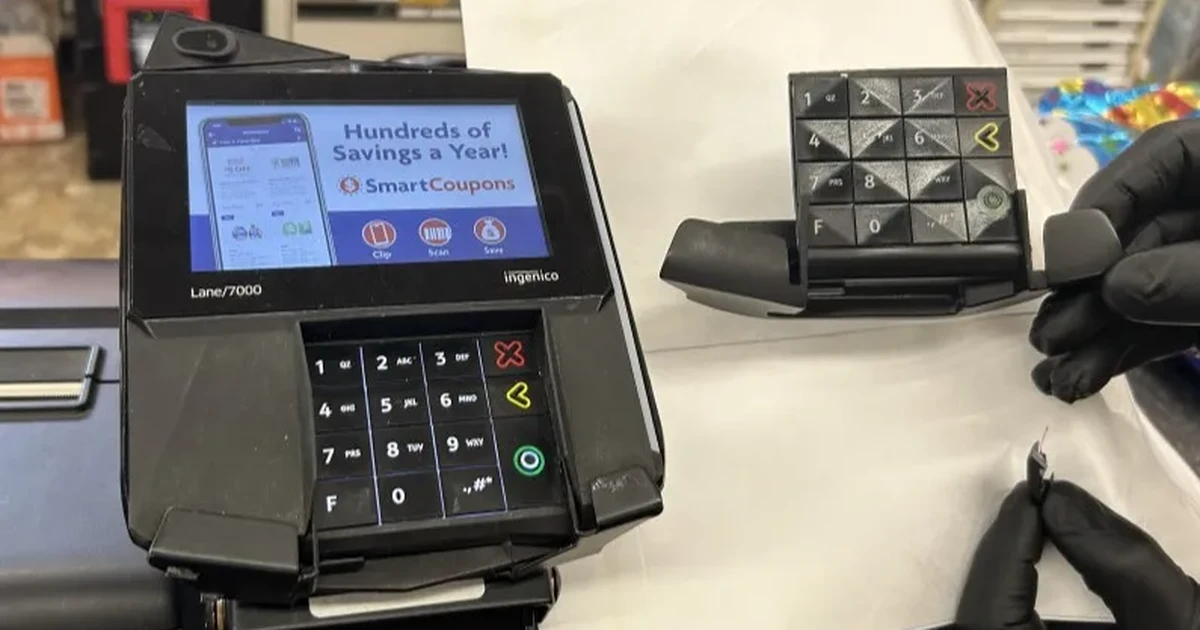
The U.S. Secret Service organized an Electronic Benefit Transfer Fraud and payment card skimming outreach operation with several law enforcement partners in late April. The sweep focused on venues where criminals commonly install fake point-of-sale devices to capture card data. Once captured, that data can be encoded onto cloned cards or sold through social channels and underground networks.
Personnel visited 510 businesses and removed five skimming devices during the operation. More than 3,000 point-of-sale terminals, gas pumps and ATMs were inspected to root out compromised readers. The visit-and-inspect approach aims to stop fraud before stolen numbers are turned into losses for account holders and merchants.
“Illegal card skimming has direct impacts on members of our community and the U.S. Secret Service is committed to working alongside our law enforcement partners to combat this fraud,” said Ryan Cole, Resident Agent in Charge of the U.S. Secret Service’s Sacramento Resident Office. “The goal of this operation was to find and remove skimming devices before card numbers can fall into the hands of criminals. I’m thankful for our partners for their participation in this operation.”
Teams also distributed educational materials about Electronic Benefit Transfer fraud and skimming so businesses could better identify warning signs on terminals and pumps. Outreach included guidance on spotting loose or altered card readers and simple steps staff can take if a device looks suspicious. Prevention and awareness are a central part of reducing opportunities for fraud across retail and fueling locations.
“The U.S. Department of Agriculture Office of Inspector General is dedicated to upholding the integrity of the EBT card system that is meant to assist needy American families who qualify for benefits under the Supplemental Nutrition Assistance Program. Such outreach operations are important to help prevent fraudsters from using technology and complicated networks to defraud SNAP,” said USDA OIG Special Agent in Charge Shawn Dionida. “We appreciate the close coordination with the U.S. Secret Service, HHS OIG, and all of our other partners on this joint effort to combat skimming operations and associated EBT fraud in Northern California. We will continue to work diligently with our partner agencies to help businesses identify potential fraud and ensure EBT cards are used only by those who qualify for and rely on these benefits to survive.”
This outreach operation was conducted by the U.S. Secret Service, Napa County Sheriff’s Department, U.S. Department of Agriculture Office of Inspector General, and the U.S. Department of Health and Human Services Office of Inspector General. “When card-skimming schemes prey on TANF recipients, they do more than defraud taxpayers— they rob stability from households that depend on these benefits,” said Special Agent in Charge Robb R. Breeden of the U.S. Department of Health and Human Services, Office of Inspector General. “Working with our federal, state, and local partners, we are aggressively targeting the criminals behind these schemes — and we want skimmers to know: if you exploit vulnerable families, we will find you and we will stop you.”
These outreach efforts build on a larger, ongoing campaign: in 2025 law enforcement personnel removed more than 400 illegal skimming devices during similar operations, preventing an estimated potential fraud loss of more than $428 million. Skimming devices are often attached to ATMs, gas pumps and merchant point-of-sale terminals to capture card and magnetic-strip data. Scammers then encode captured data onto another card or use it to siphon funds from accounts, making these devices a direct threat to both consumers and financial institutions.
Skimming is expensive: it is estimated to cost financial institutions and consumers more than $1 billion each year. Reducing that toll relies on a mix of enforcement, merchant training and consumer vigilance. Local outreach and inspections aim to close the gap between detection and prosecution by removing hardware before it can be exploited.
There are several precautions consumers can take to protect themselves:
- Inspect ATMs, point-of-sale terminals and other card readers. Look for anything loose, crooked, damaged, or scratched. Do not use a card reader if anything appears unusual.
- Whenever possible, use tap-to-pay technology or use debit and credit cards with chip technology.
- If using a debit card at a gas station, run it as a credit card to avoid entering a PIN number. If that is not an option, consumers should use their hand to hide their PIN to block scammers who may be using tiny pinhole cameras above the keypad area to record entries. Use ATMs in a well-lit, indoor location, which are less vulnerable targets.
- Be alert for skimming devices in tourist areas, which are popular targets.