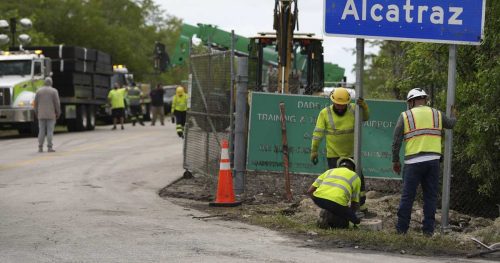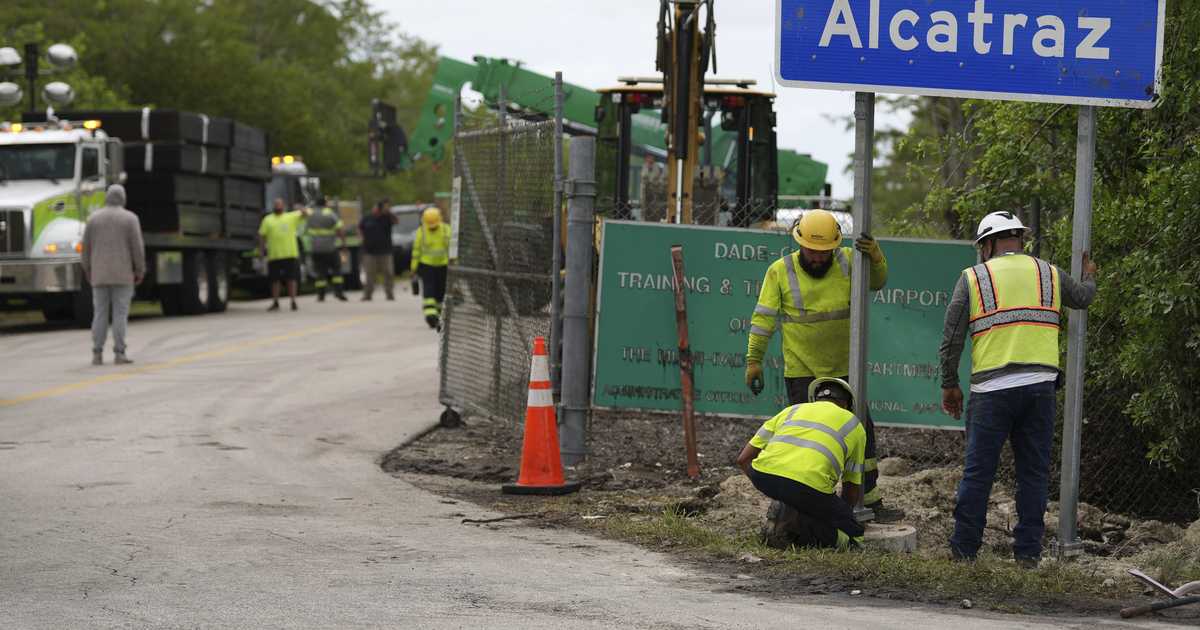
Florida Governor Ron DeSantis signaled that the controversial South Florida Detention Facility known as “Alligator Alcatraz” may be winding down, citing its temporary role, rising costs, and legal challenges as reasons the state could return the site to its original use.
Gov. Ron DeSantis confirmed the state built the tented facility to act as a temporary bridge while federal deportation efforts ramped up, and he suggested it might soon be dismantled. The center, established on an Everglades airstrip, became a flashpoint in the immigration debate and a target for legal and environmental fights.
Gov. Ron DeSantis acknowledged Thursday that Florida may soon shutter “Alligator Alcatraz,” the immigration detention center built in the middle of the Everglades that had been a centerpiece of state and federal efforts to fulfill President Donald Trump’s deportation promises.
The Republican governor, who stressed he had always intended the facility to be temporary as the Trump administration ramped up its efforts, did not give out an exact timeline of when the center may be closed and return to its role as an aircraft training site.
“We knew that it would take some time for them to stand it up, but ultimately our goal on this was for that facility to be a bridge,” said DeSantis following a bill signing ceremony in Lakeland. “If they can handle that, then yeah that would be great for us to break that facility down.”
The center opened with great fanfare from the president’s allies and even drew a visit from Trump. But it has been sharply criticized by immigration advocates and Democrats over its operations, while environmental and tribal groups filed lawsuits challenging its construction.
“Alligator Alcatraz,” or the South Florida Detention Facility, has also been a costly endeavor, but DeSantis declared it a success and said that nearly 22,000 people who were not in the country lawfully had been processed for deportation. He said people would have been released back into the community if the detention center had not been opened.
“If we shut the lights out tomorrow, we will be able to say it served its purpose,” DeSantis said.
Recent reports say state officials notified the companies running the compound that Florida plans to wind down operations, with a target of closing by June and relocating roughly 1,400 detainees to other centers. Those logistics matter because moving people, records, and security protocols takes coordination and time.
The financial picture is stark: cost projections have climbed past $1 billion, with operating expenses reported at about $1.2 million per day for the tent complex. That heavy price tag on state coffers was a key factor behind talks of ending the project now that it has performed its intended function.
Governor Ron DeSantis is now saying that he will be closing Alligator Alcatraz since it was just supposed to be a temporary detainment facility and it cost $1 million dollars per day to keep open. He still hasn’t been reimbursed the $608 million that from the Federal Government. pic.twitter.com/HPSCoFQihf
— Suzie rizzio (@Suzierizzo1) May 13, 2026
Environmental and tribal groups pressed legal challenges from the start, arguing construction damaged fragile wetlands, endangered species habitat, and tribal lands. A federal judge at one point ordered a pause on new construction and later directed a ramp down after reviewing evidence presented by opponents.
Florida appealed that decision and the 11th Circuit Court of Appeals reversed the injunction, concluding the state had built and run the site and had not yet been reimbursed by the federal government. That ruling hinged on control and funding details and meant a full federal environmental review was not required at that stage.
Supporters point to the numbers DeSantis cited — roughly 22,000 processed — as proof the facility reduced releases into communities and helped federal enforcement efforts. Critics continue to argue the same operations raised serious humanitarian and legal concerns, making the center a polarizing example of state-run immigration enforcement.
The site attracted national attention, including a presidential visit, and became shorthand for a hardline approach to illegal immigration. Whether dismantling the tents will mark an end to similar state initiatives depends on federal partnerships, funding assurances, and how leaders weigh costs against outcomes.
For now, the state appears focused on minimizing financial exposure and returning the airstrip to prior use while ensuring detainees are transferred safely. The coming weeks should clarify when and how the facility will be taken down and what lessons the state draws from the experiment.