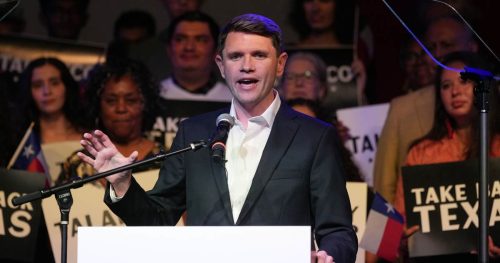
Greg Bovino, a former Border Patrol commander from the Trump era, has launched an exploratory effort for a 2028 presidential run with a laser focus on dramatically reversing illegal immigration and restoring what he calls American sovereignty.
Greg Bovino is publicly exploring a 2028 presidential bid after rising to national attention as a Border Patrol commander who led high-profile urban operations under the Trump administration. His move puts a familiar law-and-order voice back into the spotlight at a time when immigration is a top issue for many voters. Bovino frames his potential campaign around forceful enforcement and a return to strict border control.
https://x.com/GregoryKBovino/status/2064052124422640064
On social media Bovino was blunt: “Here’s the truth: My one and only priority is deporting the 106 million illegals who are here,” Bovino said in a post on social media. “That’s it. If running for President is what it takes to actually get it done, then all options are on the table.” Those lines make his priorities unmistakable and will play to voters frustrated with porous borders and weak enforcement.
His exploratory site uses incendiary language that echoes the populist immigration messaging of 2016 and brands the political prospect as “The Commander.” The site includes a section of rhetoric that reads, “America as a whole has already fallen to the grasps of the foreign global one-world hellscape ushered in by Barack Hussein Obama, however we believe that The Commander can not only usher in the great restoration of America, but also cement the continuity of a strong and sovereign United States that will last a millennia.” That passage signals a hardline, nationalist stance that will divide audiences.
Bovino’s team reportedly includes familiar conservative operatives such as former Florida GOP Executive Director George Riley and Roger Stone associate Jacob Engels. Those names suggest a campaign infrastructure oriented toward activist networks and hardball political tactics rather than traditional Washington insiders. The personnel choices align with a campaign that intends to be combative and unapologetic.
The platform content focuses heavily on immigration while also promoting unconventional policy ideas like a Department of Traditional Families and Holistic Living and a Department of Youth Masculinity. Those proposals are aimed at cultural voters who want government to reinforce certain social norms and family structures. The mix of border enforcement and social agenda aims to stitch together both security and cultural conservative coalitions.
Observers will notice the website itself is rough around the edges, with typos and inconsistent capitalization showing up across pages, and the term “America” often left uncapitalized. Merchandise and fundraising elements are already hinted at, with a promoted donation destination tied to a Cash App account called Bovino Grassroots Army. That grassroots framing looks designed to mobilize small donors and energetic volunteers rather than big-money establishment donors.
For Republicans, Bovino’s pitch has clear appeal: a straightforward, uncompromising promise to remove millions who entered the country illegally and restore secure borders. His language and policy emphasis will resonate with voters who see immigration as an existential threat to national identity and public safety. For critics, the rhetoric will be too extreme and the logistics implausible, setting up immediate pushback from the media and political opponents.
As a public figure with operational experience on the border, Bovino can claim a credentialed record on enforcement that many politicians lack. That background gives him credibility when he talks about tactics and the challenges at the border, and it sets him apart from candidates whose experience is primarily legislative or private-sector. Still, turning enforcement experience into a nationwide campaign requires fundraising, staff, and broad policy depth.
With midterm elections approaching, early exploratory moves like Bovino’s are likely to prompt a flurry of announcements and positioning for 2028. The coming months will test whether a hardline, personality-driven approach can scale into a viable national campaign and whether voters seeking tougher immigration policies rally behind another outsider figure. Either way, Bovino’s entry sharpens the debate over border security and the scope of conservative policy for the next presidential cycle.