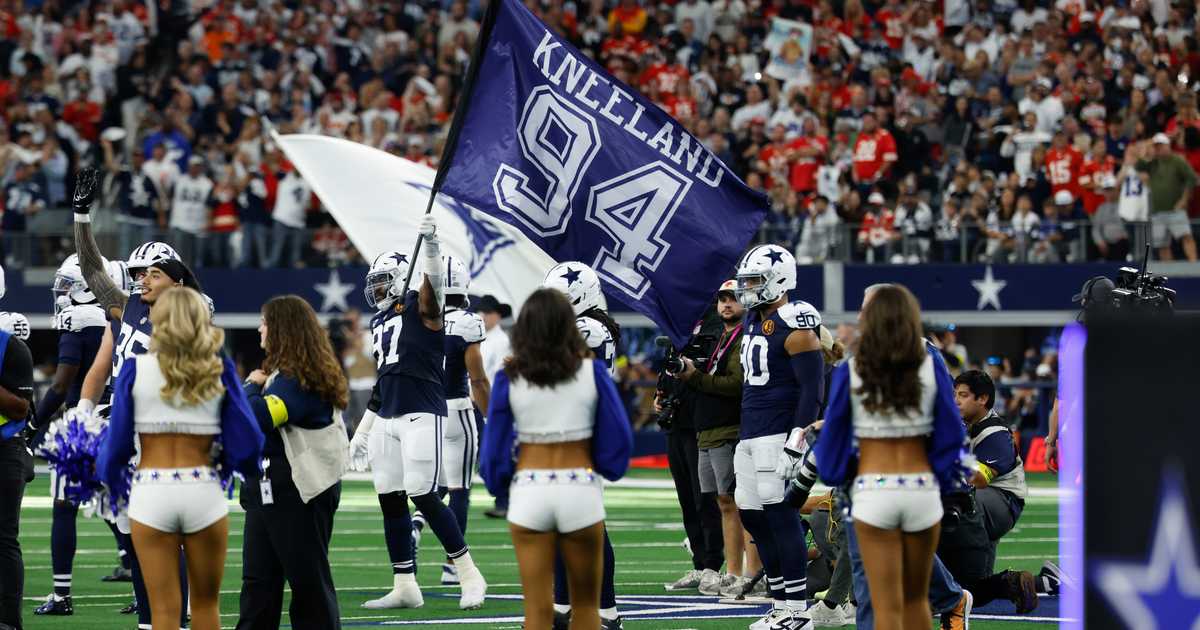
Former Dallas Cowboys defensive end Marshawn Kneeland was found posthumously to have Stage 1 chronic traumatic encephalopathy, a diagnosis announced by the Concussion & CTE Foundation after researchers at Boston University examined his brain.
Boston University researchers determined that Kneeland had Stage 1 chronic traumatic encephalopathy (CTE), the Concussion & CTE Foundation announced Tuesday. Kneeland was 24 years old when he died of a self-inflicted gunshot wound during the 2025 NFL season, and the postmortem finding has refocused attention on head trauma in contact sports. The early-stage diagnosis does not erase the tragedy, but it does offer medical context for struggles his family and friends say he experienced.
Kneeland’s family released a statement following the diagnosis, saying they want him remembered for who he was and that the finding helps explain what he may have faced. The family’s full words appear below in their original form.
https://x.com/TMZ/status/2074535206233440717
While this diagnosis does not change the tragedy of his passing, it provides important context about some of the struggles he may have been facing. We continue to remember Marshawn with compassion for the person he was, rather than defining him by the final moments of his life.
Kneeland was in just his second NFL season and had appeared in 18 games with the Cowboys before his death. His on-field career was brief but intense, and his passing came amid active roster duties and the pressures that come with professional play. Team and community responses after his death reflected shock and sorrow, and the CTE finding has amplified questions about long-term player safety.
The timeline of events around his death has been widely reported: on the night of November 5, 2025, a Texas Department of Public Safety trooper pursued Kneeland after he allegedly sped through an intersection at more than 145 mph. The trooper lost sight of the car, which was later found crashed with a holster left behind, and Frisco police found Kneeland’s body in the early morning of November 6, 2025, after he had texted a group chat saying “Goodbye.” Police noted that Kneeland had previously expressed suicidal thoughts.
The diagnosis has reignited a wider conversation about the risks tied to repeated head impacts in football and other contact sports. CTE is described as a four-stage disease linked to repeated head trauma and it can only be confirmed after death through microscopic examination of brain tissue. Boston University’s CTE Center has reported testing hundreds of former athletes, and its published totals show a high number of positive cases among those examined.
Boston University’s findings are stark: their center diagnosed CTE in 345 out of 376 tested former NFL athletes, underscoring how often pathology shows up in players whose brains have been studied. That sample, while not a random population study, has driven urgent debate about how the sport manages collisions and long-term health. Medical experts stress the limits of current prevention efforts and the challenge of translating pathology results into practical protective measures.
Chris Nowinski, co-founder and CEO of the Concussion & CTE Foundation and a former professional wrestler, has been vocal about what the science means for prevention. He cautioned that adapting concussion protocols and advanced headgear alone do not prevent CTE because it is “caused by repeated head impacts, not just concussions.” Nowinski added, “If we want to reduce CTE risk, we must implement CTE prevention protocols and aggressively reduce the number and strength of head impacts at every level of the game.”
The history of CTE stretches back nearly a century: the condition was first identified in boxers by pathologist Dr. Harrison Martland in 1928 as “punch drunk syndrome,” and the term chronic traumatic encephalopathy emerged in the medical literature by 1949. The NFL’s first widely publicized confirmed case involved Mike Webster, a long-time center who was later diagnosed with CTE by neuropathologist Dr. Bennet Omalu in 2005 after Webster’s death in 2002 at 50 years old. Those early cases helped open the modern inquiry into how repeated head impacts change the brain.
The Kneeland diagnosis is one more data point in a growing archive of postmortem findings that researchers, families and leagues must reckon with. Across youth leagues, college programs and the pros, conversations about reducing contact, changing practice routines and improving monitoring have accelerated, but the science continues to show difficult trade-offs. For now, Kneeland’s family and the medical teams involved have added their names to a long list of players whose posthumous exams are informing the debate about player safety and the future of collision sports.