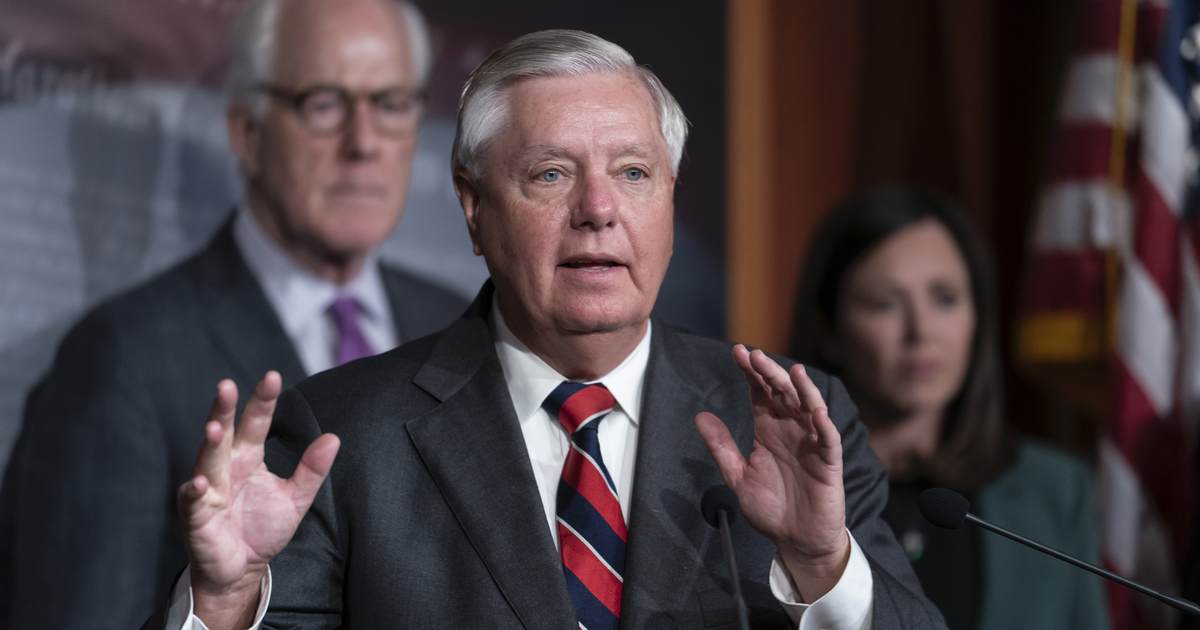
Sen. Lindsey Graham’s sudden death leaves a gaping hole in Republican politics, removing a rare Senate figure who could bridge the White House and Capitol Hill, shepherd major bills, and handle delicate national security work.
Lindsey Graham had his critics, but few could match his knack for getting things done inside the Senate and across the aisle. He brought decades of service, deep national security chops, and a willingness to sit down and make deals that advanced conservative priorities. Losing that mix of experience and access hits the GOP at a vulnerable moment.
Graham died suddenly at his Washington residence after a brief illness, with preliminary reports pointing to an aortic dissection. He had just returned from a trip to a Ukrainian drone production facility and had told aides he wasn’t feeling well, but he chose to delay care until after a public appearance. At the time of his death he was pushing major initiatives: a US-Saudi defense treaty, work toward normalizing Israel-Saudi relations, new Russian sanctions, and efforts to advance the SAVE America Act.
President Trump reacted with clear sorrow and stressed what made Graham indispensable: his ability to connect with both sides and move legislation forward. That unique channel between the White House and the Senate made Graham a go-to problem solver, someone who could carry the president’s priorities through tricky legislative terrain. His sudden absence leaves those lines of communication frayed.
The late senator was a close ally of Trump’s, and the president described him to “Meet the Press” as someone who was “like a member of the family to me.” The two spoke regularly on the phone and golfed together. Graham had just returned from a trip to Ukraine before his sudden death.
The president said that Graham called him in the early evening to discuss the SAVE America Act, a bill that would reshape how elections operate but does not have enough support to pass the Senate.
“He actually said he was tired, but he wanted to pass the SAVE America Act, and I said, ‘Well, we’re going to get it done, Lindsey. We’re going to get it done. I’ll see you, like, soon,’” Trump told “Meet the Press” moderator Kristen Welker, adding that the two believed they might meet on Sunday.
In a separate interview on CNN’s “State of the Union,” Trump said that Graham was also “telling me about the trip” in their phone call, noting that the senator “had a great trip.”
Trump remembered the late senator as someone with a “unique ability,” saying that Graham could work out issues with Democrats and that he “loved being a politician.”
“If I had a problem, a real problem, I wouldn’t often ask. But if I had a problem with a Democrat, he could work it out,” Trump said. “He was a great, he was a great politician, actually.”
At the same time, Trump said, the senator could be a “tough cookie.”
“If he wanted to get something, if he thought he was right, and he had people against him, he could be very tough, actually,” Trump said. “But he was a good person.”
Graham’s track record was concrete: he moved high-profile bills, negotiated sensitive bipartisan deals, and eased tensions between Senate Republicans and the White House when necessary. That practical influence translated to wins on immigration enforcement, national security measures, and sanctions policy. He was the kind of senator who could translate the administration’s goals into Senate reality.
Political insiders say no obvious successor steps into Graham’s exact role. Other Republicans have strong ties to the president, but few combine long Senate tenure, deep foreign policy experience, and the personal rapport with the White House that Graham held. Replacing that specific blend of trust and institutional muscle will be difficult.
Trump said Graham called him just hours before he died to discuss the SAVE America Act, the GOP elections bill that has stalled for months in the Senate. Graham supported the legislation but frequently explained how most Senate Republicans did not want to eliminate the 60-vote filibuster rule to pass it.
It was one of several points of friction between the White House and the more tradition-bound Senate that needed to be smoothed over by Graham and others during Trump’s first and second terms.
He eased tensions during hot conversations between Senate Republicans and the president, and helped shepherd last year’s “big, beautiful bill” and this year’s immigration enforcement bill. But Graham’s power had its limits: He was among the most ardent supporters for strong U.S. support for Ukraine, a position Trump didn’t embrace as fervently.
“His role in the Senate and his role as a liaison between the administration and the Senate and trusted confidant and adviser was colossal,” said a White House official who like others in this report was granted anonymity to discuss internal dynamics. “It’s a devastating development. Everyone who touches the legislature and the administration is crushed.”
Graham’s ability to communicate with and persuade the executive branch was “multidimensional — from rounds of golf, to appearances on television, to dinner with administration officials,” a person close to the administration said. “I think the senator saw his relationship as a loyal and longtime friend trying to help navigate the president’s priorities through the Senate.”
In turn, “Senate leadership saw Lindsey as a key link — whether as a colleague, chairman, counselor, or conduit,” the person said.
There are several Republicans with strong relationships with the White House. Still, replacing the role that Graham filled — combining a close relationship with Trump, the ability to cut deals with Democrats and decades of national security experience — won’t be easy. Graham’s death comes after another Trump White House ally in the chamber, former Oklahoma Sen. Markwayne Mullin, departed to become Homeland Security secretary.
[…]
One Republican senator said no other colleague could step into the role Graham played.
“Lindsey knew his place, but he was the only senator who could tell Trump what he didn’t want to hear and not face his backlash,” the lawmaker said. “A lot of us can talk to the president but no one can deal with the president like Lindsey did.”
Other senators including Katie Britt of Alabama, Rick Scott of Florida, Eric Schmitt of Missouri, and Bill Hagerty of Tennessee are known to speak frequently with Trump. But none bring the long experience in the Senate and the volume of relationships domestically and abroad that made Graham a singular resource for the president — to say nothing of his personal skills in translating between the White House and Capitol Hill.
“Lindsey spoke Trump more fluent than anyone in the Senate,” said a senior adviser to a Republican senator.
[…]
During the long shutdown of the Department of Homeland Security earlier this year, Graham traveled with Sens. Britt, Bernie Moreno (R-Ohio) and Steve Daines (R-Mont.) to the White House in March in a bid to sell Trump on a plan to use the reconciliation process to end the standoff with Democrats. And he and Senate Majority Whip John Barrasso (R-Wyo.) went to the White House in April to pitch Trump on the Senate’s vision of a narrowly tailored immigration funding bill. The president, in a win for Thune and Graham, endorsed the Senate’s strategy shortly after the meeting.
After Trump blew up plans to renew a key surveillance tool and Jay Clayton’s director of national intelligence nomination in June, Senate Republicans privately floated Graham as someone who could help detangle the stalemate with Trump given his relationship with the president and role as a national security hawk, according to two people granted anonymity to speak candidly.
Graham was also part of a bipartisan group of senators who had spent months negotiating with the White House over a new package of sanctions targeting Russia’s trading partners — announcing just last week that they had reached an agreement with the administration allowing it to move forward.
When Graham wanted something done, it often became law. His ability to move policy from conversation to congressional text is a practical loss for anyone serious about advancing conservative reforms. Without him, the legislative rhythm and the certainty he provided are suddenly missing.
https://x.com/SophiaCai99/status/2076295117866926082?ref_src=twsrc%5Etfw
Sen. Katie Britt of Alabama is one name floated as someone who might shoulder parts of Graham’s role, but it will take time to see if any senator can match his reach and resolve. For now, the party and the White House must figure out how to navigate without the steadying presence he supplied.