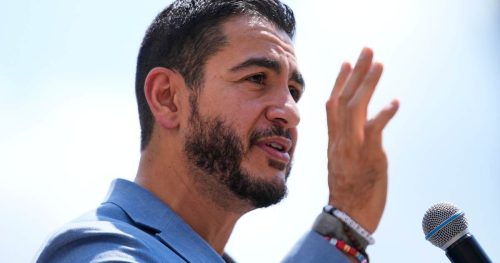
Summary: A San Francisco Board of Supervisors race has been rocked by an accusation of groping involving a local activist turned candidate, amid other high-profile sex-allegation headlines hitting the national scene.
On the same day a rape allegation was dropped against Graham Platner and ended his Maine Senate run, San Francisco found itself dealing with its own reputation problem in local politics. A candidate for a Castro neighborhood seat faces a serious personal accusation going back to 2020, and the fallout has been swift within the city’s political circles.
The person accused is Manny Yekutiel, the owner of Manny’s Café, a well-known spot in the Mission District where Democratic figures and donors have gathered. The allegation comes from Brad Chapin, who says an encounter at a 2020 house party turned violent and humiliating, and the story has already prompted some public supporters to step back.
Chapin described the incident in blunt terms to local reporters, saying he was grabbed and held in a manner that caused pain and shame. Local authorities looked into the matter but the investigation did not lead to charges, and the case was apparently dropped. Yekutiel denies the claim in the strongest possible terms.
A well-connected San Francisco activist turned political candidate is facing an allegation that he groped an acquaintance at a party in 2020.
Manny Yekutiel, a cafe owner who’s hosted top Dems like Kamala Harris, Gov. Gavin Newsom and former First Lady Jill Biden at his Mission District hotspot Manny’s Cafe, is facing the upsetting sexual assault claim as he campaigns to represent the famed Castro neighborhood on the San Francisco Board of Supervisors.
Brad Chapin, a city gardener, alleged that Yekutiel brazenly accosted him at a house party in 2020 — grabbing his testicles before insulting his physique in claims first detailed by the San Francisco Standard.
Chapin alleged that a “sweating” Yekutiel approached him at a February 2020 party and painfully clenched his genitals “like an animal,” according to the report.
“He grabbed me, and I was trying to get away. He wouldn’t let me go,” Chapin told The Standard. “He stuck one of his hands down my pants and grabbed me and was squeezing me and intentionally causing pain.
“It was bizarre. He literally had me by the testicles. It was intentionally sexually demeaning,” he added.
[…]
Yekutiel, a Los Angeles native, gained fame as an influential Democratic organizer known for hosting political and civic discussions, phone banks, watch parties and other community events at his popular cafe.
The cafe became an essential stop for rising Democrats to help raise money and rally support in the progressive stronghold of San Francisco.
[…]
But a handful of those supporters, including Attorney General Rob Bonta, Supervisor Myrna Melgar and Rep. Lateefah Simon, rescinded their endorsements after Chapin’s allegation, The Standard reported.
The allegation has political consequences beyond the personal accusations: several endorsements were rescinded, and the incident is now a campaign issue in a city that prides itself on progressive values. The atmosphere in local politics makes any accusation especially damaging when leaders have cultivated reputations around community standards and inclusion.
Manny’s Café has been a gathering place for high-profile Democrats, and that visibility cut both ways when the claim surfaced. The association with prominent figures and fundraising activity at the cafe means the accusation has been amplified in public conversation about accountability and vetting candidates.
Yekutiel is opposing Gary McCoy, who previously served as a top aide to Nancy Pelosi, in the race for the Castro seat. The matchup has become more than a neighborhood contest because it now involves questions about character, credibility, and who gets to represent the neighborhood’s culture and values.
Local activists and neighbors are watching closely, and some of the reaction has come from within the Democratic establishment that once embraced the cafe owner. The police action that followed the allegation ultimately did not produce charges, but the political consequences moved quickly regardless of the legal outcome.
That tension between legal closure and political fallout is familiar in campaigns across the country, where allegations can stick and endorsements can evaporate even without a conviction. In San Francisco, where public image and progressive credentials matter deeply, these kinds of stories can shift races and reputations overnight.
Regardless of the final political or legal result, the episode underscores how local races can be upended by personal conduct allegations and how networks of support react when a candidate’s past is scrutinized. For voters in the Castro and beyond, the choice will now weigh the claims, the denials, and what each candidate represents for the neighborhood’s future.