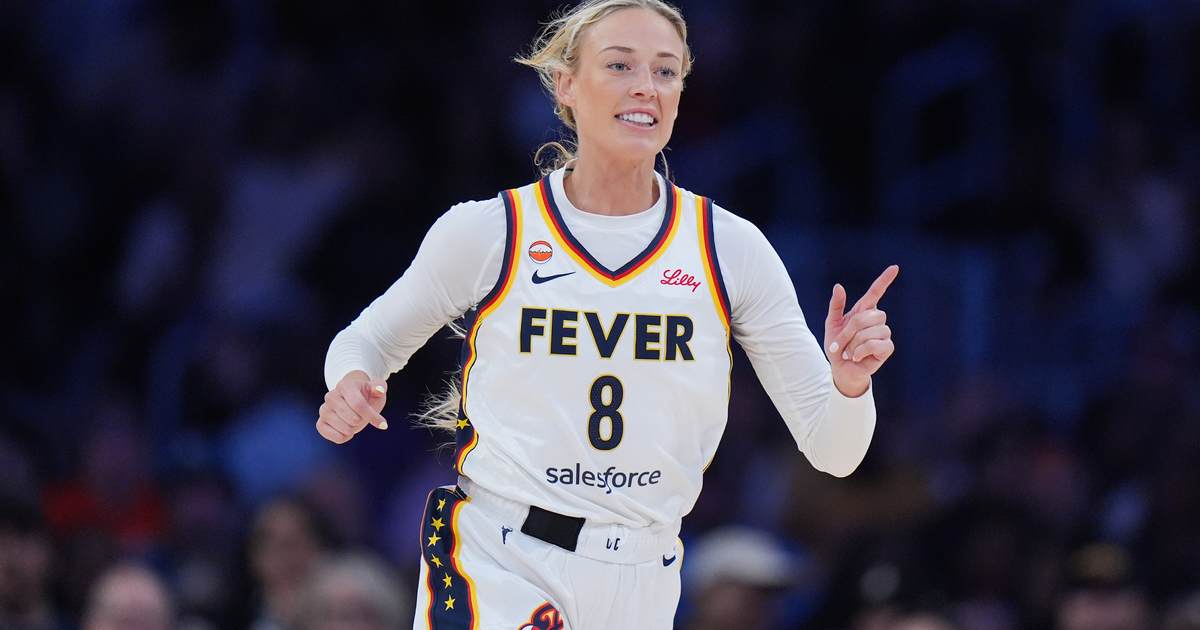
The WNBA keeps stumbling through a controversy over men in women’s sports, coaches dodge hard answers, fans turned a game into a political scene, and Sophie Cunningham’s stand has become the moment everyone is talking about.
The WNBA keeps digging itself into a hole after Indiana Fever guard Sophie Cunningham openly pushed back on letting men into women’s sports, and the league’s response has been weak and muddled. Coaches who should be defending women’s basketball have instead offered confusion, equivocation, or refusal to take a firm stance. That silence matters because sports need clear rules that protect competitive fairness and the safety of women’s leagues.
Indiana Fever coach Stephanie White was asked directly about barring men from the league and claimed she didn’t believe “that exclusion is an answer.” White added, “I don’t know, when we talk about biological male and scientifically where we are, I think it’s a totally different scenario,” and admitted, “I’m not educated enough in terms of transgender and transitioning to give you a smart answer. I would say though that I just don’t feel like exclusion is an answer. We need to have deeper and more layered conversations.”
Those words sound thoughtful until you realize they are the sort of noncommittal language that lets a problem fester. White then described the debate as “a part of our growth as a league.” That phrasing treats a basic fairness question like a PR problem to be managed rather than a policy to be decided.
https://x.com/JackThompsonFOX/status/2083370966948643001
Portland Fire coach Alex Sarama was asked the same issue and replied by saying he supports “people from all communities and all walks of life,” then declined to answer when pressed about men playing in the WNBA. Avoiding the question doesn’t neutralize the controversy; it hands momentum to the loudest activists and leaves the players who compete under women’s rules without a clear defender. Fans notice that lack of backbone and react accordingly.
The crowd at the Fever-Fire game made its own political point. Some fans waved gay and transgender pride flags and kissed on the jumbotron in a clear response to Cunningham’s stance, and they booed her when she had the ball. Those boos were temporary — the same crowd cheered when Cunningham sank a three — but the spectacle underlined how much the league has become a political theater rather than a place to simply celebrate women’s sport.
Out on the court, Cunningham kept her focus and even created a warmer moment after the win by giving a young Fever fan one of her game-worn shoes, a viral gesture that cut through the noise. Moments like that remind viewers why fans show up: to see athletes who compete and care about the game. The league, however, keeps letting controversies distract from play, and that’s on management and vocal leaders to fix.
Cunningham’s position has made her a lightning rod, but it’s also forced the league to confront its direction. The WNBA will either set clear eligibility rules grounded in biology and competitive fairness or it will continue to flounder, letting coaches and executives dodge responsibility while the debate burns hotter. That indecision costs credibility and risks alienating many long-time fans who want predictable standards.
Cunningham’s heroic stance has largely overshadowed much of the controversy surrounding the league’s treatment of fellow Fever star Caitlin Clark, who currently isn’t featured in the MVP race despite posting one of the best in the WNBA. The optics are disastrous: a league that can’t answer simple fairness questions also seems to mishandle how it recognizes and rewards its top performers. Political theater should not dictate awards or the basic structure of competition.
The WNBA’s leadership needs to stop treating this like a PR problem and start treating it like governance. Coaches must stop offering fuzzy answers that protect nobody, and owners need to set transparent policies that protect women’s competition. Without that, the league will keep losing credibility and giving up ground to activists who profit from chaos while athletes lose clarity about the rules under which they compete.