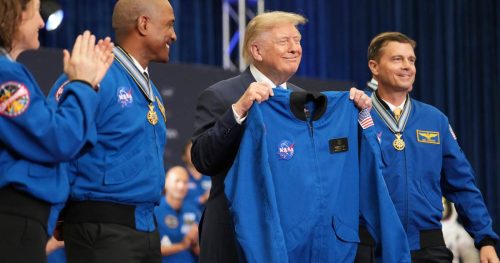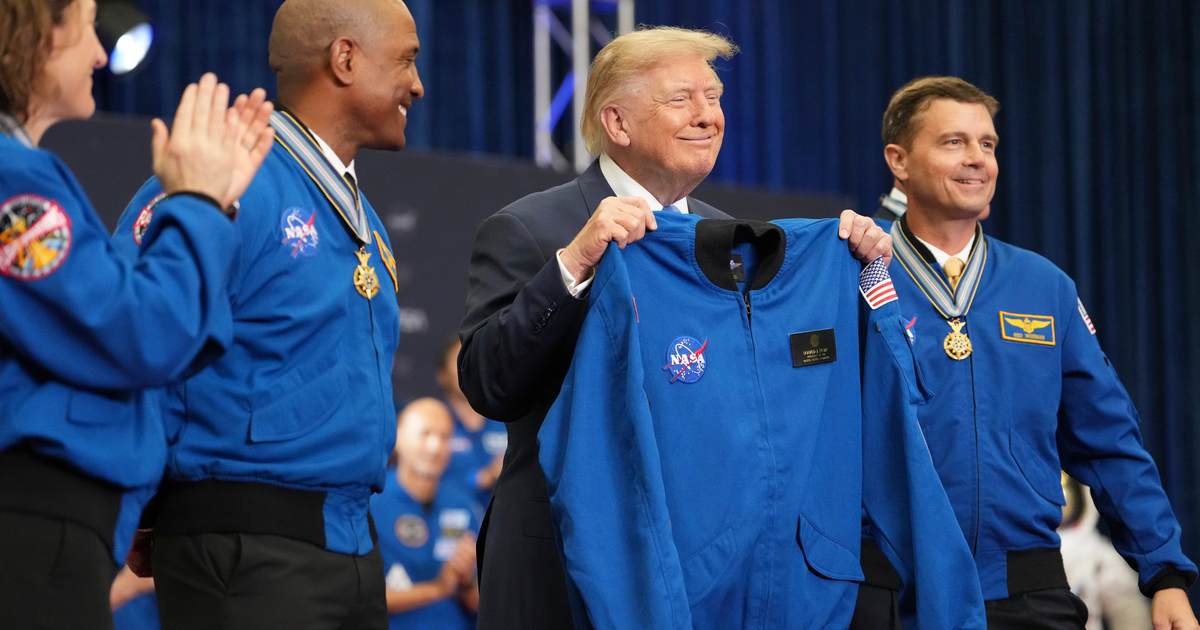
President Trump’s recent visit with astronauts in Houston and the comments from NASA’s press office have stirred discussion about a renewed, more aggressive American space agenda centered on strategic advantage, civil milestones like moon bases, and next-generation propulsion such as nuclear spacecraft.
In Houston, senior NASA personnel described the momentum building behind federal space initiatives and credited recent White House priorities with motivating the agency. The conversation shifted from routine visits to bold language about permanent lunar presence and rapid advancement of mission capabilities. That tone reflects a broader political push to reassert U.S. leadership in space.
NASA’s press secretary told reporters that Trump has been “the most revolutionary space advocate and the best president for space of our time” – a claim that intentionally compares current ambitions to those of the Kennedy era. The comparison is framed around the scale of projects now being planned, not just symbolic gestures. Officials emphasize that the program’s ambition is what sets it apart.
Officials point to concrete moves, like honoring the Artemis II crew with top distinctions and plans to expand training infrastructure with a United States Space Academy concept. “I mean, you look back, you have Kennedy saying to go to the moon, but you have President Trump establishing a moon base, launching a nuclear spacecraft,” she noted. Those are the kinds of specific, headline-grabbing initiatives driving internal enthusiasm at the agency.
NASA staff describe a work tempo they say hasn’t been seen since the late 1960s. “This agency has not worked this hard since the late 1960s, early 1970s to accomplish an objective. And it was the catalyst of the first space race, race to the moon, which in hindsight we had all of the margin in the world because no one has gone back since us,” the press office said, underscoring a sense of purpose tied to strategic competition. That historical perspective is being used to justify a faster cadence of missions and technology demonstrations.
National security concerns are a frequent theme when leaders discuss the push into lunar and deep-space efforts. “Now we see a real threat with China and people are responding in kind and living up to the challenge and meeting the moment,” Stevens added, framing the buildup as an answer to adversaries’ growing capabilities. For many policymakers, space is now the central theater for demonstrating technological and military edge.
Americans have not walked on the moon since 1972, and agency officials are blunt about getting people back there regularly. They express confidence that renewed activity will normalize lunar missions and eventually make moon visits routine. “without a shadow of doubt,” was the phrase used to convey that certainty about future manned lunar operations.
The expectation from senior officials is that public interest will evolve once the operations become steady-state rather than episodic. “I think what’s actually ultimately going to happen is Americans are gonna get really used to seeing moon landings,” she said, arguing that frequent missions will shift public perception. To illustrate how normalization works, she referenced broadcast fatigue around the Apollo era.
Her recounting of the Apollo-era media reaction was blunt: “What we saw happen in the 1970s is there were three network news options. All three of them were initially taking Apollo launches, and then we got to a point where they refused to take moon walks, moon landings […] because it had already been done. It was so overdone that people were like, ‘Yeah, yeah, we’ve seen this before,’” she added, using the example to argue that frequency reduces spectacle and builds steady support. Officials expect modern media and streaming will simply make lunar activity another part of everyday science coverage.
https://x.com/NASA/status/2093459546425475519
The eventual goal, according to the administration’s space advocates, is a permanent human presence on the moon supported by live feeds and continuous operations. “We’re gonna be in a world where it becomes normalized. Like the administrator [Jared Issacman] talks about it all the time, we’re gonna have a live feed on our moon base where astronauts will be living and working just like we do on the International Space Station,” Stevens continued. “And people are going to be able to get online […] and immediately be able to see a live feed on the moon.”
Beyond public fascination, leaders stress the practical and defensive benefits of dominance in orbit and beyond. “If you’re able to secure superiority in the ultimate strategic high ground, that is something that will impact people’s everyday lives,” Stevens said, pointing to spin-offs from space tech that touch terrestrial communications and security. That argument ties exploration to national resilience and industry growth.
One of the more transformative technical projects discussed is the Space Reactor-1 (SR-1) Freedom, billed as “the first interplanetary nuclear spacecraft” and targeted for a Mars-bound demonstration in December 2028. Officials say testing nuclear propulsion and renewable power concepts in space could change mission economics and timelines. “We’re testing something with renewable energy and space. Eventually, we’ll want to get that technology human rated,” she said, and she added that “it completely changes the game. We’d be light years ahead of every single adversary in space, every single nation in space.”
The message from the administration and its space partners is straightforward: secure the high ground, make exploration routine, and maintain a technological edge. “We’ve established space superiority. We’re maintaining it at this point. But with nuclear space travel, it blows everything outside of the water,” she said, summarizing how leadership in propulsion and infrastructure could reshape global dynamics and cement long-term American influence in space.