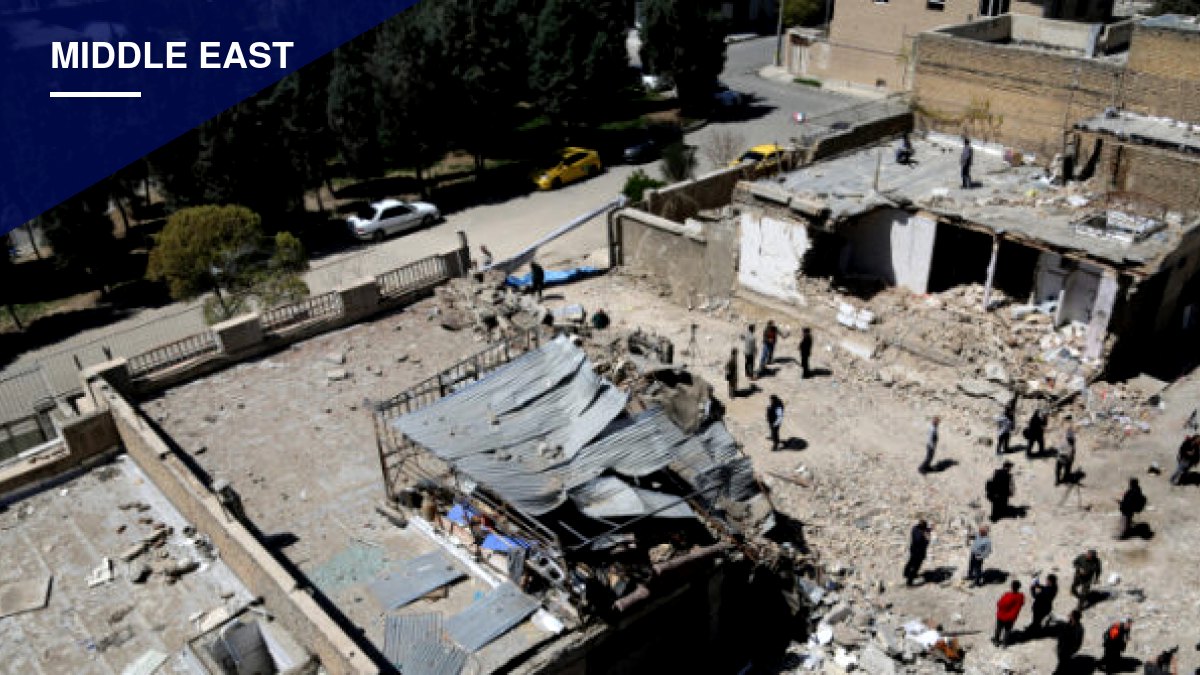
Jordan’s air defenses shot down 10 of 13 ballistic missiles fired from Iranian territory on Tuesday, in an attack that included a strike on Camp Titin, a U.S. military facility near Aqaba. The three missiles that got through landed in remote areas away from population centers, and the Jordanian Armed Forces reported no injuries or deaths.
The attack came hours after U.S. forces launched a fresh round of strikes on Iranian military targets across the country’s south, which Washington described as retaliation for Iranian threats to shipping in the Strait of Hormuz and for an earlier missile attack on U.S. forces in Jordan that took place three days earlier.
A U.S. official told ABC News that American forces shot down Iranian missiles during Tuesday’s attack. Two U.S. officials told Reuters no American casualties had been reported, and a U.S. source told Al Jazeera that the strike on Camp Titin caused no injuries or major damage.
Iran’s account of the attack differed sharply. The Islamic Revolutionary Guard Corps claimed its Aerospace Force carried out a “heavy ballistic missile attack” on Camp Titin and alleged that numerous American personnel were killed and several facilities and attack helicopters destroyed. Those claims were not corroborated by U.S. or Jordanian authorities.
Jordan said its surveillance and air-defense systems remained on high alert as the military continued monitoring the situation.
Second attack in three days
Tuesday’s barrage was the second Iranian missile attack involving U.S. forces in Jordan within three days. On Sunday, U.S. Central Command struck two IRGC launchers on Iran’s Larak Island after saying Iranian forces were preparing rockets carrying sea mines for launch into the Strait of Hormuz. Iran responded with ballistic missiles toward U.S. forces in Jordan, and Jordanian defenses intercepted eight of them at that time.
President Donald Trump cited that earlier attack as part of the justification for the U.S. strikes carried out on Tuesday, which CENTCOM said began at noon Eastern time and targeted IRGC air-defense sites, radar systems, maritime assets, mine-laying capabilities and communications sites. CENTCOM announced Tuesday evening that the operation had been completed successfully.
Trump warns of harsher response
Speaking by phone with Fox News chief foreign correspondent Trey Yingst as the strikes were underway, Trump said Iran would face far greater consequences if it kept attacking American forces.
“If they do respond, they’ll be hit much harder. This is a very big hit today. If it goes a third time, they’re going to be totally wiped out as a country,” Trump said.
Trump also told Yingst that the U.S. had deliberately waited to strike Iranian radar systems until Tehran had nearly finished rebuilding them.
“They tried to rebuild their radar because they can’t see anything,” Trump said. “We waited until it was almost built and then we hit it.”
U.S. officials had told Axios ahead of Tuesday’s operation that the strategy involves periodically hitting Iranian radar, air-defense and anti-ship missile capabilities as Tehran tries to rebuild them around the Strait of Hormuz — an approach one official described as “mowing the lawn.” Trump pointed to the aircraft carrier USS George Washington, which arrived in the region last week, as evidence of further capacity for strikes, saying it was “loaded to the gills.”
Region widens
Iranian media reported strikes across a broad stretch of southern Iran, including Bandar Abbas, Qeshm Island, Chabahar, Konarak, Jask and Sirik, as well as on the outskirts of Ahvaz in the southwest. Iranian authorities claimed four people, including a child, were killed and more than 50 wounded when a residential home hosting a wedding near Sirik was struck. Iran’s Foreign Ministry blamed the United States for that strike, and the IRGC cited it in announcing what it called a second wave of retaliation.
The exchange spread further Tuesday evening as officials in Kuwait and Bahrain reported activating air defenses against incoming Iranian drones. Kuwait’s military said it was responding to “hostile drones” linked to Iranian aggression, with no reports of injuries or damage in either country. Iran’s army said its drones were targeting radar installations and areas housing U.S. forces at Sheikh Isa Air Base in Bahrain.
CENTCOM said more than 50,000 American service members across the Middle East remained “vigilant, lethal, and prepared to continue executing operations directed by the Commander in Chief.”
Diplomacy in doubt
Hours before the latest exchange, Iranian President Masoud Pezeshkian said Tehran was prepared to return to the June ceasefire framework if Washington resumed what Iran considers its commitments under that agreement. Trump dismissed the prospect later Tuesday, telling Fox News: “I think an agreement with them isn’t worth the paper it’s written on. We gave them a lot of chances.”