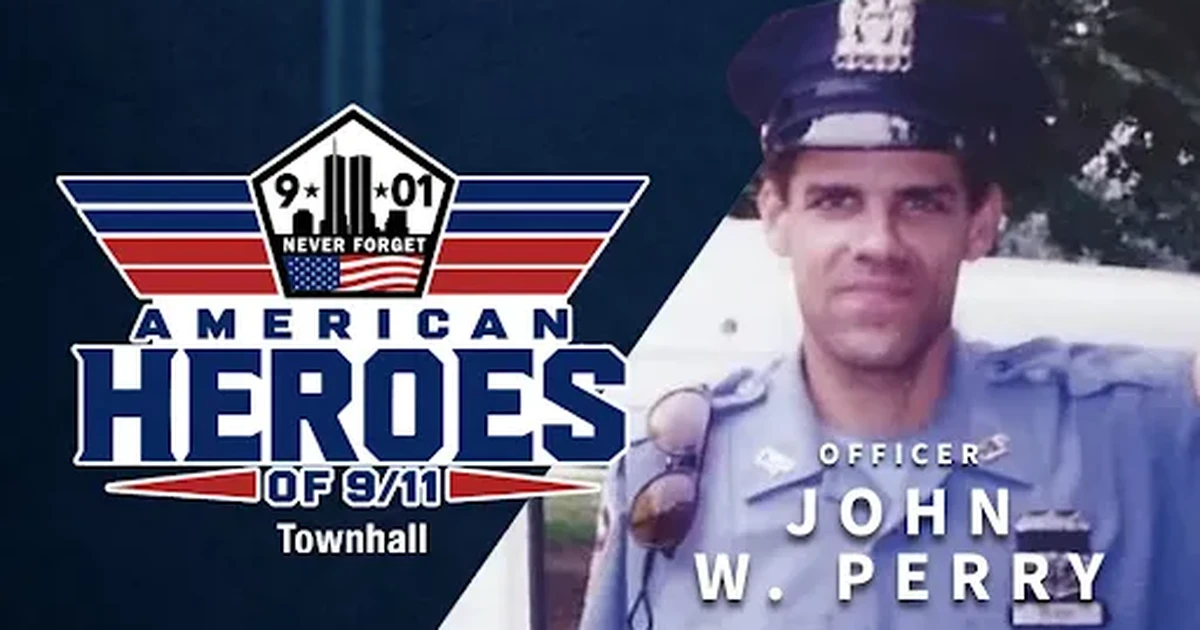
Officer John W. Perry left a legal career lined up but grabbed his badge on September 11, 2001, returning to the streets of Lower Manhattan to help strangers, guiding people to safety before he vanished in the North Tower collapse; his remains were recovered March 7, 2002, his badge and Seaford High School letterman patch are displayed at the 9/11 Memorial & Museum, and his name appears on Panel S-24 of the South Pool.
John W. Perry had already decided to leave the NYPD after eight years and had a job waiting at a Manhattan law firm when the first plane struck the World Trade Center. He reclaimed his badge, put on an NYPD shirt, and went straight to Lower Manhattan to assist his fellow officers and civilians. That choice would define his final day.
Perry’s early life included real academic struggle; he was diagnosed in first grade with learning disabilities and spent years in special education. He didn’t learn to tie his shoes until age nine, yet he pushed forward, finished law school, and found a passion for languages. He learned French in eighth grade and later spoke French, Russian, Spanish, Swedish, and Portuguese.
Before September 11, Perry ran marathons, acted in television and film, and balanced multiple interests. He appeared in shows and movies such as NYPD Blue, The Devil’s Advocate, and Die Hard with a Vengeance, bringing a unique mix of grit and charisma to his off-duty life. Those pursuits never overshadowed his commitment to public service.
On September 9, 2001, he spent the day with Norman Siegel, then running for public advocate, working in both English and Spanish. “We spent September 9 driving around in his car as he made campaign announcements in English and Spanish,” Siegel recalled. “I was convinced he would run for office himself one day.”
Perry was known among friends for his generosity and quiet support of others who needed help. Vladimir Azbel remembered asking Perry what to do about $1,700 in parking tickets; “‘Yeah, don’t worry. Just don’t get anymore tickets,'” Azbel said. “Later on I found out that he just paid them.”
His apartment became an open place for friends in need, and he was active in civil liberties circles, joining the Nassau Chapter of the New York Civil Liberties Union. Executive director Barbara Bernstein described him plainly: “He sort of out-libertarianed us. If someone thought it wasn’t the right timing or [a case] wasn’t winnable, he was an idealist. He made us justify what we were doing.”
When Perry reached the World Trade Center on September 11, he worked in the North Tower lobby alongside other officers helping shocked workers and visitors find exits. He guided stunned people away from windows and toward safer routes down the stairs and away from the plaza. “It was sheer pandemonium,” said Timothy Pearson, who was also working in the lobby.
The officers had to keep moving frantic crowds under impossible pressure. “We had to grab [shocked people] and keep them moving toward the escalator,” said Morse, another officer on the scene. Amid falling debris and panic, Perry remained calm and hands-on, helping to shepherd people to safety.
A woman collapsed in the lobby complaining of chest pains and could not go on; Perry and Pearson took her by the arms to help her move. Then a thunderous sound filled the lobby like a waterfall — Morse heard it and recognized the danger: the South Tower was collapsing at 9:59 AM. The North Tower would fall less than 30 minutes later at 10:28 AM.
Pearson and Morse both escaped the North Tower collapse, but Officer John W. Perry and the woman he was aiding were never seen again after that morning. For months and years the loss was felt deeply by family, friends, and colleagues who could not let go of his absence.
On March 7, 2002, crews recovered Officer Perry’s remains in the rubble at Ground Zero. His badge and his Seaford High School letterman patch were later placed on display at the 9/11 Memorial & Museum. His name is engraved on Panel S-24 of the South Memorial Pool.
On September 5 of this year the corner of East 101st Street and Madison Avenue was renamed John William Perry Way to honor his memory and sacrifice. He had retired officially the morning of September 11 to pursue a different career, yet he chose one more shift to help others and paid the ultimate price.
He was 38 years old when he died, and his mother remembered the son who would not be defined by early labels. “I always wondered why John did so much,” said his mother, Patricia Perry. “As a child, he was classified as having a learning disability, but he rose