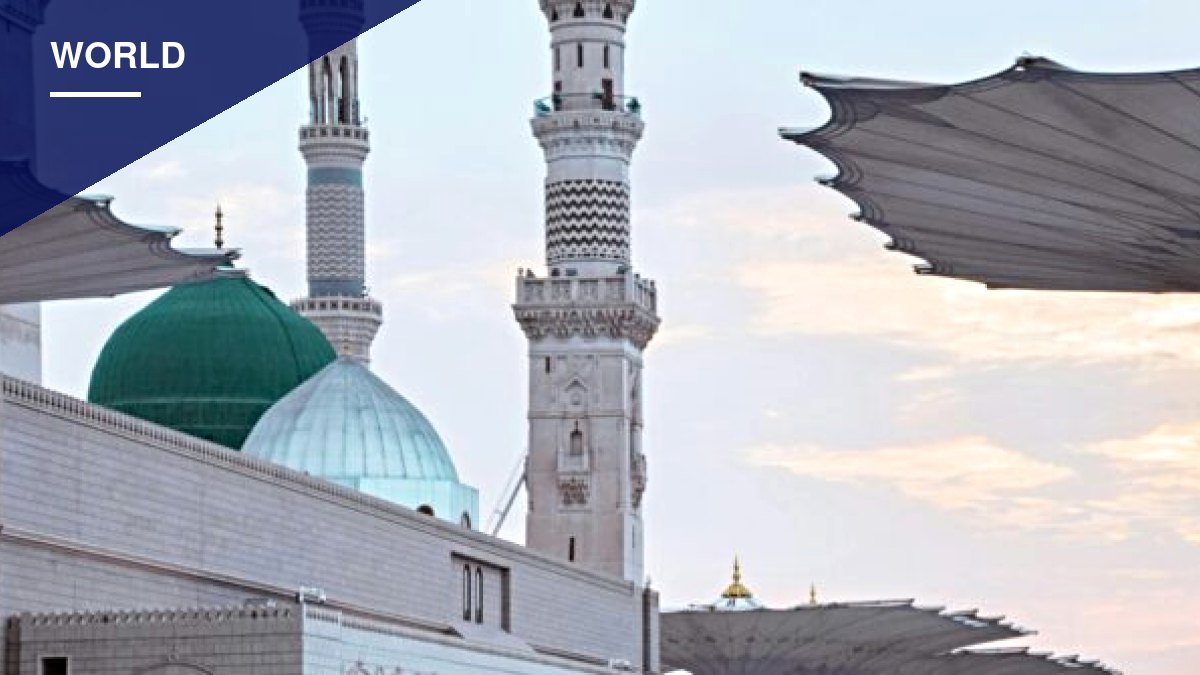
Saudi Arabia says it has discovered a massive deposit of rare-earth minerals and uranium in Medina, the second-holiest city in Islam, that the kingdom plans to develop as part of its push to diversify away from oil.
Saudi Energy Minister Prince Abdulaziz bin Salman announced the find on Monday at the annual conference of the International Atomic Energy Agency (IAEA), the United Nations’ nuclear watchdog. According to the Saudi outlet Al Arabiya, the prince said the government believes a mix of rare-earth materials and uranium concentrations totaling 110 million tons has been located in Medina.
The announcement comes after the White House said earlier this year that President Donald Trump had approved an agreement to help Saudi Arabia develop nuclear energy for peaceful purposes, including power generation and medical use. It also arrives at a difficult moment for the kingdom’s oil sector, as Iran and its proxies continue to disrupt shipping across the Middle East.
Prince Abdulaziz said Saudi Arabia intends to use the newly identified resources to help diversify its economy, and he called the discovery “among the most significant rare earth mineral resource sites currently under development globally.”
Assurances on Nuclear Intent
The energy minister also used his remarks to insist that Saudi Arabia would follow international law on nuclear development and non-proliferation, and that it has no interest in building a nuclear weapon.
“The Kingdom follows a clear approach founded on transparency, openness and international cooperation,” Prince Abdulaziz said, adding that Saudi Arabia would not pursue a nuclear weapon “through activities conducted in secrecy or facilities concealed deep within mountains.”
That remark appeared aimed at neighboring Iran, which for years ran uranium enrichment operations inside underground mountain facilities. The largest of those sites are believed to have been destroyed in American airstrikes in June 2025.
IAEA Director-General Rafael Grossi posted a photo with Prince Abdulaziz on social media Monday following their meeting, pledging his agency’s support for Saudi Arabia’s nuclear development. “Saudi Arabia is moving forward with its nuclear power programme and research reactor, with a strong commitment to non-proliferation,” Grossi wrote. “The @IAEAorg stands ready to support [Saudi Arabia] every step of the way.”
Part of a Broader Economic Shift
Saudi Arabia has long been one of the world’s largest oil producers, and profits from its state oil company, Aramco, one of the most valuable companies in the world, have built much of the country’s modern infrastructure. But since Crown Prince Mohammed bin Salman took power in 2017, the government has pursued “Vision 2030,” a program meant to reduce the kingdom’s dependence on oil and guard against a future downturn in the industry. Nuclear power and rare-earth mineral development are both central to that effort.
In October 2017, Saudi officials said they would begin limiting uranium exports to build up a domestic nuclear fuel industry. “Regarding the production of uranium in the kingdom, this is a program which is our first step towards self-sufficiency in producing nuclear fuel,” said Hashim bin Abdullah Yamani, the Saudi official overseeing nuclear energy at the time.
Rare-earth minerals, used in batteries for laptops, phones and other technology, are an industry currently dominated almost entirely by China. In January 2025, Saudi officials launched a $100 billion mineral investment project aimed at challenging that dominance. Around the same time, Aramco said it would partner with the state mining company Ma’aden on a project to expand mineral production tied to what is often called the “energy transition” away from fossil fuels.
Later in 2025, Trump announced that he and Crown Prince Mohammed bin Salman had agreed on a joint project to develop Saudi rare-earth resources, under which an American company would take a stake in a Saudi mine and help develop it. In July, the U.S. Department of Energy signed a separate agreement with Saudi Arabia on nuclear energy, describing it as a “decades-long, multi-billion-dollar partnership” that would give Saudi Arabia access to American nuclear technology while upholding nonproliferation standards.
Grossi said last week that the IAEA had been involved in shaping that U.S.-Saudi agreement to ensure adequate oversight. “What is important is that in the consultations, in the preparation process, it has been possible to introduce a number of provisions to the bilateral agreement that will give the agency additional verification and monitoring authorisations,” he said. “These are sensitive activities, as we all know. So for those we are going to have authorisations and capacities which are very, very similar to those that you may find in an Additional Protocol.”