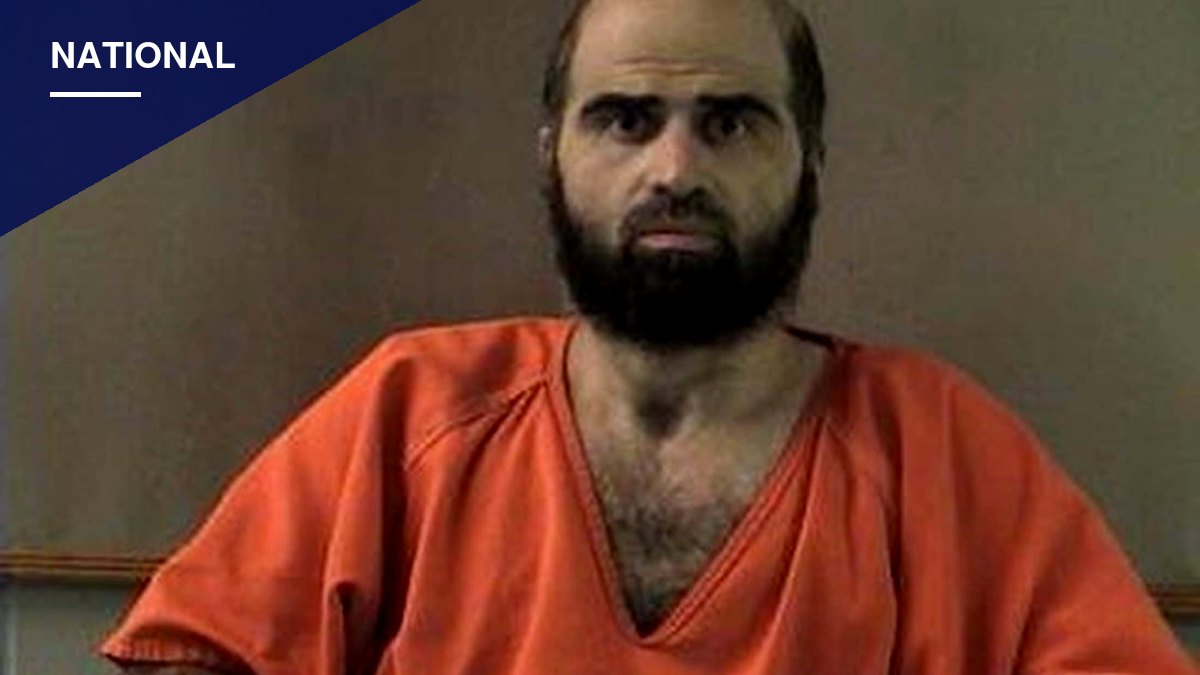
Sixteen years after the 2009 shooting rampage at Fort Hood, the U.S. Army is reportedly preparing to formally recommend the execution of Nidal Hasan, the former Army major convicted in the attack, according to an opinion piece published by the New York Post. Under that scenario, the recommendation would go to President Donald Trump for a final decision.
Hasan, an Army major, murdered 13 people and wounded 33 others at the Fort Hood military base in Bell County, Texas, on Nov. 5, 2009. Witnesses said he shouted “Allahu Akbar” while firing on unarmed soldiers.
Reed D. Rubinstein, senior vice president of America First Legal, represented victims and families of the attack in a 2012 lawsuit against the Army and the FBI. He wrote that government agencies knew of warning signs about Hasan well before the shooting but failed to act.
According to Rubinstein’s account, Hasan had made statements during his Army medical training defending suicide bombing and Osama bin Laden, and said his religious beliefs took precedence over the Constitution. His business card reportedly read “Soldier of Allah.” Two Army officers — an instructor and a colleague — separately described him as a “ticking time bomb,” Rubinstein wrote.
A 2011 Senate investigation found that Hasan’s official officer evaluation reports had recast his focus on violent Islamist extremism as legitimate counterterrorism research, and he was promoted to major despite what Rubinstein described as poor performance.
Between December 2008 and June 2009, Hasan exchanged 18 messages with Anwar al-Awlaki, the al Qaeda cleric later killed in a U.S. drone strike, asking whether military service was compatible with Islam, martyrdom and suicide operations. The San Diego Joint Terrorism Task Force, which was monitoring Awlaki’s communications, flagged the exchange and forwarded it to FBI superiors in Washington, but Hasan was not interviewed and his chain of command was not notified. A San Diego field office official reportedly was told the matter was “politically sensitive.”
In the aftermath of the shooting, President Obama’s Nov. 10, 2009 memorial remarks did not use the words “terrorism,” “terrorist” or “terror,” and Gen. George W. Casey Jr., then Army Chief of Staff, told ABC News two days later that he feared “a greater tragedy” if “diversity became a casualty” of the incident. The Pentagon subsequently classified the attack as “workplace violence,” a designation that initially denied victims Purple Hearts and combat-related benefits.
In 2015, Congress passed legislation requiring the Obama administration to award Purple Hearts and related benefits to the victims of the attack.
Rubinstein’s piece argues that the Trump administration, under Defense Secretary Pete Hegseth, is working to remove what he calls a longstanding policy of downplaying Islamist extremism within government, military and immigration institutions, though he contends similar patterns persist in academia, local bureaucracies and allied nations’ government and military circles.