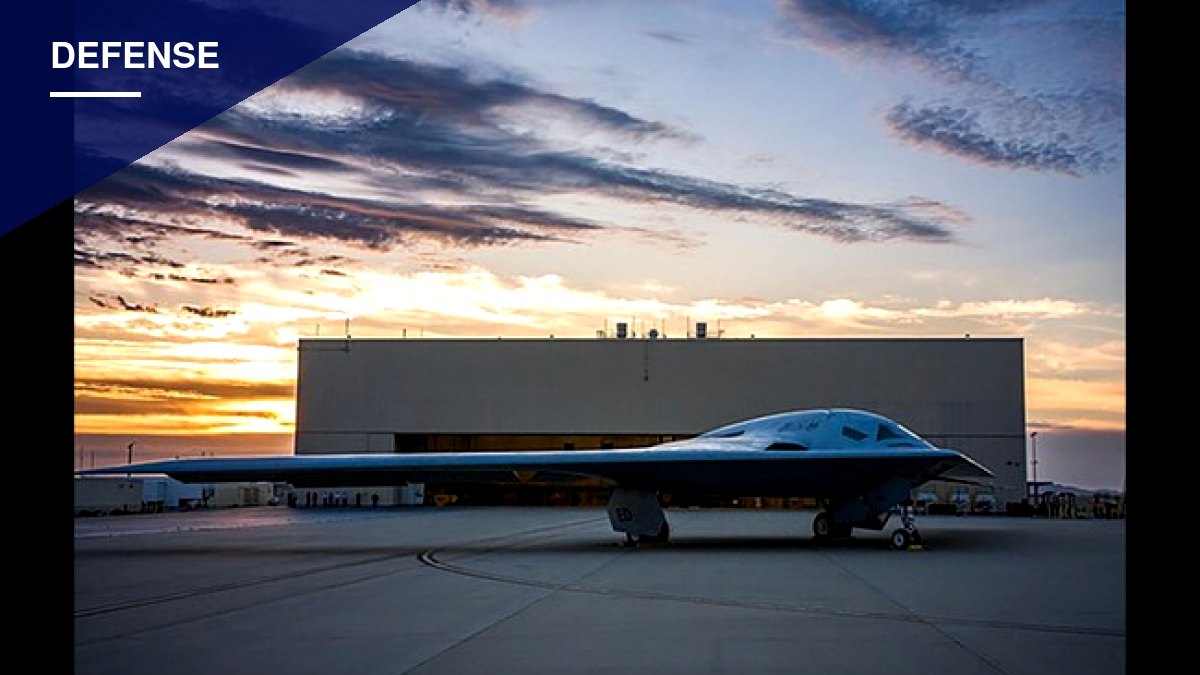
The Air Force is studying whether its new B-21 Raider bomber could take on air-to-air combat duties, a departure from the traditional role of bombers in American military history.
The idea surfaced in a long-term fighter force structure report the Air Force submitted to Congress last week. Aviation Week was first to report on the possibility after obtaining a copy of the unclassified document. Broader media coverage followed a roundtable held Tuesday with Lt. Gen. David Tabor, the Air Force’s Deputy Chief of Staff for Plans and Programs. The full report itself was not distributed to reporters at that time.
Historically, American bombers have only engaged enemy aircraft defensively. During World War II, formations of B-17 and B-24 bombers flying over Germany and occupied Europe carried as many as 13 .50 caliber machine guns each, forcing attacking fighters to fly through heavy defensive fire. An offensive air-to-air role for a bomber would be a new concept.
Outlets covering military aviation have noted for years that the B-21’s design features could make it a plausible candidate for air-to-air missions. Its large size, extreme range, high operating ceiling, broadband stealth characteristics, and advanced sensors are the kinds of attributes that could support such a role, whether flown alone or alongside Collaborative Combat Aircraft drones. The Air Force’s other bombers could also factor into these plans.
Air Force officials have floated versions of this idea before. In 2019, then-Maj. Gen. Scott Pleus, discussing the Next Generation Air Dominance program, told Air Force Magazine that thinking of future aircraft purely as fighters would be too narrow.
“If we were to characterize it [NGAD] as a fighter, we would be… thinking too narrowly about what kind of airplane we need in a highly contested environment,” Pleus said. This could be “a B-21 that also has air-to-air capabilities” and can “work with the family of systems to defend itself, utilizing stealth – maybe that’s where the sixth-generation airplane comes from.”
Exactly how the B-21 would be adapted for air-to-air combat remains unclear. The aircraft’s stealth and high altitude ceiling could put it beyond the reach of some enemy ground-to-air and air-to-air weapons, though adversaries continue developing their own countermeasures against such advantages.
One possibility is that a B-21 could carry a substantial load of air-to-air missiles. There has also been discussion of the bomber eventually launching semi-autonomous drones to penetrate enemy airspace and assist with targeting, though that capability does not appear to be planned currently. Reports indicate the B-21 will be able to control drones in flight, but it remains unclear whether it could launch or retrieve them. As of now, the Air Force reportedly has no plans for the Raider to carry drones aboard the aircraft, though it may still be able to coordinate with them.
The Air Force continues to evaluate the B-21’s capabilities as the program matures.