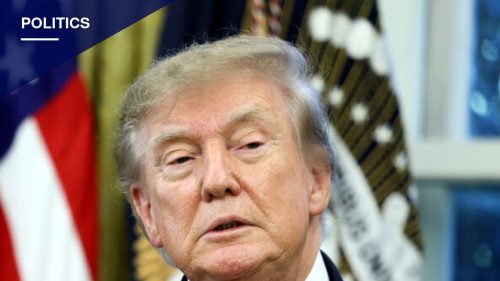
President Donald Trump described a round of American strikes on Iran as “minor” while speaking to reporters Friday evening shortly after he landed in West Palm Beach, telling them U.S. forces destroyed an Iranian anti-aircraft installation in a matter of minutes.
“They built a little bit of an anti-aircraft device, and we knocked it out in about 15 minutes, maybe five,” Trump said.
The comments came as Iranian state media reported that two missiles had struck Qeshm Island, an Iranian military site in the Strait of Hormuz, with witnesses describing aircraft overhead and explosions near the city of Suza. The extent of the damage was not immediately clear. U.S. Central Command told Al Jazeera the situation around the island was “relatively calm” and acknowledged the reports without offering further detail.
A day later, Iranian military officials claimed they had shot down an American MQ-9 drone over Qeshm. U.S. officials had not confirmed that claim.
The action followed an earlier American strike on the same island this week, in which U.S. forces destroyed an Iranian surface-to-air missile launcher after it was fired at an American aircraft. Trump said Tuesday that U.S. forces had tracked the construction of the anti-aircraft installation for about two months before destroying it once it was completed.
Qeshm Island, located near key shipping lanes in the Strait of Hormuz, houses an underground missile facility and a naval base, and sits close to Iranian ports that American forces have kept under blockade. Officials say much of Iran’s air-defense network was destroyed or badly damaged during Israeli strikes in June 2025 and the early stages of the current conflict, prompting Tehran’s attempts to rebuild it.
Decision Looms on Broader Campaign
The West Palm Beach remarks came as Trump weighs whether to escalate the confrontation with Iran now that the midterm elections have passed; he had previously signaled he would hold off on major action until after the vote.
During a White House meeting Thursday, national security officials laid out options ranging from expanded military operations to continued negotiations backed by economic pressure. Speaking to reporters afterward, Trump said he would decide “soon” whether more strikes were needed to stop Tehran from rebuilding its nuclear program.
“I would rather not destroy the rest of the country if possible, but maybe I’ll have to,” Trump said.
Even so, he suggested Friday that a negotiated settlement was still within reach. “We’re dealing with them now. They want to make a deal,” he said, adding that the two sides had made “a lot of progress.”
Diplomacy Through Qatar
Behind the scenes, Vice President JD Vance has been in intensive talks with Qatari and Pakistani intermediaries, while Special Envoy Steve Witkoff and Jared Kushner have pursued parallel diplomatic contacts. Trump spoke by phone Friday with Qatar’s emir, Sheikh Tamim bin Hamad Al Thani, as mediators tried to push a potential agreement forward.
A two-day proposal circulating through Qatar would have Washington lift its naval blockade and release some frozen Iranian assets in exchange for letting International Atomic Energy Agency inspectors into nuclear sites damaged by U.S. and Israeli strikes. Iran would then reopen the Strait of Hormuz under a temporary arrangement based on an understanding with Oman that Washington has not yet approved, potentially opening the door to broader talks over Iran’s stockpile of highly enriched uranium.
Tehran, however, has said Washington must first lift sanctions and the naval blockade, release frozen assets, pay compensation for military damage, and end hostilities across the region, including in Lebanon, before substantive talks can begin. Trump has rejected those conditions, and Mohsen Rezaei, secretary of Iran’s Supreme National Security Council and a former Islamic Revolutionary Guard Corps commander, has said the Strait of Hormuz will stay closed until Tehran’s demands are met.
Despite the standoff over terms, Qatar said Saturday that mediation efforts remained active and pushed back on reports that talks had broken down. Iranian Foreign Minister Abbas Araghchi said he had spoken with a dozen regional counterparts over the previous two days.
Tensions remained high nonetheless. Iranian army spokesman Mohammad Akraminia warned Saturday that any further American or Israeli attack would draw an immediate response with no geographic limits, saying Iran’s forces were on heightened alert and better prepared for confrontation than before. Iran’s supreme leader, Ayatollah Mojtaba Khamenei, who has not appeared in public since the conflict’s opening strikes, was quoted by state media warning the fighting would spread if Washington resumed military operations, and dismissed any expectation that the midterm elections would change American policy.